



Ana Mendieta
- Feminist Art
Ana Mendieta arrived in the United States at the age of twelve, part of Operation Peter Pan, the Catholic Church-organised airlift that evacuated more than fourteen thousand Cuban[1] children between 1960[1] and 1962. She and her sister were moved through refugee camps in Iowa before being placed in foster homes. The displacement, she later said, was the root of everything: "I am overwhelmed by the feeling of having been cast from the womb (nature). My art is the way I re-establish the bonds that unite me to the universe."
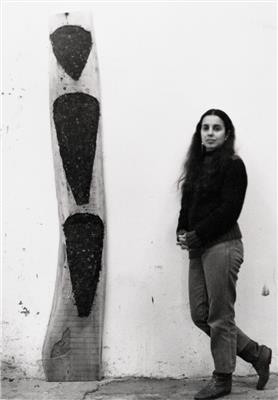
Biography
At the University of Iowa she completed three degrees in art under Hans Breder and encountered the land art and ritual workshops of Mary Beth Edelson, which gave form to what would become the Silueta series. Between 1973[1] and 1980 she made approximately two hundred earth and body works, tracing her silhouette in the landscape through fire, flowers, mud, and smoke. The earliest, Flowers on Body (1973), was executed at El Yagul, an archaeological site in Oaxaca, Mexico, where she lay in a womb-like cavity in the earth and covered herself with white blooms.
The Siluetas resist easy categorisation. They operate where feminist art, Afro-Caribbean spiritual practice (particularly Santeria), land art, and body performance converge. She was in direct contact with the critic Lucy Lippard, who shaped much of the early feminist reading of the work, and the critical debate centred on whether Mendieta's identification of the female body with the earth affirmed feminine specificity or dissolved individual identity into an essentialist archetype.
She moved to New York in 1978[1], joined the AIR Gallery (a feminist collective), and won the Rome Prize in 1983. She died in September 1985[1] following a dispute with her husband, the minimalist sculptor Carl Andre, who was tried for homicide and acquitted. She was thirty-six.
Timeline
- 1948Born in Cuba.
- 1960Arrived in the United States at 12 via Operation Peter Pan, a Catholic Church organised airlift.
- 1973Created "Flowers on Body" at El Yagul, Oaxaca, Mexico, covering herself with white blooms in a cavity.
- 1973Began the Silueta series (approximately 200 earth and body works made until 1980).
- 1978Moved to New York and joined the AIR Gallery, a feminist collective.
- 1983Won the Rome Prize.
- 1985Died in New York at 36, following a dispute with her husband Carl Andre.
Notable Works
Tap to view larger.
Next stop
Browse the movements →
Every movement in the collection, from the Renaissance to Pop art.
Related Artists




Frequently Asked Questions
What is Ana Mendieta known for?
Ana Mendieta is known for her Silueta series, approximately two hundred earth and body works made between 1973[1] and 1980. In these works, she traced her silhouette in the earth using fire, flowers, mud, and smoke. Her work is also associated with feminist art, Afro-Caribbean spiritual practice, land art, and body performance.Who was Ana Mendieta?
Ana Mendieta was a Cuban[1]-American artist who arrived in the United States as a refugee in 1960[1]. She created earth and body works, tracing her silhouette in the earth using materials such as fire, flowers, mud, and smoke. Her husband, Carl Andre, was accused of homicide in relation to her death in 1985[1], but he was acquitted.How did Ana Mendieta die?
Ana Mendieta died in 1985[1] at the age of 37.
Sources
Editorial draws on the following primary and tertiary references for Ana Mendieta.
- [1] wikipedia Wikipedia: Ana Mendieta Used for: biography, birth dates, death dates, identifiers, movement attribution, nationality.
- [2] book Pollock, Griselda (editor);Sauron, Victoria Turvey (editor), The Sacred and the Feminine_ Imagination and Sexual Difference (New Encounters_ Arts, Cultures, Concepts) Used for: biography, stylistic analysis.
- [3] book Pollock, Griselda (editor);Sauron, Victoria Turvey (editor), The Sacred and the Feminine_ Imagination and Sexual Difference (New Encounters_ Arts, Cultures, Concepts) Used for: biography, stylistic analysis.
- [4] book Charlene Spretnak (auth.), The Spiritual Dynamic in Modern Art _ Art History Reconsidered, 1800 to the Present Used for: biography, stylistic analysis.
Editorial overseen by Solis Prints. Sources verified 2026-09-30. Click a source for details, or hover over [N] in the page above to preview.
Editorial standardsMethodologyCorrectionsAI disclosureAbout the editorial team