

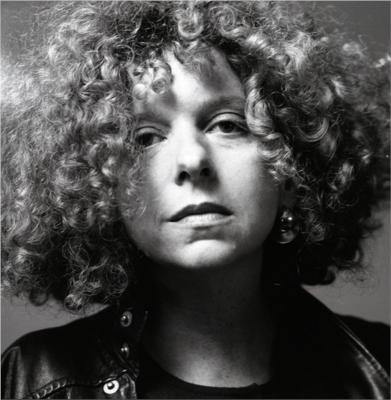
Barbara Kruger
- Conceptual
- Feminist Art
Barbara Kruger's artistic journey began not in a studio, but in the fast-paced world of magazine design. Born in 1945 in Newark, New Jersey, she studied at Parsons School of Design and Syracuse University before starting work. From the late 1960s into the early 1970s, Kruger served as a graphic designer and art director for publications like Mademoiselle and House and Garden. This experience gave her practical insight into how images and words combine to influence an audience, a skill she would later adapt for her own art.
Biography
Kruger moved into the art world during the mid-1970s, first exploring woven objects and photography. By the late 1970s and early 1980s, she had established her distinct style. She began to overlay bold, declarative text onto existing black-and-white photographs, often in white Futura Bold or Helvetica against a red background. These pieces commonly explored ideas of power, money, and gender. Her 1987 work, "I shop therefore I am," became a defining example of this direct method.
The confrontational yet accessible nature of Kruger's art quickly drew notice. By employing methods similar to advertising, her work moved beyond galleries, appearing on billboards, bus shelters, and even t-shirts. This strategy blurred the divisions between art and mass media, encouraging a broader public to engage with social commentary. Kruger has maintained this direct, often provocative, style across her career, applying it to new forms and current topics.
Timeline
- 1945Born in Newark, New Jersey
- 1960Studied at Parsons School of Design and Syracuse University
- 1960Worked as a graphic designer for Mademoiselle and House & Garden
- 1970Explored woven objects and photography
- 1980Established her distinct style of text over black and white photos
- 1987Created 'I shop therefore I am'
- 1990Displayed work on billboards, bus shelters, and t-shirts
Notable Works
Tap to view larger.
Next stop
Browse the movements →
Every movement in the collection, from the Renaissance to Pop art.
Related Artists

.jpg)
Frequently Asked Questions
What is Barbara Kruger known for?
Barbara Kruger is known for combining bold text with black-and-white photographs. Her works often explore ideas of power, control, and identity using methods similar to advertising.What is Barbara Kruger's most famous work?
Barbara Kruger is best known for her combination of photographic images and pithy slogans. Her work critiques how self-identity, desire, and public opinion are manipulated. Kruger's art often plays on cultural stereotypes to undermine the persuasive power of representation. A particularly well-known piece is *Untitled (Your body is a battleground)* from 1989. This photographic silkscreen on vinyl is a large-scale work, measuring 284.5 x 284.5 cm. The image features a woman's face, cropped closely, staring directly at the viewer. Kruger employs the media's stereotypical standards of symmetry and female beauty, parodying aspects of society that are widely accepted, yet often ignored. The model’s features, including arched eyebrows and full lips, are considered stereotypically beautiful. The artwork draws attention to society’s emphasis on the superficial objectification of women. Coupled with the words, large scale, and stark colouring, the image portrays the intensity and difficulties of the Feminist struggle. Kruger’s background in design and picture editing at magazines such as *Mademoiselle* and *House and Garden* equipped her with skills in the selection and integration of photographs with meaningful texts. Her art belongs to Conceptualism and Feminist Postmodernism.What should I know about Barbara Kruger's prints?
Barbara Kruger, born in Newark, New Jersey, in 1945, is known for combining photographic images with pithy slogans. Her art questions how self-identity, desire, and public opinion are manipulated, often using clichés and cultural stereotypes to undermine the power of representation. Kruger's work is distinctively feminist. It examines how gender differences are reinforced through media presentations, where women are often displayed as objects of desire or targeted as consumers. Kruger brings gender identification into question through her ambiguous use of pronouns such as "I", "you", and "we". Before incorporating photography and text, Kruger explored decorative possibilities using textile-oriented materials. By 1975, she focused on writing, developing a narrative voice with spare imagery and language. She returned to visual art in 1977, bringing words into her work. In the late 1970s, Kruger created sequences of coupled photographs and narratives, addressing autobiographical and social subjects. Her later photo-word works incorporate found imagery subjected to formal and verbal analysis. Her piece *Untitled (Your Body is a Battleground)* (1989) was made to support a women's rights protest.What style or movement did Barbara Kruger belong to?
Barbara Kruger's work is associated with Conceptualism and Feminist Postmodernism. Her background in graphic design at magazines like *Mademoiselle* and *House and Garden* equipped her with skills in integrating photographs and text. Kruger appropriates photographs, often presenting them as large gelatin silver prints overlaid with text similar to advertising. For example, she placed the phrase "Your body is a battleground" over a photograph of a woman's head, referencing the abortion debate of the 1980s. In another work, she placed "Your gaze hits the side of my head" over an image of a sculpture, commenting on the male gaze in art as theorised by Jacques Lacan. Kruger's art addresses social inequalities, particularly as conveyed through media. She sets up dichotomies, such as maker versus manipulated, and nature versus culture, to deconstruct the power dynamics within images. Her work reflects European Postmodernism and is driven by feminist theory, which gained prominence in journals like *Camera Obscura* and *Differences*. Kruger challenges patriarchy and conventions by borrowing from advertising, a traditionally male-dominated medium.What techniques or materials did Barbara Kruger use?
Barbara Kruger, born in Newark, New Jersey, in 1945, combines photographic images with text. Her works address power, control, and injustice. Kruger often uses black and white photographs overlaid with white writing on a red background. Kruger's technique often involves photo-screen printing, a stencil method suitable for various surfaces like paper, fabric, wood, and vinyl. This process involves stretching a fine mesh fabric over a frame, coating it with a light-sensitive liquid, and exposing it to UV light with a film positive to create a stencil. Ink is then pushed through the mesh onto the chosen surface. Kruger’s choice of materials results in a signature style: red-framed text in a media-style font printed across a black and white photograph. She often displays her art on a large scale, even outside gallery spaces on billboards or building exteriors. Kruger uses language to communicate ideas, aiming to reach a broad audience. Her slogans appear on various items, prompting viewers to question the 'truth' presented in media and advertisements.What was Barbara Kruger known for?
Barbara Kruger is known for her conceptual art that combines photography and text to critique cultural stereotypes. Born in Newark, New Jersey, in 1945, Kruger studied at Syracuse University and Parsons School of Design in New York. She worked as a designer for *Mademoiselle* magazine and as a picture editor for *House and Garden*, developing skills in integrating photographs with text. Kruger's artworks often incorporate mass media photographs juxtaposed with pithy slogans. These works address how self-identity, desire, and public opinion are manipulated. Her art, often presented as billboards or posters, plays on clichés to undermine the persuasive power of representation. Kruger is often grouped with feminist postmodernism because her work examines how gender difference is reinforced through media presentation. For example, *Untitled (Your body is a battleground)* (1989) uses a closely cropped image of a woman's face coupled with text to portray the intensity of feminist struggle.When did Barbara Kruger live and work?
Barbara Kruger was born in Newark, New Jersey, on 16 January 1945. She studied at Syracuse University in 1965, then at Parsons School of Design from 1966 to 1967, and finally at the School of Visual Arts in 1968. Kruger's artistic direction shifted significantly early in her career. Her initial work explored decorative possibilities, but by 1975, she turned her attention to writing, concentrating on poetry. She evolved a narrative voice, maintaining spare imagery and language. Returning to visual art in 1977, she incorporated words into her pieces. Since then, Kruger's work has combined photographic images and text. In the late 1970s, she fabricated sequences of coupled photographs and narratives in book and exhibition form. These addressed autobiographical and social subjects. Her work often critiques consumerism and gender politics, using a signature style of red, white, and black. She lives and works in New York.Where can I see Barbara Kruger's work?
Barbara Kruger's work has been exhibited extensively since the 1970s. Early solo exhibitions included Artists Space, New York, in 1974; Fischbach Gallery, New York, in 1975; and John Doyle Gallery, Chicago, in 1976. During the 1980s, Kruger had solo shows at Larry Gagosian Gallery, Los Angeles; CEPA Gallery, Buffalo; Annina Nosei Gallery, New York; the Institute of Contemporary Art, London; Rhona Hoffman Gallery, Chicago; Nouveau Musée, Lyon; Kunsthalle Basel; and the Los Angeles County Museum of Art. A joint exhibition with Jenny Holzer was held at The Israel Museum, Jerusalem, in 1986. Kruger has also participated in numerous group exhibitions. These include the Whitney Museum of American Art, New York (1973 Biennial Exhibition); Florida State University, Tallahassee ("Thickening Surface", 1976); the San Francisco Art Institute ("The Annual", 1977); and the Los Angeles Institute of Contemporary Art ("Narrative Themes I Audio Works", 1977). Her work was also part of "Content: A Contemporary Focus 1974-1984" at the Hirshhorn Museum and Sculpture Garden, Smithsonian Institution, Washington, D.C.Where was Barbara Kruger from?
Barbara Kruger was born in Newark, New Jersey, on 16 January 1945. She studied at Syracuse University, New York, in 1965. Later, from 1966 to 1967, she attended Parsons School of Design in New York. She completed her studies at the School of Visual Arts, also in New York, in 1968. Kruger's artwork shifted direction early in her career. Around 1975, she focused on writing, evolving a spare, poetically inflected narrative voice. By 1977, she combined words with photographic images, addressing autobiographical and social subjects. Her work often questions consumerism and gender politics. Kruger is known for her signature style: works printed in red, white, and black, juxtaposing provocative texts with found images.Who did Barbara Kruger influence?
Barbara Kruger's art employs mass media strategies to challenge cultural attitudes. Her work, often large-scale collages of photographs and text, critiques stereotypes and assumptions found in advertising and media. Kruger's methods include appropriating the look of advertising, but subverting its typical use to expose media deceptiveness. She undermines myths, particularly those about women, that the media reinforces. Her work utilises layout techniques from mass media to sell consumer goods, but with the goal of subverting the typical use of such imagery. Other artists, like Jenny Holzer (born 1950), also use language to question stereotypes. Holzer's Truisms , first displayed anonymously in Lower Manhattan, addressed societal issues. Kruger and Holzer both use public spaces, like billboards and building exteriors, to display their art. Holzer printed her slogans on T-shirts and condom wrappers, aiming to reach beyond the art world and encourage people to question what they read as "truth" in the press.Who influenced Barbara Kruger?
Barbara Kruger (born 1945) studied at Syracuse University, Parsons School of Design, and the School of Visual Arts. Her background in graphic design at *Mademoiselle* and *House and Garden* magazines gave her insight into mass media's operations. Kruger appropriates photographs from magazines, re-presenting them as gelatin silver prints, often large scale. She overlays these images with wording similar to that found in advertising. Her work questions stereotypes and assumptions encoded in words and pictures. Kruger and Jenny Holzer (born 1950) both use language to question these stereotypes. Holzer's *Truisms* (1977-79) were pasted anonymously on walls across Lower Manhattan and displayed on electronic signs in Times Square. Kruger's deconstruction reflects European Postmodernism and the rise of feminist theory. Journals like *Camera Obscura*, *Differences*, and *Heresies* (started in 1976) contributed to this. The Guerrilla Girls, founded in New York in 1985, produced printed matter and presentations wearing gorilla masks, a feminist ploy. Kruger's work raises issues of power, control and injustice, challenging patriarchy and convention.Who was Barbara Kruger?
Barbara Kruger, born in Newark, New Jersey, in 1945, is an American feminist artist. She studied at Syracuse University (1965), Parsons School of Design (1966-67), and the School of Visual Arts (1968). She currently lives and works in New York. Kruger is known for her work combining photographic images with text. Informed by her experience as a graphic designer for magazines aimed at female readers, Kruger developed a signature style of bold, declarative statements printed in red, white, and black. She juxtaposes provocative texts with found images, often culled from mass media. Her work questions consumerism, gender politics, and the manipulation of self-identity and desire. Kruger's pieces address social subjects, often with a feminist perspective. She examines how gender difference is reinforced through media presentation. Her work plays on clichés and cultural stereotypes, undermining the persuasive power of representation. One example is *Untitled (Your Body is a Battleground)* (1989), produced to signal support for a women’s rights protest in Washington.
Sources
Editorial draws on the following primary and tertiary references for Barbara Kruger.
- [1] book guggenheim-19artistsemergen00solo Used for: biography.
- [2] book guggenheim-emergingartists100wald Used for: biography.
- [3] book Penny Huntsman, Thinking About Art Used for: biography.
Editorial overseen by Solis Prints. Sources verified 2026-09-22. Click a source for details, or hover over [N] in the page above to preview.
Editorial standardsMethodologyCorrectionsAI disclosureAbout the editorial team