



Anton Azbe
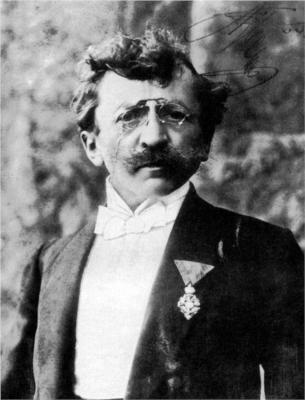
- portrait
Without Anton Ažbe's private school in Munich's Schwabing district, the history of abstract art might have unfolded very differently. Wassily Kandinsky and Alexej Jawlensky both arrived from Russia in 1896[1] and enrolled immediately; it was in Ažbe's cramped, crowded atelier that they first met each other. Neither would develop the ideas that defined their careers until later, but the colour theory Ažbe taught, specifically the Impressionist divisionist approach in which pure pigments influence each other on the surface, gave Kandinsky his first sustained introduction to colour as an independent force.
Biography
Ažbe himself was Slovenian, born in 1862[1], and by the 1890s had become what the Guggenheim's Kandinsky in Munich catalogue calls 'a monumental legendary figure' in Schwabing, despite operating entirely outside the Royal Academy system. His paintings, a modified Impressionism with a sensitivity to Symbolist form and colour, are represented by Self-Portrait (1886[1]), Half-Nude Woman (1888), and Portrait of a Negress (1895). The Munich art world of the period positioned him against Franz von Stuck: where Stuck was the Academy insider, medal-winning and physically imposing, Ažbe was the outsider with the top hat and cigar visible in a class photograph circa 1895.
His pedagogy is best remembered through a single Kandinsky quotation: 'you must learn anatomy, but before the easel, you must forget it.' The school was international: Igor Grabar and Richard Jakočič both passed through, as did many other Russian émigrés who would form the nucleus of the Schwabing bohemian colony. Jawlensky attended for three years, 1896[1] to 1899. Kandinsky stayed roughly two years before transferring to Franz von Stuck's Academy class.
Ažbe died in 1905[1], aged forty-three, worn out by what the Guggenheim catalogue describes as 'the conflicting demands of his talent and the restrictions of his existence as an outsider' and by his addiction to alcohol. He did not live to see Kandinsky and Jawlensky help found the Blaue Reiter in 1911.
Timeline
- 1862Born in Slovenia.
- 1886Painted "Self-Portrait".
- 1888Painted "Half-Nude Woman".
- 1895Painted "Portrait of a Negress".
- 1896Wassily Kandinsky and Alexej Jawlensky enrolled in Ažbe's private art school in Munich.
- 1896Jawlensky attended Ažbe's school for three years, until 1899.
- 1905Died in 1905, aged 43, due to the demands of his career and alcohol addiction.
Notable Works
Tap to view larger.
Next stop
Browse the movements →
Every movement in the collection, from the Renaissance to Pop art.
Related Artists



Frequently Asked Questions
What is Anton Azbe known for?
Anton Ažbe is known for his private school in Munich, where he taught colour theory and Impressionist divisionism. His students included Wassily Kandinsky and Alexej Jawlensky, who both credited him with giving them their first sustained introduction to colour as an independent force. His pedagogy is best remembered through the Kandinsky quotation: 'you must learn anatomy, but before the easel, you must forget it.'What is Anton Azbe's most famous work?
Anton Ažbe is best known for his role as a teacher and mentor to numerous artists, rather than for a single, celebrated artwork of his own. He operated a private art school in Munich from 1891[1] until his death in 1905[1]. While Ažbe's own artistic output is not extensively documented, his influence on the development of modern art is considerable. Many of his students went on to achieve international recognition. These included artists such as Wassily Kandinsky, Alexej von Jawlensky, David Burliuk, and Marianne von Werefkin. His teaching methods, which emphasised the importance of understanding form and colour, had a significant impact on their artistic styles. Ažbe's studio provided an alternative to the more traditional academic training offered at the Munich Academy. His approach encouraged experimentation and individual expression, which helped to shape the course of early 20th-century art. Although he is not primarily remembered for a specific painting, his contribution to art history lies in his dedication to teaching and his impact on the artists who studied with him.What should I know about Anton Azbe's prints?
Anton Ažbe (1862[1]-1905[1]) was a Slovenian painter and teacher. Although he is not primarily known for printmaking, understanding his artistic background is useful before collecting his works. Ažbe was born in Carniola, then part of the Austrian[1] Empire. He trained in Ljubljana and Vienna, later opening his own art school in Munich in 1892[1]. His Munich school became a popular destination for artists from Eastern Europe; many went on to achieve considerable success. Igor Grabar, Rihard Jakopič, Alexej von Jawlensky, and Marianne von Werefkin were among his students. Ažbe's teaching methods emphasised colour theory and anatomical accuracy. He encouraged his students to develop their individual styles, rather than imposing a single aesthetic. Although Ažbe's own paintings are relatively few, his contribution to modern art through his pedagogy is significant. Prints related to Ažbe may include reproductions of his paintings or, potentially, works created by his students under his supervision or in his style. Collectors should carefully research the provenance and authenticity of any print attributed to him.What style or movement did Anton Azbe belong to?
Anton Azbe was associated with the artistic movement known as photodynamism. This style, developed by Anton Giulio Bragaglia and his brother, explored the representation of movement through photography. Photodynamism employed long exposure techniques to capture the subject in motion. This resulted in images where moving parts appeared as spectral blurs, while stationary areas retained sharp detail. The focus was on conveying the energy and rhythm inherent in movement, rather than creating a precise representation. Bragaglia believed that these blurred images captured the essence of movement by showing what occurs between static moments. He aimed to depict the sensation of motion, rather than accurately reproducing it. Like the Futurist painters, Bragaglia valued the ability of art to create dynamic effects over representational accuracy. He saw the deformation of forms, moving away from faithful representation, as a way to enhance this potential.What techniques or materials did Anton Azbe use?
Anton Azbe, a respected teacher in Munich, is known for his virtuoso technique. His teaching emphasised the importance of anatomical drawing and easel painting. However, he also stressed that artists should move beyond strict anatomical accuracy when at the easel. The concept of "Faktura", or the use of materials to generate specific forms, is relevant to understanding artistic techniques. This approach values the literal qualities of materials as determinants of form and meaning. The placement and manipulation of brushstrokes are also significant, distinguishing artists. Various methods, such as pointillé, impasto, glazing, and layering, contribute to the surface of a picture. Historical practices reveal diverse approaches to materials. Some artists used multiple palettes, each for a distinct tone, with a dedicated brush for each. Others employed unconventional methods, such as using oil mixed with dust and paint residue. Some artists would also modify oil paint with additives.When did Anton Azbe live and work?
Anton Ažbe (1862[1]-1905[1]) was a Slovenian painter and teacher active in the Austro-Hungarian Empire. Born in the Carniolan region, Ažbe is best known for establishing a private art school in Munich, which operated from 1891[1] until his death. Ažbe's Munich school attracted students from across Europe, particularly from Slavic countries. His teaching methods emphasised anatomical accuracy, observation, and individual artistic expression. He encouraged students to develop their own styles rather than adhere to a single academic approach. Among his notable students were numerous artists who later achieved international recognition. These included painters such as Ivan Grohar, Matija Jama, Nadežda Petrović, Rihard Jakopič, and Matej Sternen. Wassily Kandinsky also studied with Ažbe for a time; he later became a major figure in abstract art. Ažbe's influence extended through his students, who carried his teaching principles into various artistic movements of the 20th century. Although his own artistic output was relatively small, his pedagogical impact was considerable.Where can I see Anton Azbe's work?
Anton Azbe's work can be viewed in a number of museums. These include the Charles Hosmer Morse Museum of American Art (Winter Park, Florida), the Los Angeles County Museum of Art (Los Angeles), and the Metropolitan Museum of Art (New York). Other locations include the Minneapolis Institute of Arts, the Museum of Modern Art (New York), and the Royal Ontario Museum (Toronto). Additionally, one can find his works at the Virginia Museum of Fine Arts (Richmond), and the Wolfsonian at Florida International University (Miami Beach). In the United Kingdom, museums with works by Azbe include the Bakelite Museum (Williton), the Brighton Museum & Art Gallery, the Geffrye Museum (London), and the Manchester Art Gallery. Additional locations are the National Museums of Scotland, Royal Museum (Edinburgh), and the Victoria & Albert Museum (London).Where was Anton Azbe from?
Anton Ažbe was born in 1862[1] in the village of Carniola, in what was then Austria-Hungary. Today, this region is part of Slovenia. Ažbe spent his early years in relative poverty. He was the illegitimate son of a peasant woman and, possibly, a travelling Austrian[1] field marshal. He showed artistic talent from a young age, initially carving figures from wood. His abilities led him to formal training. Ažbe's artistic education began in Ljubljana. Later, he moved to Vienna to study at the Academy of Fine Arts. After Vienna, Ažbe went to Munich, a popular destination for artists at the time. He enrolled at the Munich Academy in 1884[1] and later opened his own private art school there. This school became highly influential, attracting students from across Europe and beyond; many went on to achieve significant artistic success. Ažbe remained in Munich until his death in 1905[1].Who did Anton Azbe influence?
Anton Ažbe operated a private art school in Munich between 1891[1] and 1905[1]. He is remembered as an influential teacher of modern artists. Igor Grabar, Alexej von Jawlensky, Marianne von Werefkin, and Dmitry Kardovsky were among his students in the 1890s. Ažbe's teaching method combined rigorous academic training with elements of impressionism. He emphasised the importance of tone and the relationships between colours. His method involved working from plaster casts and live models, using a limited palette. Students were encouraged to analyse the structure of forms and capture the essential qualities of their subjects. Many of Ažbe's students went on to become significant figures in 20th-century art. Jawlensky and Werefkin were important members of the Neue Künstlervereinigung München (New Artists' Association of Munich), a precursor to Der Blaue Reiter (The Blue Rider) group. Kardovsky later became a professor at the Imperial Academy of Arts in Saint Petersburg. Ažbe's emphasis on colour and form had a lasting impact on the development of expressionism and other modern movements.Who influenced Anton Azbe?
Anton Ažbe's artistic development occurred in the late 19th century. He was exposed to a range of artistic styles and philosophies. Ažbe's early training at the academies in Vienna and Munich exposed him to academic traditions. These institutions emphasised technical skill and classical subjects. Wilhelm von Diez, one of Ažbe's instructors at the Munich Academy, had a considerable effect on him. Diez's teaching style promoted individual expression and a more naturalistic approach. Diez encouraged students to observe nature directly and to develop their own artistic voices. Ažbe's work also shows the influence of the Realist movement. Realism sought to portray everyday subjects and people with accuracy and objectivity. This contrasted with the more idealised or historical subjects favoured in academic art. The Barbizon School, a group of French Realist painters, may also have been an influence. Their emphasis on painting en plein air (outdoors) and capturing the effects of light had a wider effect on European painting.Who was Anton Azbe?
Anton Ažbe (born in 1862[1]) was a Slovenian painter and teacher, active in Munich. Although not formally associated with the Munich Academy, Ažbe was well-regarded for his artistic technique and teaching abilities. Around 1890[1], Ažbe ran a celebrated, though crowded, painting school in Munich. He taught anatomy and easel painting, but emphasised that students should "forget it" when at the easel. Wassily Kandinsky studied with him, learning the basics of drawing. Ažbe's students came from many countries. He taught some without charge, asking only that they work hard. Despite his success, Ažbe's life was considered mysterious and lonely. He died in Munich in 1905[1] at the age of 43. He was known for his generosity; despite earning a considerable income, only a small amount of money remained at his death.Why are Anton Azbe's works important today?
Anton Azbe's legacy exists in his influence on a generation of Ukrainian modernists. During the early 20th century, Ukraine experienced a flourishing of avant-garde art; however, in the 1930s, this progress was suppressed by Soviet authorities. Artistic innovation was denied recognition and deliberately obscured from public view. Only in the 1960s did some aspects of this history resurface, and full disclosure became possible in the 1990s. Today, galleries and museums in Ukraine explore not only the avant-garde and modernism but also medieval and baroque art, icons, folk traditions, underground and dissident art, and new experimental trends. Narratives are being rewritten to incorporate “native” artists into European history and European trends into the story of Ukraine’s cultural development. There is now a greater public awareness that many figures were part of both “European” and “Ukrainian” art. The reconstruction of this history has sometimes been contentious, largely because it has coincided with a vigorous debate over cultural memory and identity.
Sources
Editorial draws on the following primary and tertiary references for Anton Azbe.
- [1] wikipedia Wikipedia: Anton Azbe Used for: biography, birth dates, death dates, identifiers, movement attribution, nationality.
- [2] book guggenheim-inmemoryofwassil00reba Used for: biography.
- [3] book guggenheim-kandinskyinmunic00kand Used for: biography.
- [4] book Peter. Leek, Russian Painting Used for: biography.
Editorial overseen by Solis Prints. Sources verified 2026-09-22. Click a source for details, or hover over [N] in the page above to preview.
Editorial standardsMethodologyCorrectionsAI disclosureAbout the editorial team