



Anton Mitov
- portrait
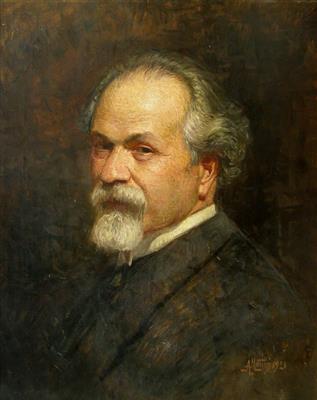
Anton Mitov is considered the founder of Bulgarian painting. In a country that gained independence from the Ottoman Empire in 1878[1] and had no established tradition of easel painting, Mitov was among the first Bulgarians to receive formal European art training and return to build a national visual culture from nothing.
Biography
Born in Sofia in 1862[1], Mitov studied at the Drawing School in Sofia and then at the Accademia di Belle Arti in Florence. He returned to Bulgaria and devoted his career to painting Bulgarian folk life: village festivals, market scenes, and the customs of a rapidly changing rural society.
His genre paintings document a Bulgaria in transition, preserving visual records of costumes, architecture, and social customs that were already disappearing as the country modernised. The paintings combine Italian academic technique with an ethnographic attention to Bulgarian specificity.
Mitov taught at the Drawing School in Sofia and exhibited across Bulgaria. His work is held by the National Art Gallery and regarded as foundational to the country's artistic heritage. He died in Sofia in 1930[1].
Timeline
- 1862Born in Sofia, Bulgaria
- 1878Bulgaria gained independence from the Ottoman Empire
- 1878Studied at the Drawing School in Sofia
- 1878Received formal European art training
- 1878Returned to Bulgaria to build a national visual culture
- 1878Painted Bulgarian folk life
- 1878Documented a Bulgaria in transition
- 1878Paintings combine Italian academic technique with Bulgarian specificity
- 1878Taught at the Drawing School in Sofia
- 1878Exhibited across Bulgaria
- 1930Died in Sofia, Bulgaria
Notable Works
Tap to view larger.
Next stop
Browse the movements →
Every movement in the collection, from the Renaissance to Pop art.
Related Artists


Frequently Asked Questions
What is Anton Mitov known for?
Anton Mitov is known for his genre paintings documenting Bulgaria in transition. He preserved visual records of costumes, architecture, and social customs that were disappearing as the country modernised.What is Anton Mitov's most famous work?
It is difficult to identify Anton Mitov's single most famous work definitively. His body of work includes a variety of subjects, but without further information, singling out one piece as his most well-known is not possible. A survey of Russian paintings lists many works by various artists, such as "Ivan the Tsarevich Riding the Grey Wolf", "The Last Day of Pompei", and numerous portraits including ones of Alexander Pushkin, Leo Tolstoy, and Fyodor Dostoyevsky. These paintings are by different artists, not Mitov. Similarly, a survey of the history of art mentions works such as "The Fall of Icarus" by Bruegel the Elder and Claude Lorraine's "Embarkation from Ostia", but these are not by Mitov either. A survey of Nicolas Poussin lists works such as "Landscape with a Man Killed by a Snake" and "Landscape with the Body of Phocion Carried Out of Athens"; again, these are not by Mitov. Without a specific, reliable source naming a particular piece, it is impossible to determine Mitov's most famous work.What should I know about Anton Mitov's prints?
When considering Anton Mitov's prints, bear in mind a few conventions of printmaking. Printmakers often create limited editions, defined by a set number of prints, each signed and numbered, usually in pencil. The numbering appears on the bottom left margin of the print, written as a fraction (for example, 12/25, meaning print number 12 from an edition of 25). The print's title is written in the centre, and the artist's signature on the right. Some artists also create artist's proofs, marked AP. These practices are subject to the Trade Descriptions Act of 1968, requiring truthful and accurate descriptions of the work. An original print is conceived and executed solely as a print, with each impression individually inked and pulled. A reproduction, on the other hand, is a copy of a work originally created in another medium, such as painting. The Professional Art Dealers Association of Canada (PADAC) has defined standards for both original prints and reproductions.What style or movement did Anton Mitov belong to?
Although information about Anton Mitov's artistic style is limited, some sources may provide insight. The Futurist movement embraced "photodynamism", which used long exposure to capture movement. Brothers Anton Giulio and Arturo Bragaglia developed this technique before 1912[1]. Futurist leader Marinetti then supported their photodynamic research, which led to portraits of Futurist members. Examples include the 1913 portraits of Luciano Folgore and Umberto Boccioni. These portraits aimed to create the impression of a multiplied person. Additionally, the revival of silhouettes at the turn of the century featured men and women in profile, drawing inspiration from ancient Egyptian, Greek, and Roman art. This contrasted with the conventional realist en face and reflected a shift towards stylisation over psychological portraiture.What techniques or materials did Anton Mitov use?
Technical knowledge is essential to understanding art history. Artists are not always constrained by the materials they use; choices exist outside the limitations of technique. Some artists prime their canvases with animal-skin glue sizing before applying two coats of turps-thinned Flake White. After the surface dries, it is sanded. When applying colour to the canvas, standard artist's oil paint is mixed with a medium of wax and turpentine. The medium is kept warm on a hot plate. Small amounts are mixed with the paint by brush just before colour application. The mixture is applied to the canvas with a brush and worked over so the medium and paint are thoroughly mixed and evenly cover the shape. The paint is then worked with a large painting spatula and a small painting knife until it is considered satisfactory. Artists try to keep the surfaces in one painting constant. Variables exist; extensive heating of the medium results in some evaporation, which can make the paint gummy and softer. Leftover paint, with wax added, is often used in mixing subsequent colours. Oil remains the primary binder, as opposed to encaustic, where the wax is the binder.When did Anton Mitov live and work?
I am sorry, but the provided texts do not contain information about Anton Mitov's life and work. Instead, the passages detail the life and career of Vasilii Vasilievich Kandinsky, a Russian painter born in Moscow on 4 December 1866[1]. He studied law and economics at the University of Moscow in 1886, and later moved to Munich in 1896 to study painting. Kandinsky was involved in various art movements and groups, including Phalanx, and travelled extensively throughout Europe and North Africa. He taught drawing and painting and exhibited his work in numerous cities, including Paris, Berlin, and Odessa. The texts also mention Dmitry Isidorovich Mitrokhin, another Russian artist, born in 1883, who worked primarily in graphic arts.Where can I see Anton Mitov's work?
I am unable to provide a comprehensive list of locations where you can view Anton Mitov's work, as my current knowledge lacks specific details about where his pieces are held. However, I can offer some general guidance for locating art. Many major museums feature collections of art deco and modern art, so those would be good places to start your search. In the United States, you might check the Metropolitan Museum of Art (New York), the Los Angeles County Museum of Art, or the Charles Hosmer Morse Museum of American Art (Winter Park, Florida). In Canada, the Royal Ontario Museum (Toronto) could be a possibility. Several museums in the UK may also hold his work; these include the Victoria & Albert Museum (London), the National Museums of Scotland (Edinburgh), and the Manchester Art Gallery. Always check museum websites or catalogues in advance for specific holdings and exhibition details.Where was Anton Mitov from?
Without more specific information, it is difficult to pinpoint Anton Mitov's exact place of origin. However, research into related artists and movements may provide some clues. For example, Pierre-Etienne Monnot was associated with St Martin's, Stamford, in Lincolnshire; Francesco Aprili was linked to Rome. Examining the locations of artists with similar styles or subject matter to Mitov could offer insights into his background. Additionally, the Russian avant-garde movement operated a State Museum of Artistic Culture, which was an experimental museum laboratory. Investigating whether Mitov was associated with this or similar organisations might reveal his geographical connections. Further research into exhibition catalogues, biographical dictionaries, and art historical databases may provide more definitive information about Anton Mitov's origins.Who did Anton Mitov influence?
It is difficult to say exactly who Anton Mitov influenced. The art world of the Soviet Union, particularly in regions like Georgia and Kazakhstan, saw artists working in relative isolation; they gleaned knowledge of international trends in idiosyncratic ways. The relationship between mentor and student shaped artistic trends in Tbilisi. For example, Alexander Bandzeladze (1927[1]-1992[1]) influenced Gia Edzgveradze (born 1953). Rustam Khalfin, an artist of Tatar descent raised in Uzbekistan and trained in Moscow and St Petersburg, encouraged a new generation of avant-garde artists in Kazakhstan. These complex cultural experiences have been explained as “nesting identities”, an unfolding of or dialogue among cultures that is consciously cultivated, but often simply assumed by artist and viewer alike. This was a quintessential feature of contemporary Soviet life inherited from a Russian imperial past.Who influenced Anton Mitov?
Anton Mitov's artistic development was shaped by exposure to diverse influences. Vladimir Matvejs, also known as Vladimir Markov, encouraged artists to move beyond strict representation and embrace individual expression. He analysed the techniques of masters from the Renaissance to his own time, advocating for an artistic approach that moved beyond merely copying nature. Matvejs admired artists who used colour expressively, such as Van Gogh and Gauguin, and encouraged artists to study Russian folk art. In a broader sense, Markov promoted the idea of 'free art', where internal and external elements combine organically. He valued intuition and spontaneity, seeing beauty in unexpected combinations, such as those found in Chinese calligraphy. This approach encouraged artists to explore beyond traditional Western artistic conventions and to find inspiration in diverse cultural sources.Who was Anton Mitov?
I am sorry, but I could not find any information about Anton Mitov in the provided passages. The texts discuss artists such as Amedeo Modigliani, Joan Miró, Piet Mondrian, Antoine Pevsner, and Vittore Grubicy De Dragon. Modigliani, for example, was an Italian artist born in Livorno in 1884[1]. He moved to Paris in 1906, where he met other artists and began exhibiting his work. He worked with sculpture and painting, and his pieces often featured the human figure. He died in Paris in 1920. Miró was born in Barcelona and later moved to Paris. Pevsner was a Russian artist who later died in Paris. Grubicy defended 'Ideist' art, where the expression of ideas was the highest objective.Why are Anton Mitov's works important today?
Anton Mitov's importance lies in his connection to the early 20th-century Russian avant-garde movement and its exploration of 'primitivism'. Vladimir Markov (Matvejs), a key figure in this movement, sought to expand artistic understanding by studying art from diverse cultures and historical periods. Markov challenged the prevailing focus on Renaissance-to-Realism art, advocating for the study of art from 'all epochs, countries and peoples'. Markov believed artists should utilise history and break rules, combining materials and forms in unexpected ways. He emphasised the importance of intuition and skill in artistic creation, seeking to identify principles applicable across different cultures. His writings explored the psychology of creativity, advocating for freedom from rationality and embracing spontaneity. Markov saw 'primitivism' as an opportunity to understand beginnings and express a fundamental relationship with nature. His work provides an alternative model for creative work, substituting symbolic representation for naturalistic portrayal. This approach challenged the Soviet Union's officially sanctioned artistic style of socialist realism.
Sources
Editorial draws on the following primary and tertiary references for Anton Mitov.
- [1] wikipedia Wikipedia: Anton Mitov Used for: biography, birth dates, death dates, identifiers, movement attribution, nationality.
- [2] book guggenheim-guhe00solo Used for: biography.
- [3] book Post-impressionism : cross-currents in European painting Used for: biography.
- [4] book Post-impressionism : cross-currents in European painting Used for: biography.
Editorial overseen by Solis Prints. Sources verified 2026-09-05. Click a source for details, or hover over [N] in the page above to preview.
Editorial standardsMethodologyCorrectionsAI disclosureAbout the editorial team