



Antonietta Raphael
- Scuola Romana
A Lithuanian rabbi's daughter who trained first as a concert pianist, Antonietta Raphael became one of the central figures in the formation of Roman modernism between the wars. Born in Kaunas in 1895[1], she moved to London after her father's death, where she graduated in piano from the Royal Academy of Music and taught solfeggio in the East End while meeting sculptors Jacob Epstein and Ossip Zadkine. That London circle introduced her to the visual arts before she arrived in Rome in 1925[1] to enrol at the Accademia di Belle Arti.
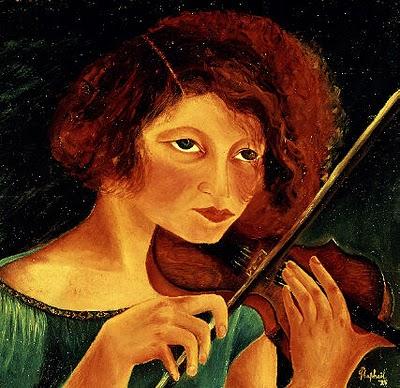
Biography
Her relationship with the painter Mario Mafai, whom she met at the academy, was immediately productive. By 1927[1] they had set up a shared studio at Via Cavour, which also drew in the painter Scipione and sculptor Renato Marino Mazzacurati. The critic Roberto Longhi labelled the group the Scuola di via Cavour in 1929, what became widely known as the Scuola Romana[1]: Roman artists who resisted both Fascist monumentalism and academic realism in favour of an expressive, psychologically charged figuration. Raphael's formation in the orbit of Chagall and Soutine brought an explicitly Jewish-European expressionist quality to Rome's more Mediterranean circles. She is credited with steering Scipione away from his early naive style towards the lyrical expressionism that defined his mature work.
Initially a painter, she shifted to sculpture after 1932[1], working under the influence of Antoine Bourdelle's approach to monumental form. Sculptures such as Miriam dormiente (1933), Fuga da Sodoma (1935-36), and Niobe (1939) combined formal simplification with a dream-like symbolism critics placed between naive art and Chagallian fantasy.
The introduction of Fascist racial laws in 1938[1] forced Raphael to flee Rome for Genoa, where she continued working with support from collectors Emilio Jesi and Alberto Della Ragione. After the war she returned to exhibition: Venice Biennale (1948), Rome Quadriennale (1959-60), and in 1956 a trip to Beijing to show her work. She died in Rome in 1975[1].
Timeline
- 1895Born in Kaunas, Lithuania. Her father was a rabbi.
- 1925Moved to Rome and enrolled at the Accademia di Belle Arti.
- 1927Established a shared studio on Via Cavour with Mario Mafai, Scipione, and Renato Marino Mazzacurati.
- 1929The group at Via Cavour was labelled the Scuola di via Cavour, later known as the Scuola Romana, by the critic Roberto Longhi.
- 1932Shifted from painting to sculpture, influenced by Antoine Bourdelle.
- 1933Created the sculpture "Miriam dormiente".
- 1935Created the sculpture "Fuga da Sodoma" (completed in 1936).
- 1938Fled Rome for Genoa due to the introduction of Fascist racial laws.
- 1948Exhibited at the Venice Biennale.
- 1975Died in Rome at 80.
Notable Works
Tap to view larger.
Next stop
Browse the movements →
Every movement in the collection, from the Renaissance to Pop art.
Related Artists


.jpg!Portrait.jpg)
Frequently Asked Questions
What is Antonietta Raphael known for?
Antonietta Raphael is known for her involvement with the Scuola Romana[1], where she resisted Fascist monumentalism and academic realism. She is also recognised for bringing a Jewish-European expressionist quality to Rome's art scene, influenced by artists like Chagall and Soutine. Later in her career, she became known for her sculpture.Who was Antonietta Raphael?
Antonietta Raphael was a Lithuanian-born artist who became a central figure in Roman modernism between the wars. Initially trained as a concert pianist, she later became a painter and sculptor after moving to Rome in 1925[1]. She is also known for her association with the Scuola Romana[1], a group of artists who resisted Fascist monumentalism.What was Antonietta Raphael's art style?
Antonietta Raphael's painting style was initially influenced by Chagall and Soutine, bringing a Jewish-European expressionist quality to the Roman art scene. After 1932[1], she shifted to sculpture, influenced by Antoine Bourdelle's approach to monumental form. Her sculptures combined formal simplification with a dream-like symbolism, which critics placed between naive art and Chagallian fantasy.How did Antonietta Raphael die?
Antonietta Raphael died in 1975[1] at the age of 80.
Sources
Editorial draws on the following primary and tertiary references for Antonietta Raphael.
- [1] wikipedia Wikipedia: Antonietta Raphael Used for: biography, birth dates, death dates, identifiers, movement attribution, nationality.
- [2] book Penelope J.E. Davies, Walter B. Denny, Frima Fox Hofrichter, Joseph Jacobs, Ann S. Roberts, David L. Simon, Janson's History of Art_ The Western Tradition (8th Edition) Used for: biography, stylistic analysis.
- [3] book Masterpieces of western art : a history of art in 900 individual studies from the Gothic to the present day Used for: biography.
- [4] book Claudia La Malfa;, Raphael and the Antique Used for: biography, stylistic analysis.
- [5] book Müntz, Eugène; , Raphael - Volume 1 Used for: biography.
Editorial overseen by Solis Prints. Sources verified 2026-10-07. Click a source for details, or hover over [N] in the page above to preview.
Editorial standardsMethodologyCorrectionsAI disclosureAbout the editorial team