



Bernardo Bellotto
- cityscape
- landscape painting
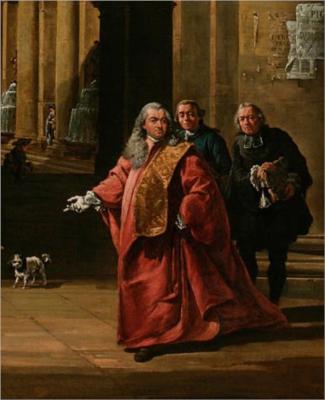
When Soviet forces withdrew from Warsaw in 1945, leaving behind a city reduced almost entirely to rubble, Polish rebuilding committees used eighteenth-century paintings as architectural blueprints. The paintings were by Bernardo Bellotto, a Venetian court artist who had died sixty-five years earlier; his Warsaw views were precise enough to guide the reconstruction of street facades, arcades, and building heights. No other vedutista has earned an afterlife like it.
Biography
Born in Venice in 1721[4], Bellotto was the nephew of Giovanni Antonio Canal on his mother's side and trained in his uncle's studio from early adolescence. By his mid-teens he was a registered member of the Venetian painters' guild. His early work so closely followed Canaletto's manner that he occasionally signed canvases "Canaletto" himself, a habit that has tangled attribution ever since. He left Venice in 1746[4] for a long Italian[4] tour before heading north; in 1747, aged twenty-six, he accepted an invitation to Dresden from Frederick-Augustus II, Elector of Saxony, who paid him twenty thalers a year as court painter.
The Dresden commissions produced some of his finest work: The Moat of the Zwinger (1749[4]-53, 133 x 235 cm, Gemaldegalerie) and a series of Neumarkt views including the Frauenkirche, in which extreme diagonal compositions amplify the spatial depth of the city's Baroque squares. Empress Maria Theresa summoned him to Vienna in 1758, where he painted View from the Belvedere (1759-60, Kunsthistorisches Museum); in 1767 he moved to Warsaw, entering the service of Stanislaw II of Poland and beginning the topographical documentation that would outlast the city itself.
His palette runs consistently cooler and crisper than Canaletto's; he paid more attention to cloud formations, deep shadows, and foliage, and packed his views with more figure groups. Where Canaletto often revisited the same standpoints, Bellotto almost always sought new vantage points. Scholars read his documentary precision as a function of his market: not Venice's tourist trade but the royal courts of Europe, patrons who wanted their capitals recorded with near-surveyor exactitude.
Timeline
- 1721Born in Venice. He was the nephew of Giovanni Antonio Canal (Canaletto) on his mother's side.
- 1734Began training in Canaletto's studio during his early adolescence.
- 1736Became a registered member of the Venetian painters' guild during his mid-teens.
- 1746Left Venice for a tour of Italy before heading north.
- 1747Aged 26, he accepted an invitation to Dresden from Frederick-Augustus II, Elector of Saxony, becoming court painter.
- 1749Painted "The Moat of the Zwinger" in Dresden (completed in 1753).
- 1758Summoned to Vienna by Empress Maria Theresa.
- 1759Painted "View from the Belvedere" in Vienna (completed in 1760).
- 1767Moved to Warsaw and entered the service of Stanislaw II of Poland.
- 1780Died in Warsaw at the age of 59.
Notable Works
Tap to view larger.
Where to See Bernardo Bellotto
2 museums worldwide.
-
3 works
Louvre
Paris, France
Wed–Mon 09:00–18:00 (Fri until 21:45); closed Tue · €22 adults, free under-18
-
1 works
Liechtenstein Museum
Vienna, Austria


Next stop
Browse the movements →
Every movement in the collection, from the Renaissance to Pop art.
Bernardo Bellotto prints
Hand-finished archival prints from Bernardo Bellotto's body of work.
 Piazza San Marco, Venice - Bernardo Bellotto
From £28.00
Piazza San Marco, Venice - Bernardo Bellotto
From £28.00
 View of Warsaw from Praga - Bernardo Bellotto
From £28.00
View of Warsaw from Praga - Bernardo Bellotto
From £28.00
 The Spanish Riding School - Bernardo Bellotto
From £28.00
The Spanish Riding School - Bernardo Bellotto
From £28.00
 Vienna, Panorama from Palais Kaunitz - Bernardo Bellotto
From £28.00
Vienna, Panorama from Palais Kaunitz - Bernardo Bellotto
From £28.00
 The New Market in Dresden - Bernardo Bellotto
From £28.00
The New Market in Dresden - Bernardo Bellotto
From £28.00
 Wilanów Palace as seen from north east - Bernardo Bellotto
From £28.00
Wilanów Palace as seen from north east - Bernardo Bellotto
From £28.00
Related Artists
Take Bernardo Bellotto home.
See all Bernardo Bellotto prints →Frequently Asked Questions
What is Bernardo Bellotto known for?
Bernardo Bellotto is known for his precise city views, particularly those of Warsaw. These paintings were so accurate that they were used to rebuild the city after it was destroyed in 1945.What is Bernardo Bellotto's most famous work?
Bernardo Bellotto, nephew and pupil of Canaletto, is best known for his city views. For a time, he even signed his works as Canaletto, which has caused confusion. Bellotto's style is similar to his uncle's, but his paintings are often cooler, crisper, and include more figures. Bellotto travelled extensively throughout Europe. After leaving Venice in 1746[4], he visited cities including Munich, Dresden, and Warsaw. He also worked in Rome, Vienna, London, Milan, Padua, and Verona. His views of Dresden, such as *View of the New Market in Dresden* (1751), are particularly celebrated. He painted two series of canvases depicting what was then called the "Florence of the Elbe". Bellotto's paintings of Warsaw were considered so accurate that they were used in the city's reconstruction after the Second World War. In 1758, Empress Maria Theresa summoned Bellotto to Vienna, where he produced views of the Habsburg capital. His skill led to his appointment as court painter to August III of Poland in 1751.What should I know about Bernardo Bellotto's prints?
Bernardo Bellotto (1722[4]-1780[4]) was a Venetian painter and printmaker, known for his detailed city views or vedute. He trained in the workshop of his uncle, Canaletto, and initially worked in his style, even using his uncle's name for a time. Bellotto created prints throughout his career, often based on his own paintings. These prints, typically etchings, allowed for wider distribution of his city views. He is admired for his technical skill in capturing architectural details and atmospheric effects. After working in Venice, Bellotto held positions in various European cities, including Dresden, Vienna, and Warsaw. This led to series of prints depicting these locations. His Dresden views, for example, document the city's architecture before its damage in the Seven Years' War. The Warsaw views were commissioned by King Stanisław August Poniatowski, and record the city's rebuilding after the war. Bellotto's prints offer valuable historical records of these urban centres during the 18th century. They also demonstrate the development of vedute as a popular genre.What style or movement did Bernardo Bellotto belong to?
Bernardo Bellotto is best known for his cityscapes, or *vedute*. He trained with his uncle Canaletto in Venice, and his early style closely resembled Canaletto's. Both artists captured city views with great accuracy. Bellotto’s paintings are cooler and crisper than his uncle’s. Bellotto paid more attention to clouds, shadows, and foliage. He also included more figures in his compositions. Bellotto left Venice in 1746[4] and travelled extensively. He worked in various cities, including Dresden, Vienna, Munich, and Warsaw. While in Dresden, he painted canvases depicting the city, which earned him considerable recognition. Empress Maria Theresa summoned Bellotto to Vienna, where he produced views of the capital. Later, he spent his final years in Warsaw, depicting the city with precision. His views of Warsaw were so accurate that they were used to reconstruct the city after the Second World War. Bellotto's style evolved over time. Initially, he enriched his views with atmospheric effects, such as cloudy skies and magical lighting. Later, his style became clearer, with sharper contours and a greater emphasis on draughtsmanship.What techniques or materials did Bernardo Bellotto use?
Bernardo Bellotto's painting methods aligned with established Baroque techniques. This involved a white ground layer to reflect light. The artist would then apply an underpainting, potentially a grey-toned version of the final image. Alternatively, he may have used a more complex method, starting with an underdrawing to define contours, followed by an imprimatura, a thin transparent paint layer, to establish a middle tone. Highlights could then be added using white paint. Colour was applied as thin, transparent glazes, allowing the underpainting to define forms. For highlighted areas, a thin application of local colour sufficed, tinting the white underpainting. Dark tones, however, required multiple layers to cover the underdrawing and establish the proper colour. Bellotto may have employed impasto, a technique using thick paint, for highlights, a common practice among Baroque artists. He may have separated colour from value, achieving luminous effects. Some artists of the period used small palettes with colours specifically for certain painting parts.What was Bernardo Bellotto known for?
Bernardo Bellotto (1722[4]-1780[4]) was an Italian[4] painter and printmaker, known for his detailed cityscapes or *vedute*. He was the nephew and pupil of Canaletto, and at times even signed his works with his uncle's name, which has caused confusion. Bellotto's style is similar, yet his works are often cooler, crisper, and show more interest in clouds, shadows, and foliage. He also included more figures in his compositions. Bellotto travelled extensively throughout his career. After working in Venice and other Italian cities, he moved to Munich, Dresden, and eventually Warsaw. He became court painter to King August III of Poland. Bellotto's views of Warsaw were so accurate that they were used to reconstruct the city after the Second World War. He also produced city views of Vienna following an invitation from Empress Maria Theresa. His paintings often portray everyday life within the architectural setting.When did Bernardo Bellotto live and work?
Bernardo Bellotto, also known as Canaletto like his uncle and teacher, was born either in 1721[4] or 1722[4] and died in 1780[4]. Bellotto followed in his uncle's footsteps, painting cityscapes, but developed his own style. Early in his career, he created atmospheric effects through his use of light and shadow. Later, his style became more linear and precise, with less emphasis on colour, especially after working in various European cities. Bellotto worked in several locations, including Rome, Vienna, Munich, and Dresden. He also spent time in London, Milan, Warsaw, Padua, and Verona. His views of Dresden are particularly well known. In 1751, he was appointed court painter to Elector August III of Saxony, with an annual pension. Later in his career, he worked for Stanisław II of Poland in Warsaw, documenting the city. These paintings later aided in the city's reconstruction after the Second World War.Where can I see Bernardo Bellotto's work?
Bernardo Bellotto's paintings and prints can be viewed in numerous museums and galleries across Europe and North America. In Germany, you can find his work in Berlin at the Staatliche Museen; in Braunschweig at the Herzog Anton Ulrich-Museum; and in Dresden at the Gemäldegalerie Alte Meister. Elsewhere in Europe, Bellotto's art is held in Edinburgh at the National Gallery of Scotland; in Florence at the Galleria degli Uffizi; and in Vienna at the Kunsthistorisches Museum. You can also view his pieces in London, with several locations holding his works: The British Library, The British Museum, The National Gallery, the National Portrait Gallery, Tate, UCL Art Collections, and the Victoria and Albert Museum. Other locations include Madrid's Museo Thyssen-Bornemisza and The Hague's Royal Cabinet of Paintings, Mauritshuis. In North America, notable collections are held in New York at the Metropolitan Museum of Art; in Los Angeles at the J. Paul Getty Museum; and in Washington, at the National Gallery of Art.Where was Bernardo Bellotto from?
Bernardo Bellotto was born in Venice. He was the nephew and pupil of Canaletto, and for a time he worked with his uncle as an assistant. Because Bellotto sometimes signed his works 'Canaletto', there has been confusion between them. Bellotto's style, however, is cooler and crisper than his uncle's. He also showed more interest in clouds, shadows, and foliage, and his paintings include more figure groups. Bellotto left Venice in 1746[4] and visited other Italian[4] cities. He later travelled to Munich, Dresden, and finally Warsaw, where he died in 1780[4]. Bellotto also worked in Rome, Vienna, London, and Milan. In 1751, he received the title of court painter from Elector August III in Dresden, along with an annual pension.Who did Bernardo Bellotto influence?
Bernardo Bellotto's influence is most apparent in the work of his students and followers, and in the vogue for urban views that swept Europe in the 18th century. Bellotto, nephew and pupil of Canaletto, trained in his uncle's studio. He adopted his uncle's style so successfully that their paintings were often confused. Bellotto travelled extensively, working in cities such as Dresden, Vienna, and Warsaw. He produced detailed views of these locations, which were admired by local rulers and collectors. His detailed approach had an impact on topographical painting. Bellotto's influence can be seen in the work of artists who followed him, such as his son, Lorenzo Bellotto (1744[4]-1780[4]), who also painted city views. More generally, his paintings contributed to a fashion for accurate depictions of European cities, which became popular among wealthy patrons. These city views provided a record of urban development and a source of civic pride.Who influenced Bernardo Bellotto?
Bernardo Bellotto (1722[4]-1780[4]) was an Italian[4] topographical painter, also a printmaker in etching. He is best known for his detailed city views, especially of Warsaw, Dresden, and Vienna. Bellotto's training began in the workshop of his uncle, Giovanni Antonio Canal (Canaletto), in Venice. Canaletto's influence on Bellotto is apparent in his early work. Bellotto adopted Canaletto's precise style, attention to architectural detail, and use of perspective. Bellotto's early paintings are sometimes difficult to distinguish from those of his uncle. Bellotto travelled extensively, working in several European cities. He adapted his style to suit the tastes of his patrons and the characteristics of the locations he depicted. While Canaletto primarily worked in Venice and London, Bellotto's career took him to Dresden, Vienna, Munich, and Warsaw. In each location, he produced views that captured the specific character of the city. Although he was initially derivative of Canaletto, Bellotto developed his own distinct artistic identity. His later works show a greater interest in atmospheric effects and a slightly cooler palette than those of his uncle.Who was Bernardo Bellotto?
Bernardo Bellotto (1721[4]-1780[4]) was an Italian[4] artist, also known as Canaletto, like his uncle and teacher. He adopted his uncle's name, which has caused confusion in identifying their works. Bellotto's style resembled his uncle's, but his paintings have a cooler, crisper quality. He showed more interest in clouds, shadows, and foliage. Bellotto also included more figures in his paintings than Canaletto did. Bellotto painted city views, called vedutas. In his earlier years, he created atmosphere through cloudy skies, sunsets, or impending storms. After working in Vienna, Munich, and Dresden, his style became clearer, with sharper contours. He reduced the emphasis on colour, focusing on draughtsmanship. Bellotto's paintings documented architecture and also depicted everyday life. His views of Warsaw were so accurate that they were used to reconstruct the city after the Second World War. In 1751[4], he received the title of court painter from Elector August III in Dresden, with an annual pension.
Sources
Editorial draws on the following primary and tertiary references for Bernardo Bellotto.
- [1] museum Royal Castle in Warsaw Used for: museum holdings.
- [2] museum Liechtenstein Museum Used for: museum holdings.
- [3] academic The Editors of Encyclopaedia Britannica, Bernardo Bellotto | Venetian, Canaletto, Views - Britannica Used for: biography.
- [4] wikipedia Wikipedia: Bernardo Bellotto Used for: biography, birth dates, death dates, identifiers, movement attribution, nationality.
- [5] book Beard, Lee, 1973- author, Butler, Adam, author; Van Cleave, Claire, author; Fortenberry, Diane, author; Stirling, Susan, author, Beard, Lee, 1973- author, Butler, Adam, author; Van Cleave, Claire, author; Fortenberry, Diane, author; Stirling, Susan, author - The Art Book_ New Edition, Mini Format Used for: biography, stylistic analysis.
- [6] book Masterpieces of western art : a history of art in 900 individual studies from the Gothic to the present day Used for: biography.
- [7] book Victoria Charles, Rokoko Used for: biography, stylistic analysis.
- [8] museum Bernardo Bellotto (1722 - 1780) | National Gallery, London Used for: biography.
- [9] museum Bernardo Bellotto | National Gallery of Art Used for: biography.
- [10] museum Bernardo Bellotto - Pirna: The Obertor from the South - The Metropolitan Museum of Art Used for: notable works.
- [11] museum View of the Grand Canal and the Dogana (about 1740) (The J. Paul Getty Museum Collection) Used for: notable works.
Editorial overseen by Solis Prints. Sources verified 2026-08-29. Click a source for details, or hover over [N] in the page above to preview.
Editorial standardsMethodologyCorrectionsAI disclosureAbout the editorial team