



Arne Quinze
Arne Quinze dropped out of the Royal Academy of Fine Arts in Brussels before finding his artistic voice on the city's streets as a graffiti writer, a period that shaped his instinct for urban-scale intervention. Born in Ghent in 1971[1], he went on to become one of Belgium's most recognisable makers of large-scale public sculpture, building structures from timber and recycled materials that interrupt city spaces rather than merely occupying them.
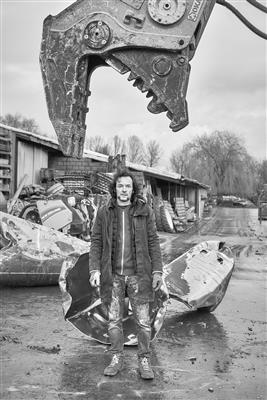
Biography
His 2006 installation Uchronia at Burning Man in Nevada, a towering wooden construction subtitled A Message from the Future, made international headlines and confirmed a practice built around the tension between nature and the built environment. Two years later, The Sequence connected parliament buildings in Brussels across a temporary wooden corridor that stretched nearly a kilometre. In Shanghai's Jing'an Sculpture Park, Red Beacon (2010) continued this dialogue between organic form and metropolitan setting.
Quinze has worked with institutions and brands including Louis Vuitton, and his installations have appeared on every continent. From 2014 to 2019, The Passenger dominated the centre of Mons, Belgium, a slow-growth form of interlocked timber that changed appearance as the seasons shifted around it.
He lives and works near Ghent in Sint-Martens-Latem, returning repeatedly to the same formal vocabulary: curved branches, layered structures, the language of growth translated into engineered wood.
Timeline
- 1971Born in Ghent, Belgium.
- 1990Dropped out of the Royal Academy of Fine Arts in Brussels.
- 1990Began as a graffiti writer in Brussels, developing an instinct for urban-scale work.
- 2006Created "Uchronia" at Burning Man in Nevada, a large wooden construction.
- 2008Constructed "The Sequence", a temporary wooden corridor connecting parliament buildings in Brussels.
- 2010Created "Red Beacon" in Shanghai's Jing'an Sculpture Park.
- 2014Installed "The Passenger" in the centre of Mons, Belgium; it remained until 2019.
Notable Works
Tap to view larger.
Next stop
Browse the movements →
Every movement in the collection, from the Renaissance to Pop art.
Related Artists
Frequently Asked Questions
What is Arne Quinze known for?
Arne Quinze is known for his large-scale public sculptures. He builds structures from timber and recycled materials that interrupt city spaces, creating a dialogue between organic form and metropolitan settings.What is Arne Quinze's most famous work?
It is difficult to name one single work as Arne Quinze's most famous, as his reputation rests on large-scale public art installations and a distinctive style, rather than individual pieces. Quinze is known for his use of brightly coloured wood and his construction of complex, abstract structures in urban environments. These installations often invite public interaction and aim to challenge perceptions of space. Some of his better-known projects include "Uchronia", a temporary wooden city built in the Nevada desert; "The Sequence", a series of red planks that appeared to cascade down a Brussels street; and "Rock Strangers", colourful abstract forms placed in public spaces around the world. These works are temporary, and their impact comes from their scale and situation. Quinze's work is characterised by its bold colours, unusual forms, and ambition to transform public spaces into areas for interaction.What should I know about Arne Quinze's prints?
Arne Quinze is a Belgian[1] contemporary artist, best known for his large, temporary public art installations. He also produces smaller-scale works, including prints, that echo the themes and aesthetics of his larger projects. Quinze's prints often feature bright colours and irregular, abstract shapes. These reflect his interest in urban environments and the energy of crowds. His installations often use wooden planks painted in many colours, creating a sense of organised chaos. This approach translates into his printmaking, where he explores similar ideas on a smaller scale. The prints can be seen as extensions of his installations, offering a more accessible way to engage with his artistic vision. Many of Quinze's works, whether large installations or smaller prints, explore the idea of bringing people together. He aims to encourage interaction and dialogue through his art. His prints, with their bold colours and dynamic compositions, encapsulate this desire to stimulate and engage viewers. They offer a concentrated version of the experience one might have encountering one of his large-scale public works.What style or movement did Arne Quinze belong to?
Without more specific information about Arne Quinze's artistic output, it is difficult to assign him definitively to a particular movement. However, based on the reference passages, some possible connections can be explored. One passage mentions artists of Le Nouveau Réalisme, such as Tinguely and Cesar, who worked with assemblage and mechanical movement. If Quinze's work involves similar techniques or themes, a connection to this movement might be considered. Another passage discusses Olafur Eliasson, who creates simulations of natural phenomena and challenges the separation of nature and culture. If Quinze's art engages with similar ideas about perception and reality, there could be a link to Eliasson's approach. Finally, the passages mention the use of games and narrative in art, as well as the manipulation and deconstruction of experience. If Quinze's work incorporates these elements, it might align with artists who explore the boundaries between fiction and reality. Ultimately, determining Quinze's specific style or movement requires a more detailed examination of his artworks and their relationship to established artistic trends.What techniques or materials did Arne Quinze use?
Arne Quinze is known for using non-traditional materials and techniques in his artworks. His practice often involves the recuperation and recycling of discarded objects, both ordinary and sophisticated. He combines these found elements to create sculptures. Quinze reorganises materials, restoring a sense of their former life while propelling them into a new realm. Movement is integral to his constructions, and he often incorporates sound, light and film to animate them. These complex pieces might be defined as machines rather than sculptures. Quinze explains that he is interested in all machines, ancient and contemporary, because of their movement and their capacity for creating stories. They stimulate mental projections in the spectator, forcing them to create associations and open another space. He enjoys the functional and aesthetic qualities of machines, and both participate in his sculptures. He uses operative motors, fans, projectors and record players to generate energy, wind, imagery, music and other sounds. His constructions are refined, yet deliberately crude and makeshift in their juxtaposition of parts.What was Arne Quinze known for?
Arne Quinze is a Belgian[1] contemporary artist, known for his large, temporary public art installations. These sculptures, often constructed from wooden planks, appear in urban centres. Quinze's intention is to encourage people to interact with their environment, and with each other, in new ways. His installations frequently disrupt or alter the function of public spaces, inviting viewers to reconsider their surroundings. This approach can be seen in the site-specific works of other contemporary artists, such as Richard Serra's *Tilted Arc* (1981) in Manhattan; Serra's sculpture bisected the plaza, altering the space and interrupting pedestrian traffic. Similarly, Anish Kapoor's *Cloud Gate* (2004) in Chicago's Millennium Park encourages interaction, with its curved, mirrored surface reflecting and distorting the city skyline.When did Arne Quinze live and work?
Arne Quinze is a Belgian[1] artist, born in 1971[1]. He lives and works in Sint-Martens-Latem, Belgium. Quinze's work has been shown widely since the late 1990s. His early gallery exhibitions include 'Chaos' at Galerie Artiscope, Brussels, in 1999. His large-scale public art installations include 'Uchronia,' displayed at the Burning Man festival in Nevada in 2006; 'Re-frame,' constructed in Brussels in 2008; 'The Sequence' in the city centre of Leuven, Belgium, also in 2008; and 'Camille' in Karlsruhe, Germany, in 2011. Quinze is known for his use of brightly coloured wooden planks in his sculptures, often creating temporary, accessible structures that invite public interaction. His work explores themes of urbanism, social interaction, and the relationship between people and their environment.Where can I see Arne Quinze's work?
Museums around the world hold artworks that may include pieces by Arne Quinze. In Belgium, you can see art at the Koninklijk Museum voor Schone Kunsten (Antwerp) and the Musées Royaux des Beaux-Arts (Brussels). Other European museums include the Musée d’Art et d’Industrie (Roubaix, France), Musée de l’Ecole de Nancy (Nancy, France), Musée des Arts Décoratifs (Paris, France), Musée des Beaux-Arts (Nancy, France), and Musée National Fernand Léger (Biot, France). Additional museums include the Musée Condé (Chantilly, France), Musée d’Unterlinden (Colmar, France), Chateau de Fontainebleau (Fontainebleau, France), Musée Fabre (Montpellier, France), Musée des Beaux-Arts (Nantes, France), Bibliotheque Nationale, Centre National des Arts Plastiques, Musée Bourdelle, Musée d’Art Moderne de la Ville de Paris, Musée de l’Orangerie, Musée d’Orsay, and Musée du Louvre (all in Paris, France). Other museums that may hold works by this artist are located in the United States, Canada, the UK, and Australia.Who influenced Arne Quinze?
It is difficult to say precisely who influenced Arne Quinze. However, some sources suggest possible influences on other artists working in installation and video art. Bill Viola, for example, has stated that he was inspired by Italian Renaissance master Luca Signorelli's fresco cycle in the Orvieto Cathedral (1499-1504[1]). Viola also drew inspiration from Dante's visions of the Inferno and Purgatorio and the Egyptian Book of the Dead. He notes the importance of art, the value of history, and the social responsibility of image making. Viola also mentions Nam June Paik as a mentor and model, particularly regarding the connection to music in Paik's video work. He also worked with composer David Tudor, which opened his eyes and ears to the world of sound. Viola cites Robert Campin, a Flemish artist from the fifteenth century, as an influence, specifically mentioning Campin's optical precision and clarity.Why are Arne Quinze's works important today?
Arne Quinze is a Belgian[1] artist and sculptor known for his large-scale public art installations. These works often use wood and bright colours to create striking, sometimes chaotic, structures in urban environments. Quinze's installations encourage public interaction and challenge conventional perceptions of space. His work shifts the way people experience their surroundings. By placing art directly into the everyday lives of people, Quinze prompts viewers to reconsider their relationship with art. His installations are temporary, and this ephemeral nature is part of their appeal. The works exist for a limited time, creating a sense of urgency and encouraging people to engage with them while they can. This approach democratises art by making it accessible outside traditional gallery or museum settings. Quinze’s art also introduces an element of surprise and playfulness into urban settings. His structures invite exploration and offer a new perspective on familiar places. By using public space as a canvas, Quinze creates moments of wonder and encourages a sense of community.What was Arne Quinze's art style?
Quinze's formal vocabulary includes curved branches, layered structures, and the language of growth translated into engineered wood. His works often explore the tension between nature and the built environment.When was Arne Quinze born?
Arne Quinze was born in 1971[1].
Sources
Editorial draws on the following primary and tertiary references for Arne Quinze.
- [1] wikipedia Wikipedia: Arne Quinze Used for: biography, birth dates, death dates, identifiers, movement attribution, nationality.
- [2] book Fred S. Kleiner, Helen Gardner, Gardner’s Art Through the Ages_ A Concise Global History, Loose-leaf Version Used for: stylistic analysis.
- [3] book guggenheim-byday00viol Used for: biography.
- [4] book guggenheim-hugo00newy Used for: biography, stylistic analysis.
- [5] book guggenheim-refigur00kren Used for: biography.
- [6] book Saaze, Vivian van, Installation Art and the Museum: Presentation and Conservation of Changing Artworks Used for: biography, stylistic analysis.
- [7] book Masterpieces of western art : a history of art in 900 individual studies from the Gothic to the present day Used for: biography.
Editorial overseen by Solis Prints. Sources verified 2026-09-30. Click a source for details, or hover over [N] in the page above to preview.
Editorial standardsMethodologyCorrectionsAI disclosureAbout the editorial team