



Charles Hermans
- portrait
At the 1878[1] Paris World Fair, a single Belgian[1] canvas stopped crowds: Charles Hermans's 'At Dawn,' a monumental Realist scene of working-class women wearily heading home as revellers from the previous night's ball stumble past. The contrast was deliberate, unflinching, and made Hermans's name across Europe overnight.
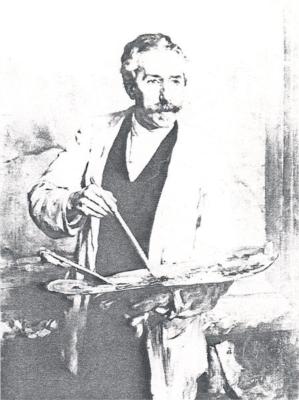
Biography
Born in Brussels on 7 August 1839[1] into a prosperous bourgeois family, Hermans trained first under Louis Gallait before heading to Paris in 1858[1], where he enrolled under Charles Gleyre at the Ecole des Beaux-Arts. His classmates included Claude Monet, Pierre-Auguste Renoir, and James McNeill Whistler; the company was good, the ambition higher. He returned to Brussels and worked steadily through the 1860s and early 1870s, refining a monumental figure style that owed as much to the moral weight of Realism as to academic technique.
'At Dawn' was accepted at the Brussels Salon in 1875[1] without opposition and exhibited three years later in Paris, where it cemented his international standing. The large-format work depicted its subject with the kind of blunt social observation that made comfortable viewers uneasy. Hermans continued with portrait[1] commissions, landscapes, and still lifes, producing a body of work that was respected if rarely shocking after that early triumph.
His influence on the next generation of Belgian[1] painters was substantial. Eugene Laermans and Leon Frederic both drew on the social Realist current Hermans had helped establish. 'The Masked Ball' (1880[1]) showed he could handle the glitter of bourgeois society as well as its shadows.
Hermans died in Brussels on 7 December 1924[1], aged 85. His reputation has always been anchored to 'At Dawn,' a painting that arrived at precisely the right moment with precisely the right argument.
Timeline
- 1839Born in Brussels on 7 August. He came from a prosperous middle-class family.
- 1858Moved to Paris at 19 and enrolled under Charles Gleyre at the Ecole des Beaux-Arts.
- 1875His painting, "At Dawn", was accepted at the Brussels Salon.
- 1878Exhibited "At Dawn" at the Paris World Fair, where it gained him international recognition.
- 1880Painted "The Masked Ball".
- 1924Died in Brussels on 7 December, aged 85.
Notable Works
Tap to view larger.
Next stop
Browse the movements →
Every movement in the collection, from the Renaissance to Pop art.
Related Artists



Frequently Asked Questions
What is Charles Hermans known for?
Charles Hermans is best known for his 1878[1] painting 'At Dawn,' a Realist scene depicting working-class women. The painting made him famous across Europe due to its blunt social observation.What is Charles Hermans's most famous work?
Charles Hermans, a Belgian[1] painter, is best known for his 1875[1] painting *At Dawn* (also known as *A l'Aube* or *Matin de Grève*). The painting depicts a group of impoverished people, including prostitutes and vagrants, gathered at the wholesale market in Cologne, seeking food or work at daybreak. Hermans spent a considerable time in Cologne making studies for the work. He aimed for a realistic, unsentimental portrayal of urban poverty. The painting's subject matter was controversial, and its exhibition at the Brussels Salon of 1875 caused considerable debate. Some critics praised its unflinching realism, while others condemned its perceived vulgarity. *At Dawn* is considered Hermans's most important work because of its scale, its social commentary, and the controversy it generated. It marked a shift in Hermans's oeuvre toward social realism. The painting is now part of the collection of the Royal Museums of Fine Arts of Belgium in Brussels. Other notable works by Hermans include *The Drunkard* and *The Reading of the Proclamation*.What should I know about Charles Hermans's prints?
Charles Hermans (1839[1]-1924[1]) was a Belgian[1] painter known for his Realist and Naturalist scenes of contemporary life. Although he is best known for his paintings, prints after his work circulated during his lifetime. Hermans first studied at the Académie Royale des Beaux-Arts in Brussels. Later, he worked in the studio of the Swiss painter Charles Gleyre in Paris. His early paintings often depicted historical or genre subjects. However, his style shifted towards Realism after his exposure to the work of Gustave Courbet and other French Realists. Hermans achieved considerable recognition for his paintings that portrayed modern urban life and social issues. One of his most celebrated works is "At Dawn" (1875[1]; Royal Museums of Fine Arts, Brussels), a depiction of prostitutes waiting for clients at the end of their night. This painting caused a sensation at the time because of its frank portrayal of a taboo subject. Other important paintings include "The Drunkard" and "The Strike". These paintings often focused on the working class and the poor. Prints after Hermans's paintings made his work accessible to a wider audience. These reproductions allowed people to engage with his social commentary, even if they could not afford an original painting.What style or movement did Charles Hermans belong to?
It is difficult to assign Charles Hermans to one specific movement. He was active during a period of considerable change in European painting, and his work shows the influence of several styles. Some have associated Hermans with Realism, a movement that emerged in France around the mid-19th century. Realist artists sought to depict everyday subjects and scenes in an objective, unidealised manner. This focus on modern life is apparent in some of Hermans's paintings, such as "At Dawn" (1875[1]), which portrays the lives of working-class people. However, Hermans's style also incorporates elements of Naturalism, an offshoot of Realism that placed greater emphasis on scientific observation and the depiction of social problems. His paintings often possess a sense of psychological depth and explore the darker aspects of human experience. He also had contact with the Hague School.What was Charles Hermans known for?
Charles Hermans (1839[1]-1924[1]) was a Belgian[1] painter known for his Realist and Naturalist scenes of contemporary life. He moved away from historical subjects, favouring depictions of the middle and working classes in Brussels. Hermans studied at the Académie Royale des Beaux-Arts in Brussels. Here, he was influenced by the academic style, but he later reacted against it. His early work included history paintings such as "The Battle of Kressenbrunn" (1861[1]). A state grant allowed him to travel to Germany, where he studied the work of Wilhelm Leibl. Leibl's realistic style had a significant impact on Hermans' artistic development. He gained recognition for paintings that portrayed social issues and the realities of urban existence. "At Dawn" (1875) is one of his most famous works. It depicts a group of drunkards and prostitutes leaving a tavern at daybreak. This painting caused considerable controversy due to its unflinching depiction of poverty and vice. Other notable works include "The Strike" and "The Drunkard". These paintings cemented his reputation as a painter of modern life. Hermans' work often explored themes of social inequality and the darker aspects of urban society.When did Charles Hermans live and work?
Charles Hermans was born in Brussels on 17 August 1822. He began his artistic training at a young age, studying under the direction of Louis Gallait. Hermans is best known for genre paintings and portraits that often depicted scenes of contemporary life. He gained recognition for his realistic style and his ability to capture the nuances of human emotion. His paintings often explored themes of social commentary and urban life, reflecting the changing society of 19th-century Europe. Hermans lived and worked primarily in Brussels, where he was an active member of the artistic community. He exhibited his works regularly at the Brussels Salon and other international exhibitions, gaining a wide audience for his art. He died in Menton, France, on 7 December 1883[1].Where can I see Charles Hermans's work?
To view work by Charles Hermans, consider the following museums. In the United States, visit the Los Angeles County Museum of Art (LACMA) at 5905 Wilshire Boulevard, Los Angeles, CA; the Metropolitan Museum of Art, 1000 Fifth Avenue, New York, NY; the Minneapolis Institute of Arts, 2400 Third Avenue South, Minneapolis, MN; the Museum of Modern Art, 11 West 53rd Street, New York, NY; the Charles Hosmer Morse Museum of American Art, 445 North Park Avenue, Winter Park, FL; the Virginia Museum of Fine Arts, 200 N. Boulevard, Richmond, VA; the Wolfsonian at Florida International University, 1001 Washington Avenue, Miami Beach, FL; the J. Paul Getty Museum, Los Angeles; the Art Institute of Chicago; or the Field Museum, Chicago. In Canada, see the Royal Ontario Museum, 100 Queens Park, Toronto, Ontario. In the United Kingdom, try the Brighton Museum & Art Gallery, Royal Pavilion Gardens, Brighton; the Geffrye Museum, Kingsland Road, London; the Manchester Art Gallery, Mosley Street, Manchester; the National Museums of Scotland-Royal Museum, Chambers Street, Edinburgh; or the Victoria & Albert Museum, Cromwell Road, London. Other options include the Musée des Arts Décoratifs, Paris; the Musée des Beaux-Arts, Nancy; or the Kunsthaus Zurich, Switzerland.Where was Charles Hermans from?
Charles Hermans was from Belgium. In the late 1800s, Belgium went through a period of literary nationalism. According to Charles Potvin, the country could claim a tradition of glory because its writers had an 'escort of illustrious men'. If literary precursors were absent, painters were assimilated into the 'illustrious men' who inspired young Belgium. Potvin wrote in 1870[1] that the fine arts should help people appreciate Belgium's literary spirit, because the universal glory of the country's artists could lend its brilliance to literature. The glory of Flemish art supported the definition of literature that lacked federative characteristics. Painting also explained a problematic relationship to language. Writers, without their own language to express their French and Flemish culture, turned to forms and colours.Who did Charles Hermans influence?
Charles Hermans (1839[1]-1924[1]) was a Belgian[1] painter known for genre scenes and portraits. His work displays realism, and he is associated with the Société Libre des Beaux-Arts. It is difficult to identify specific artists directly influenced by Hermans. However, his style and subject matter connect him to broader artistic movements. His paintings share characteristics with other realist artists of his time. This includes a focus on contemporary life and a naturalistic approach to representation. Belgian art in the late 19th century saw a shift toward realism and social commentary. Artists explored modern subjects and everyday scenes. Hermans's work, such as "At Dawn" (1875[1]), fits within this context. He contributed to the development of Belgian realism; his influence is perhaps best understood as part of this collective movement. Other artists associated with this trend include Alfred Stevens and Henri de Braekeleer. They shared a similar interest in depicting modern life with a realistic style.Who influenced Charles Hermans?
Charles Hermans (1839[1]-1924[1]) was a Belgian[1] painter known for his Realist and Naturalist scenes of contemporary life. He initially studied at the Académie Royale des Beaux-Arts in Brussels. There, he was instructed by Louis Gallait, a history painter, and later, the genre painter, Charles-Louis Verboeckhoven. Hermans's early work shows an interest in history painting. However, he soon moved toward Realism. This shift was influenced by his contact with French Realist painters, such as Gustave Courbet. Courbet's focus on everyday subjects and his rejection of academic conventions resonated with Hermans. Hermans also admired the work of French Naturalist painters, such as Jules Bastien-Lepage. Bastien-Lepage's emphasis on depicting rural life and his use of natural light had an impact on Hermans's style. "At Dawn" (1875[1], Musée d'Orsay, Paris) demonstrates Bastien-Lepage's influence. Hermans's paintings often featured scenes of modern urban life, with a focus on social issues and the experiences of ordinary people.Who was Charles Hermans?
Charles Hermans (1839[1]-1924[1]) was a Belgian[1] painter known for his Realist and occasionally Symbolist works. He was born in Brussels, and he received his artistic training there and in Paris. Hermans's early paintings often depicted historical or genre scenes. He gained recognition for his depictions of contemporary life, particularly those showing the struggles of the working class. One of his most celebrated paintings is "At Dawn" (1875[1]), a depiction of drunkards leaving a tavern at daybreak. The painting's unflinching portrayal of poverty and social decay caused controversy when it was first exhibited. He was influenced by French Realist painters such as Gustave Courbet and Édouard Manet. However, Hermans developed his own distinctive style, characterised by its sombre colour palette, dramatic lighting, and psychological intensity. In later years, he experimented with Symbolism, producing paintings with dreamlike imagery and allegorical themes. Hermans died in Menton, France, in 1924.Why are Charles Hermans's works important today?
Charles Hermans (1839[1]-1924[1]) was a Belgian[1] painter known for his Realist depictions of contemporary life, particularly scenes of urban poverty and social alienation. His paintings offer insights into the social conditions of 19th-century Brussels. Hermans's style moved away from academic conventions. He embraced a more naturalistic approach. This is evident in his use of colour and his attention to detail in portraying everyday people. His subject matter often focused on the lives of the working class and the marginalised, offering a critical commentary on social inequality. One of his most recognised paintings, "At Dawn" (1875[1]), depicts a group of impoverished individuals seeking shelter at the central market in Brussels. The painting's stark realism and unflinching portrayal of poverty caused controversy when it was first exhibited. It challenged the prevailing artistic norms of idealisation and romanticism. Hermans's work provides valuable documentation of a specific time and place. It also raises questions about social responsibility and the role of art in addressing societal issues.
Sources
Editorial draws on the following primary and tertiary references for Charles Hermans.
- [1] wikipedia Wikipedia: Charles Hermans Used for: biography, birth dates, death dates, identifiers, movement attribution, nationality.
- [2] book Vincent van Gogh, Delphi Complete Works of Vincent Van Gogh (Illustrated) Used for: biography.
- [3] book Vincent van Gogh, Masters of Art - Vincent van Gogh Used for: biography.
- [4] book Weststeijn, Thijs, The Universal Art of Samuel Van Hoogstraten (1627-1678): Painter, Writer, and Courtier Used for: stylistic analysis.
- [5] book Thijs Weststeijn (Editor), The Universal Art of Samuel van Hoogstraten (1627-1678)_ Painter, Writer, and Courtier (Amsterdam Studies in the Dutch Golden Age) Used for: stylistic analysis.
- [6] book VINCENT VAN GOGH, Works of Vincent van Gogh (Masters of Art) Used for: biography.
Editorial overseen by Solis Prints. Sources verified 2026-09-30. Click a source for details, or hover over [N] in the page above to preview.
Editorial standardsMethodologyCorrectionsAI disclosureAbout the editorial team