



Barbara Krafft
- portrait
The posthumous portrait[1] of Wolfgang Amadeus Mozart painted by Barbara Krafft in 1819[1] has become one of the most widely reproduced likenesses of the composer, made nearly three decades after Mozart's death in 1791 and based on earlier sources. Its continued circulation says something about the reach of this particular commission.
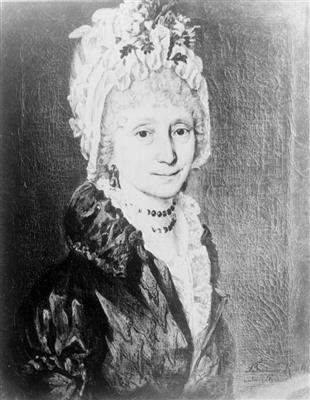
Biography
Born in Iglau (now Jihlava in the Czech Republic) in 1764[1], Krafft trained under her father, Johann Nepomuk Steiner, an Austrian[1] Imperial court painter. She first exhibited at the Vienna Academy of Fine Arts in 1786[1], and spent the following two decades working across Jihlava, Salzburg, and Prague. Portrait painting was her primary genre, though she also produced religious and genre subjects. Her son, Johann August Krafft, born in 1792, trained as a painter and lithographer under her instruction.
After separating from her husband, a Viennese pharmacist, around 1804[1], Krafft settled in Salzburg for seventeen years. In 1821, she was appointed City Painter of Bamberg, a civic recognition that was practically productive: she completed 145 works in the role before her death in 1825[1]. Her paintings are held in the Austrian[1] Gallery Belvedere in Vienna.
Krafft worked at the meeting point of late 18th-century court portraiture and the broader Neoclassical current across Central Europe, the same era that produced Angelica Kauffmann's pan-European success. Unlike Kauffmann, she remained within German-speaking territories, building a professional career across multiple cities without achieving international celebrity. The Mozart portrait[1] has kept her name in circulation far longer than her other work.
Timeline
- 1764Born in Iglau (now Jihlava, Czech Republic). Her father, Johann Nepomuk Steiner, was an Austrian Imperial court painter.
- 1786First exhibited at the Vienna Academy of Fine Arts.
- 1792Her son, Johann August Krafft, was born. He later trained as a painter and lithographer under her.
- 1804Separated from her husband, a Viennese pharmacist, and settled in Salzburg.
- 1819Painted a posthumous portrait of Wolfgang Amadeus Mozart, which became widely reproduced.
- 1821Appointed City Painter of Bamberg.
- 1825Died in Bamberg. During her tenure as City Painter, she completed 145 works.
Notable Works
Tap to view larger.
Next stop
Browse the movements →
Every movement in the collection, from the Renaissance to Pop art.
Related Artists



Frequently Asked Questions
What is Barbara Krafft known for?
Barbara Krafft is best known for her posthumous portrait[1] of Wolfgang Amadeus Mozart, painted in 1819[1]. This portrait, made nearly three decades after Mozart's death, has become one of the most widely reproduced images of the composer. Its continued circulation has kept her name in circulation far longer than her other work.Who was Barbara Krafft?
Barbara Krafft was an 18th- and 19th-century painter, primarily known for portraiture, who worked across what is now the Czech Republic, Austria, and Germany. She trained under her father, Johann Nepomuk Steiner, and exhibited at the Vienna Academy of Fine Arts in 1786[1]. Krafft was later appointed City Painter of Bamberg in 1821.What was Barbara Krafft's art style?
Krafft worked at the meeting point of late 18th-century court portraiture and the broader Neoclassical current across Central Europe. This was the same era that produced Angelica Kauffmann's pan-European success. Unlike Kauffmann, she remained within German-speaking territories, building a professional career across multiple cities without achieving international celebrity.How did Barbara Krafft die?
Barbara Krafft died in 1825[1] at the age of 61.
Sources
Editorial draws on the following primary and tertiary references for Barbara Krafft.
- [1] wikipedia Wikipedia: Barbara Krafft Used for: biography, birth dates, death dates, identifiers, movement attribution, nationality.
- [2] book Ansel Adams; Beaumont Newhall; Nancy Newhall; Louise Dahl-Wolfe; Aaron Siskind; Richard Avedon; Harry Callahan; Lee Friedlander; Tina Modotti; W. Eugene Smith; Paul Strand; Edward Weston; Garry Winogrand; Amy Rule, Ansel Adams; Beaumont Newhall; Nancy Newhall; Louise Dahl-Wolfe; Aaron Siskind; Richard Avedon; Harry Callahan; Lee Friedlander; Tina Modotti; W. Eugene Smith; Paul Strand; Edward Weston; Garry Winogrand; Amy Rule - Original sources _ art and ar Used for: stylistic analysis.
- [3] book Art Das Kunstmagazin Mai No 05 2019 Used for: biography.
- [4] book Elizabeth Otto & Patrick Rössler, Bauhaus Women Used for: biography.
- [5] book guggenheim-annialbers00webe Used for: biography.
- [6] book Palmer, Allison Lee, Historical Dictionary of Neoclassical Art and Architecture Used for: biography.
- [7] book Jennifer D. Milam, Historical Dictionary of Rococo Art Used for: biography.
- [8] book Neoclassicism and romanticism : architecture, sculpture, painting, drawings, 1750-1848 Used for: biography.
Editorial overseen by Solis Prints. Sources verified 2026-10-07. Click a source for details, or hover over [N] in the page above to preview.
Editorial standardsMethodologyCorrectionsAI disclosureAbout the editorial team