

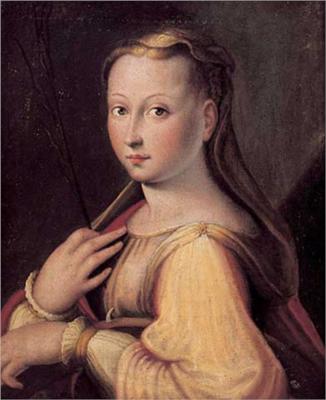
Barbara Longhi
- Italian Renaissance painting
When Giorgio Vasari published the second edition of his Lives in 1568[1], Barbara Longhi was still a teenager. Her inclusion in that foundational survey of Italian art at such an early age reflects a reputation that had spread well beyond her home city of Ravenna, where she would spend her entire life.
Biography
She was the daughter and pupil of the Mannerist painter Luca Longhi, and assisted on large altarpiece commissions in the family workshop while also modelling for her father's paintings. Her contemporary reputation rested largely on portraiture: the scholar Muzio Manfredi, in a 1575[1] lecture in Bologna, claimed she could "portray better than anybody else." That achievement is now almost entirely lost, with only a single portrait, of a Camaldolese monk, surviving from what was evidently a substantial practice.
What remains is dominated by small devotional paintings, around fifteen attributed works in total. Most are Madonna and Child compositions, painted with quiet, warm colouring and a simplicity of arrangement that suited Counter-Reformation taste for images designed for private contemplation. Her sources include Raphael, Correggio, and Parmigianino, as well as the example of Sofonisba Anguissola. The critic Germaine Greer later praised her paintings for their "simplicity and intensity of feeling."
Her work is concentrated in the Museo d'Arte della Città di Ravenna, which holds seven pieces. Others are in the Louvre, the Pinacoteca di Brera in Milan, and the Indianapolis Museum of Art. She never married and outlived her era considerably, dying in 1638[1] at the age of 86.
Timeline
- 1552Born in Ravenna. She was the daughter of painter Luca Longhi.
- 1568Included in the second edition of Giorgio Vasari's Lives, reflecting her early reputation.
- 1570Assisted in her father's workshop, working on large altarpiece commissions.
- 1575Muzio Manfredi claimed in a lecture that she could 'portray better than anybody else'.
- 1580Produced mostly small devotional paintings, mainly Madonna and Child compositions.
- 1585Painted with quiet, warm colouring and a simplicity of arrangement.
- 1590Her work was influenced by Raphael, Correggio, Parmigianino, and Sofonisba Anguissola.
- 1638Died in Ravenna at 86. She never married.
Notable Works
Tap to view larger.
Next stop
Browse the movements →
Every movement in the collection, from the Renaissance to Pop art.
Related Artists


Frequently Asked Questions
What is Barbara Longhi known for?
Barbara Longhi is known for her small devotional paintings, particularly Madonna and Child compositions. Her contemporary reputation was based on portraiture, although only one portrait is known to survive.What is Barbara Longhi's most famous work?
Pietro Longhi (1702-85) is best known for his paintings of 18th-century Venetian life. Although he began with mythological and religious subjects, he shifted to genre scenes, influenced by Giuseppe Maria Crespi. He also studied engravings of Antoine Watteau, and his drawings show an affinity with French Rococo artists. Longhi's genre paintings often resembled those of his French contemporaries. Two examples are *The Married Couple’s Breakfast* and *Blindman’s Buff* (both 1744); these were owned by the British consul in Venice, Joseph Smith, and later entered the collection of George III. One of Longhi's more unusual paintings is *The Rhinoceros* (1751). It depicts a rhinoceros on display during Carnival in Venice. Longhi included portraits of the rhinoceros's owner and the patron, Giovanni Grimani, among the onlookers. The painting's natural lighting and attention to detail create a sense of realism. During his lifetime, Longhi's work was compared to that of Carlo Goldoni, who sought truth in his plays. Goldoni even wrote a sonnet in 1750 comparing Longhi's art to his own. Longhi's paintings were popular among Venetian families and European courts.What should I know about Barbara Longhi's prints?
Information about prints by Barbara Longhi is scarce. However, some general information about fine art prints may be helpful. Since the mid-20th century, printmaking has become more accepted as a significant art form. The practice of printmaking allows artists to explore aesthetic concepts, and it has been revitalised by artists across the world. Prints are often produced in limited editions, with each print numbered and signed by the artist. The numbering indicates the print's position in the edition (e.g., 12/25 means it is the twelfth print out of an edition of 25). Some artists also create a small number of artist's proofs, marked with "AP". The limited number of prints available often increases their value to collectors. An original print is conceived and executed solely as a print, with each print individually inked and pulled from the matrix. This differs from a reproduction, which is a copy of a work originally created in another medium. The Professional Art Dealers Association of Canada has established a definition of an original print, which is accepted by major arts organisations in the country.What style or movement did Barbara Longhi belong to?
Barbara Longhi was an Italian painter working in the late Renaissance period, specifically the second half of the 16th century. Her father, Luca Longhi, was a painter of some local standing in Ravenna, and she is thought to have trained with him. Though not much is known about her life, she remained in Ravenna, unmarried, and enjoyed a successful career there. Stylistically, Longhi's work is associated with the late Mannerist and early Baroque styles. She is best known for her small-scale paintings of the Madonna and Child; these works reflect the influence of Raphael and Correggio. Her paintings are characterised by their delicate beauty, gentle emotion, and refined technique. Though she produced some history paintings and portraits, her depictions of the Virgin Mary are the works for which she is most recognised.What techniques or materials did Barbara Longhi use?
Oil paint was a common medium available to painters of Longhi's era. Artists often began with a white ground layer to make colours reflective. An underdrawing defined contours, and a thin, transparent imprimatura layer established a middle tone. The artist could then add highlights in white paint. Colour was applied as thin, transparent glazes, allowing the underpainting to define forms. Highlights used the thinnest possible application of local colour, while dark tones required many layers to cover the underdrawing. The smooth surface meant brushes with soft hair were needed, and pigments were tempered with a fluid oil medium, possibly thinned with turpentine. Linseed oil, which dried quickly, was likely used.What was Barbara Longhi known for?
Although the passages provided do not directly discuss Barbara Longhi, they do mention Pietro Longhi, an Italian painter active during the 18th century. Pietro Longhi is known for creating memorable scenes of Venetian life. Initially, he worked with mythological and religious themes. However, he shifted his focus to genre scenes, depicting everyday life; this interest developed through his study of Giuseppe Maria Crespi’s works. Some early biographers suggest Longhi entered Crespi’s studio in Bologna as an assistant after 1718. Longhi also became familiar with Antoine Watteau's art through engravings sent to Rosalba Carriera in Venice. His affinity with French Rococo artists, such as Watteau and Nicolas Lancret, is evident in his drawings, such as Young Man Sprawled in a Chair (c. 1760, Staatliche Museen, Berlin). Many of his early genre subjects are similar to those of his French contemporaries, for instance, The Married Couple’s Breakfast and Blindman’s Buff (both 1744, Windsor Castle, Windsor), owned by Joseph Smith and later acquired by George III. Other paintings, such as The Rhinoceros (1751, Ca’Rezzonico, Venice), uniquely tied to life in Venice, depict the viewing of an exotic animal during Carnival.When did Barbara Longhi live and work?
Barbara Longhi was born in Ravenna in 1552[1] and died there in 1638[1]. Her father was the painter Luca Longhi, and she remained in his workshop throughout her career. Details of Longhi's life are scarce. She never married, and her activity seems to have been largely confined to Ravenna. She gained notice at a young age; in 1570[1], when Longhi was around eighteen years old, a local historian, Girolamo Rossi, wrote that she was "a girl who paints very well". He stated that she was following in the style of her father, and that "in Ravenna she is doing things that are marvelled at". Longhi primarily painted small-scale devotional works, particularly depictions of the Virgin and Child. These paintings were popular with local patrons, and she appears to have enjoyed a successful, if quiet, career in her native city.Where can I see Barbara Longhi's work?
I am very sorry, but the reference passages provided do not contain information about where to view the work of Barbara Longhi. The passages consist of lists of museums, their addresses, and telephone numbers. These museums are located in the United States, Canada, the United Kingdom, Italy, Mexico, and the Netherlands. They include the Charles Hosmer Morse Museum of American Art, Los Angeles County Museum of Art (LACMA), the Metropolitan Museum of Art, the Minneapolis Institute of Arts, the Museum of Modern Art, the Royal Ontario Museum, the Virginia Museum of Fine Arts, the Wolfsonian at Florida International University, the Bakelite Museum, Brighton Museum & Art Gallery, the Geffrye Museum, Manchester Art Gallery, the National Museums of Scotland, the Victoria & Albert Museum, Palazzo Schifanoia, Galleria degli Uffizi, Palazzo Pitti, Museo Nazionale del Bargello, Pinacoteca di Brera, Galleria e Museo Estense, Casino dell’Aurora, Palazzo Barberini, Palazzo del Vaticano, Papal Basilica of Saint Peter, Palazzo Pubblico, Pinacoteca Nazionale di Siena, Galleria Internazionale d’Arte Moderna di Ca’ Pesaro, Galleria dell’ Accademia, Museo Correr, Palazzo Labia, Museo de Arte Alvar y Carmen T de Carillo, Stedelijk Museum, Rijksmuseum, Mauritshuis, Fondazione Regionale Cristoforo Colombo, Museo del Bijou di Casalmaggiore, and Museo Richard-Ginori della Manifattura di Doccia.Where was Barbara Longhi from?
The passages provided discuss Pietro Longhi, an Italian painter who created scenes of Venetian life during the 18th century. Longhi is known for his genre scenes. His paintings include The Rhinoceros (1751, Ca’Rezzonico, Venice), which depicts the viewing of an exotic animal during Carnival. Longhi incorporated portraits into the group of onlookers, including the owner of the rhinoceros and the patron who commissioned the work, Giovanni Grimani. Longhi's work was compared to that of Carlo Goldoni in the theatre, who had dismissed the artificial conventions of the commedia dell’arte in favour of plots based on his observations of daily life. Goldoni mentioned Longhi in a sonnet of 1750. Longhi's work was popular with Venetian families and well known in European court circles.Who did Barbara Longhi influence?
It is difficult to identify specific artists who were directly influenced by Barbara Longhi, as her artistic contributions have often been understood through the lens of her male contemporaries. During the early nineteenth century, local writers chronicled the artistic achievements of Bolognese women. However, the works by Bolognese women relate more directly to that of their male contemporaries than to that of other women. Lavinia Fontana is understood as the disciple of her father, Prospero, and Elisabetta Sirani is seen as a follower of Guido Reni. During the seventeenth century, Elisabetta Sirani and her female followers developed a subspecialisation in pictures of heroines from antiquity, produced for a small group of Bolognese private collectors whose taste for such subjects is documented in inventories and in a few extant works. The high percentage of such subjects among the works of seventeenth-century Bolognese female painters suggests that patrons found particular appeal in having heroic women painted by women artists whose own achievements may have been seen as analogous to accomplishments by ancient women that were also viewed as atypical of their sex.Who influenced Barbara Longhi?
Barbara Longhi (1552[1]-1638[1]) was an Italian painter from Ravenna. As the daughter of painter Luca Longhi, her initial artistic influence came from her father's workshop. Luca, a well-regarded artist in Ravenna, likely provided Barbara with her earliest training and exposure to painting techniques. Beyond her father, it is thought that she was influenced by local artists of the period, such as those in the circle of Correggio and Parmigianino. These artists were known for their graceful figures and use of colour, elements that are reflected in Longhi's work. Although documentation is lacking, it is reasonable to assume that Longhi would have studied the works of other established artists through prints or drawings. The artistic environment of Ravenna, while not as prominent as Florence or Rome, would still have offered Longhi access to a range of artistic styles and ideas, which would have helped shape her own unique approach to painting.Who was Barbara Longhi?
Pietro Longhi (1702-85) was an Italian painter who captured scenes of 18th-century Venetian life. Although his earliest works were on mythological and religious subjects, he moved away from narrative painting to concentrate on genre scenes. Longhi's interest in everyday life was influenced by the works of Giuseppe Maria Crespi. Some early biographers suggest he entered Crespi’s studio in Bologna as an assistant sometime after 1718. He also became familiar with the art of Antoine Watteau through volumes of engravings sent to Rosalba Carriera in Venice. Longhi's affinity with French Rococo artists, such as Watteau and Nicolas Lancret, is evident in his drawings; for example, Young Man Sprawled in a Chair (c. 1760, Staatliche Museen, Berlin). Many of Longhi's early genre subjects are similar to those of his French contemporaries. Two examples are The Married Couple’s Breakfast and Blindman’s Buff (both 1744, Windsor Castle, Windsor), which were owned by Joseph Smith, the British consul in Venice, and later entered the collection of George III. Other paintings by Longhi were more unusual and tied to life in contemporary Venice. The Rhinoceros (1751, Ca’Rezzonico, Venice) shows the viewing of an exotic animal on display during Carnival in 1751. During his lifetime, the innovative quality of Longhi's work was compared to that of Carlo Goldoni in the theatre, who dismissed the artificial conventions of the commedia dell’arte in favour of plots based on his observations of daily life. Longhi's work was popular with prominent Venetian families and well known in European court circles.
Sources
Editorial draws on the following primary and tertiary references for Barbara Longhi.
- [1] wikipedia Wikipedia: Barbara Longhi Used for: biography, birth dates, death dates, identifiers, movement attribution, nationality.
- [2] book Helen Glanville, A History of the Restoration and Conservation of Works of Art Used for: stylistic analysis.
- [3] book Jesse Bryant Wilder, Art History For Dummies Used for: biography.
- [4] book guggenheim-italianartnowame00wald Used for: biography.
- [5] book guggenheim-leeredits00lade Used for: biography.
- [6] book guggenheim-metph00cela Used for: stylistic analysis.
- [7] book guggenheim-omaggio00font Used for: biography.
- [8] book Martina Caruso, Italian Humanist Photography From Fascism to the Cold War Used for: stylistic analysis.
- [9] book Masterpieces of western art : a history of art in 900 individual studies from the Gothic to the present day Used for: biography.
- [10] book Hodge, Susie, 1960- author, The short story of women artists : a pocket guide to movements, works, breakthroughs, & themes Used for: biography.
Editorial overseen by Solis Prints. Sources verified 2026-09-22. Click a source for details, or hover over [N] in the page above to preview.
Editorial standardsMethodologyCorrectionsAI disclosureAbout the editorial team