



Bartolomeo Passerotti
When Annibale Carracci exhibited his Crucifixion at Santa Maria della Carita in Bologna in 1583[1], the city's established painters were unimpressed. Bartolomeo Passerotti, then one of the two leading figures in Bolognese painting alongside Prospero Fontana, criticised the young Carracci directly for the simplicity of his approach. Within a decade, Passerotti's own Mannerist style had been largely superseded by the programme the Carracci went on to establish.
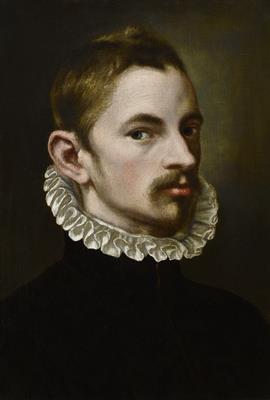
Biography
Born in Bologna in 1529[1], Passerotti spent part of his formation in Rome, working in the orbit of Taddeo Zuccaro, before returning to establish a successful workshop in his native city. He trained the young Agostino Carracci in the early 1570s, a detail that places him at the centre of Bolognese artistic education in that period.
His most original contribution was in genre painting. Passerotti adapted the market and butcher-shop tradition that had arrived from northern painters such as Pieter Aertsen, filtering it through a Bolognese Mannerist sensibility. His Butcher's Shop (Palazzo Barberini, Rome) presents a coarse cast of figures in a tight, controlled technique, with more than a suggestion that the flesh on display carries a moralising edge. Annibale later tackled the same genre subjects with a warmth and directness that left Passerotti's burlesque approach looking stiff by comparison.
He worked through the reform period initiated by Archbishop Gabriele Paleotti, whose 1582[1] treatise demanded clearer and more emotionally direct religious imagery. Passerotti's Presentation in the Temple (Pinacoteca Nazionale, Bologna) represents his response to those demands. He died in Bologna in 1592[1].
Timeline
- 1529Born in Bologna.
- 1570Trained Agostino Carracci in the early 1570s, placing him at the centre of Bolognese artistic education.
- 1582Archbishop Gabriele Paleotti initiated a reform period, which influenced Passerotti's work.
- 1583Criticised Annibale Carracci's "Crucifixion" for its simplicity.
- 1592Died in Bologna.
- 1592Painted "Butcher's Shop", now located in the Palazzo Barberini, Rome.
- 1592Painted "Presentation in the Temple", now located in the Pinacoteca Nazionale, Bologna.
Notable Works
Tap to view larger.
Next stop
Mannerism →
Explore the artists and ideas of Mannerism.
Related Artists




Frequently Asked Questions
What is Bartolomeo Passerotti known for?
Bartolomeo Passerotti is known for his genre painting. He adapted the market and butcher-shop tradition of northern painters, such as Pieter Aertsen, through a Bolognese Mannerist style.What is Bartolomeo Passerotti's most famous work?
Bartolomeo Passerotti (1529[1]-1592[1]) was a painter active in Bologna and Rome. He is best known for his genre paintings and portraits, a departure from the religious themes common at the time. Passerotti's most famous work is arguably "The Butcher's Shop" (c. 1570s). This painting offers a glimpse into everyday life. It depicts a butcher's shop with various cuts of meat, animals, and figures. The scene is realistic, showing the tools and activities associated with the trade. He made several versions of this composition; one is held by the Galleria Nazionale d'Arte Antica, Rome, and another is in a private collection. His interest in naturalism and everyday subjects influenced later artists. Passerotti also produced portraits of individuals from different social classes, further demonstrating his interest in representing the world around him. Although he created religious paintings and mythological scenes, his genre scenes, such as "The Butcher's Shop", remain his most recognisable and studied works.What should I know about Bartolomeo Passerotti's prints?
Bartolomeo Passerotti (1529[1]-1592[1]) was a painter active in the late Renaissance. Though he is not primarily known as a printmaker, prints were an important means of disseminating artistic ideas during his era. Exposure to art and architecture was often achieved through engravings. These included frontispieces in books, decorative borders in Books of Hours, and illustrated editions of classical texts. Prints by artists such as Mantegna, and celebrated plates by Bramante, were highly valued for their authority. Marcantonio Raimondi, a prolific engraver, played a significant role in spreading the works of Raphael and his circle throughout Europe. His prints covered a range of subjects, including antique sculptures, allegories, portraits, and genre scenes. Similarly, artists like Dürer, Cranach, and Lucas van Leyden contributed to the circulation of artistic ideas through their prints. The pricing of original prints is influenced by factors such as the limited edition size, the artist's reputation, the image's popularity, and the quality of materials used.What style or movement did Bartolomeo Passerotti belong to?
Bartolomeo Passerotti (1529[1]-1592[1]) was an Italian[1] painter of the late Renaissance period, active mainly in Bologna. He is often associated with the Mannerist style, though his work also shows elements of naturalism. Mannerism[1], which emerged in the early 16th century, moved away from the classical ideals of balance and proportion that characterised the High Renaissance. Mannerist artists like Passerotti often employed exaggerated forms, artificial colours, and complex compositions to create a sense of elegance and sophistication. Passerotti's paintings include religious subjects, portraits, and genre scenes. He was known for his attention to detail and his ability to capture the likenesses of his sitters. His interest in naturalism is evident in his careful observation of the natural world and his realistic depiction of human figures. Some scholars see his genre scenes of butchers' shops and markets as precursors to the later development of Realism. His style is thus a blend of Mannerist conventions and a developing interest in observed reality.What techniques or materials did Bartolomeo Passerotti use?
Bartolomeo Passerotti (1529[1]-1592[1]) was a painter active in Bologna and Rome. He is mainly known for portraiture and genre scenes. Passerotti's paintings are mostly oil on canvas. However, he also produced some works in fresco. His style is characterised by close observation and naturalism, particularly in his portraits. He paid careful attention to the details of his sitters' faces and clothing. Passerotti's anatomical studies also informed his art. He was interested in representing the human form accurately. This is evident in his genre scenes, which often feature figures engaged in everyday activities. These paintings display his skill in capturing movement and expression. Passerotti's work shows the influence of earlier artists, such as Correggio and Parmigianino. He adapted their techniques to create his own style. He also trained a number of pupils, including his sons, Tiburzio and Ventura Passerotti, who continued to work in his style after his death.What was Bartolomeo Passerotti known for?
Bartolomeo Passerotti, an Italian[1] painter of the 16th century, is known for his interest in everyday reality, a trend seen in northern Italian painting. His career is documented by a series of inscribed paintings. The earliest of these is a *Madonna and Child*, formerly in a private collection in Venice, which bears the date 1502. The inscription reads, “Bartolamio mezo venizian e mezo cremonexe,” possibly referring to his parentage or where he lived and worked. Some believe he trained in Venice, indicated by the 1502 painting and other religious works from that decade that echo compositions by Giovanni Bellini. A manuscript inventory predating 1815 records an inscription on a signed painting of 1509, in which the artist claims to be a pupil of “Ze... Be...,” presumably Gentile Bellini. From 1505, his signature included the surname “Venetus”, which may suggest he no longer resided in Venice. The majority of signed pictures dated through 1530[1], as well as those attributed to him, are bust- or three-quarter-length portraits of men and allegorising portraits of women.When did Bartolomeo Passerotti live and work?
Bartolomeo Passerotti was an Italian[1] painter who lived from 1529[1] to 1592[1]. Born in S. Angelo in Vado (Marches), he began his artistic career in Rome around 1543[1] or 1544. There, he copied antique monuments and works by Polidoro da Caravaggio, Raphael, and Michelangelo. He trained under Danielle Porri da Parma, and together they painted in S. Maria di Alvito in the Abruzzi around 1545. Passerotti collaborated with Taddeo Zuccari from approximately 1553 to 1556, producing etchings based on Zuccari's drawings. He created facade paintings, including those of Furius Camillus for Palazzo Jacopo Mattei in Rome around 1548, and temporary decorations for the coronation of Pope Julius in 1550. Passerotti's other works include four scenes from the life of St Ambrose for the Church of S. Ambrogio, and facade paintings depicting the life of Alexander the Great.Where can I see Bartolomeo Passerotti's work?
Bartolomeo Passerotti (1529[1]-1592[1]) was an Italian[1] painter of the late Renaissance period, active mainly in Bologna. Several museums hold paintings attributed to him. The Galleria Borghese in Rome includes Passerotti's painting *The Butcher's Shop* (circa 1580[1]). This large oil on canvas depicts a butcher's stall, with various cuts of meat and fowl on display. It is an example of his interest in genre painting. The Uffizi Gallery in Florence holds his *Allegory of the Arts* (1575), an oil on canvas depicting a group of figures representing painting, sculpture, architecture, and other artistic disciplines. Also in Florence, the Pitti Palace has Passerotti's *Portrait of Ulisse Aldrovandi* (circa 1550-1555[1]), showing the noted naturalist. Other paintings by Passerotti can be found in the collections of the National Gallery of Ancient Art in Rome, the Musée du Louvre in Paris, and the National Museum of Fine Arts in Stockholm. These include portraits and religious scenes, demonstrating the range of his artistic output.Where was Bartolomeo Passerotti from?
Bartolomeo Passerotti's origins are somewhat unclear. He is not mentioned by Vasari or Ridolfi, and his biography is constructed from inscriptions on his paintings. An early work, a *Madonna and Child* (formerly Dona dalle Rose Collection), is signed "Bartolamio mezo venizian e mezo cremonexe" and dated 1502. This has been interpreted to mean he was either born in Cremona and lived in Venice, or vice versa, or that his parentage was mixed. His training seems to have been Venetian, as the 1502 painting and other religious works from that decade resemble compositions by Giovanni Bellini. An inscription on a signed painting of 1509 identifies him as a pupil of "Ze... Be...", thought to be Gentile Bellini. The surname "Venetus" appears in his signature on a *Madonna and Child* of 1505 (Bergamo, Accademia Carrara), perhaps suggesting he no longer lived in Venice at that time. From 1520, Leonardesque elements in his work, and the provenance of some paintings, suggest he worked in or near Milan. Some scholars have identified him with an artist documented in Ferrara between 1505 and 1508, and with another artist who lived in Turin and died in 1531[1].Who did Bartolomeo Passerotti influence?
Bartolomeo Passerotti's artistic influence can be seen in a number of artists from different countries. These include Dutch artists Hendrick ter Brugghen, Gerrit van Honthorst, Dirck van Baburen, and Rembrandt van Rijn; French artists Simon Vouet, Valentin de Boulogne, and Georges de la Tour; and Spanish artists Francisco Ribalta, Jusepe de Ribera, and Diego Velázquez. Their work is inconceivable without his example. These artists demonstrate the broad reach of Passerotti's impact across Europe. The achievements of Venetian Renaissance painters provided an important base for the artists of Baroque Rome. Throughout the seventeenth century, the Venetians inspired not only Caravaggio, the Carracci family, and their contemporaries in Rome, but also constituted major sources of inspiration and motif for artists working outside the Italian[1] peninsula. Rubens, Van Dyck, Rembrandt, and Velázquez derived much of their pictorial style and interpretation of subject from extensive study of the Venetian paintings, which were considered throughout the seventeenth century high points in the history of art.Who influenced Bartolomeo Passerotti?
During the Renaissance, the imitation of other artists, or of nature, was a common practice. Cennino Cennini, writing in the 14th century, advised young painters to follow one master consistently. He felt that studying many would lead to a confused style. However, other contemporaries thought dependence on a single master was too restrictive. Fifteenth-century theorists, such as Alberti and Leonardo da Vinci, prioritised the imitation of nature over other artists, believing that direct engagement with nature made painting a serious intellectual activity. Leonardo urged artists to suppress personal idiosyncrasies, so their work would be as objective as possible. Literary theorists also discussed artistic imitation. Petrarch believed that while imitation was necessary, one should alter what one borrowed, so the source was not immediately obvious. He suggested artists borrow ideas and rhetorical figures, but not exact words. He also advocated borrowing from several sources to create a unique style. Pier Paolo Vergerio, however, argued for the imitation of a single, superior model, similar to how painters followed Giotto. These debates show that Renaissance artists and theorists considered imitation an important, yet complex, aspect of artistic creation.Who was Bartolomeo Passerotti?
Bartolomeo Passerotti (1529[1]-1592[1]) was an Italian[1] artist who collaborated with other artists on numerous projects. In the 1550s, he worked with Prospero Fontana on mythological scenes for Pope Julius III's Villa Giulia. He also assisted Taddeo Zuccari, creating etchings from Zuccari's drawings. Passerotti's wider activities included work in the Vatican Belvedere for Julius III and in the Torre di Niccolo V for Pius IV. Other commissions included a drawing of the Madonna for an altarpiece in the Sistine Chapel, plus frescoes in the Frangipani Chapel in S. Marcello al Corso, Rome. He also assisted with decorations for the obsequies of Charles V in S. Giacomo di Spagnuoli. Further afield, he created frescoes, stucco designs, and allegorical figures for a chapel in Orvieto Cathedral.
Sources
Editorial draws on the following primary and tertiary references for Bartolomeo Passerotti.
- [1] wikipedia Wikipedia: Bartolomeo Passerotti Used for: biography, birth dates, death dates, identifiers, movement attribution, nationality.
- [2] book Lilian H. Zirpolo, Historical Dictionary of Baroque Art and Architecture Used for: biography, stylistic analysis.
- [3] book Palmer, Allison Lee, Historical Dictionary of Neoclassical Art and Architecture Used for: stylistic analysis.
- [4] book Allison Lee Palmer, Historical Dictionary of Neoclassical Art and Architecture Used for: stylistic analysis.
- [5] book Museum of Fine Arts, Houston, Italian paintings XIV-XVI centuries in the Museum of Fine Arts, Houston Used for: biography.
- [6] book Masterpieces of western art : a history of art in 900 individual studies from the Gothic to the present day Used for: biography.
- [7] book Peter Robb, M: The Man Who Became Caravaggio Used for: biography.
- [8] book E. James Mundy; Elizabeth Ourusoff De Fernandez-Gimenez; Milwaukee Art Museum; National Academy of Design (U.S.) (1828-1997), Renaissance into baroque _ Italian master drawings by the Zuccari _ 1550-1600 Used for: biography.
Editorial overseen by Solis Prints. Sources verified 2026-09-16. Click a source for details, or hover over [N] in the page above to preview.
Editorial standardsMethodologyCorrectionsAI disclosureAbout the editorial team