



Bob Law
Bob Law arrived in St Ives in 1957[2] making pots and painting, but it was a visit to the Tate Gallery in 1959 that changed his direction entirely. Encountering the work of Barnett Newman and Mark Rothko for the first time, he shifted away from the craft sensibility of the St Ives circle toward a severe, meditative abstraction. Meetings with Peter Lanyon and Ben Nicholson in Cornwall provided early formative contacts, though Law departed the peninsula in 1960.
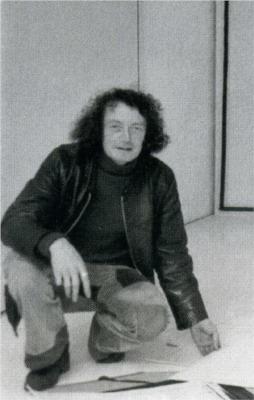
Biography
Over the following decade and a half he developed a practice rooted in near-total reduction. His characteristic works are paintings in which form is pared back to almost nothing: dark grounds, subtle tonal shifts, and fields of near-black that reward patient looking. In 1974[2] he produced a series of black paintings, using combinations of dark colours, shown at the Museum of Modern Art Oxford. Number 88, Black/Black/Blue/Violet (1974), now in the Stedelijk Museum Amsterdam, is among the most considered works of British[2] Minimalism from that period.
Law took up sculpture in the 1970s, extending his reductive approach into three dimensions, before returning to West Cornwall in 1997[2]. He died in April 2004[2], aged seventy. His contribution to British[2] abstract art remained relatively overlooked during his lifetime, though a comprehensive retrospective monograph published by Ridinghouse in 2009, with 300 images and critical essays, has since helped establish his position within post-war British art.
Timeline
- 1934Born in 1934.
- 1957Arrived in St Ives, Cornwall, making pots and painting.
- 1959Visited the Tate Gallery and encountered the work of Barnett Newman and Mark Rothko, shifting toward abstraction.
- 1960Departed from the Cornwall peninsula.
- 1974Produced a series of black paintings, using combinations of dark colours, which were exhibited at the Museum of Modern Art Oxford.
- 1974Completed "Number 88, Black/Black/Blue/Violet", now in the Stedelijk Museum Amsterdam.
- 1997Returned to West Cornwall.
- 2004Died in April, aged 70.
Notable Works
Tap to view larger.
Next stop
Abstract Expressionism →
Explore the artists and ideas of Abstract Expressionism.
Related Artists


Frequently Asked Questions
What is Bob Law known for?
Bob Law is known for paintings in which form is pared back to almost nothing; dark grounds, subtle tonal shifts, and fields of near-black that reward patient looking. In 1974[2], he produced a series of black paintings, using combinations of dark colours, shown at the Museum of Modern Art Oxford. Number 88, Black/Black/Blue/Violet (1974), now in the Stedelijk Museum Amsterdam, is among the most considered works of British[2] Minimalism from that period.Who was Bob Law?
Bob Law was an artist who, after encountering the work of Barnett Newman and Mark Rothko, moved away from the craft sensibility of the St Ives circle toward a severe, meditative abstraction. Meetings with Peter Lanyon and Ben Nicholson in Cornwall provided early formative contacts, though he departed the peninsula in 1960[2]. A comprehensive retrospective monograph published by Ridinghouse in 2009 has since helped establish his position within post-war British[2] art.What was Bob Law's art style?
Law's painting style derived mainly from Abstract Expressionism[2], but also featured elements of Cubism and Expressionism. In the decade and a half that followed, he developed a practice rooted in near-total reduction. His characteristic works are paintings in which form is pared back to almost nothing.How did Bob Law die?
Bob Law died in 2004[2] at the age of 70.
Sources
Editorial draws on the following primary and tertiary references for Bob Law.
- [1] wikidata Wikidata: Q4933123 Used for: identifiers.
- [2] wikipedia Wikipedia: Bob Law Used for: biography, birth dates, death dates, identifiers, movement attribution, nationality.
- [3] book guggenheim-australianvision00wald Used for: biography.
- [4] book guggenheim-emergingartists100wald Used for: biography.
- [5] book guggenheim-newhorizonsiname00denn Used for: biography.
Editorial overseen by Solis Prints. Sources verified 2026-10-16. Click a source for details, or hover over [N] in the page above to preview.
Editorial standardsMethodologyCorrectionsAI disclosureAbout the editorial team