



Boleslas Biegas
Expelled from the Jan Matejko Academy in Kraków for his sculpture The Book of Life, Bolesław Biegas moved to Paris and spent the next five decades making art that mixed Symbolist mythology with something darker and stranger. Born in 1877[1] in Koziczyn, Poland, and orphaned young, he had trained first in Warsaw under Antoni Panasiuk before the expulsion that set him on a more independent course.
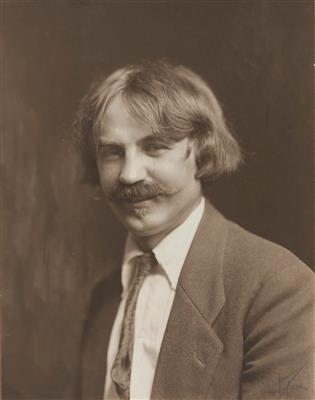
Biography
In Paris, Biegas worked in a Symbolist idiom that drew on myth and allegory. His paintings frequently feature monstrous, hybrid female figures that contemporaries read as metaphors for sexual conflict: a violent battle of the sexes rendered in visceral imagery. He exhibited in Salons and galleries across Paris, London, St. Petersburg, and Kiev from 1900[1] onwards, working from his studio at the Villa Troyon in the 6th arrondissement. Different critics in different decades classified him as Symbolist and proto-Surrealist, a range that suggests how difficult his work was to contain within the mainstream art-historical narrative.
What sets Biegas apart most clearly is his determination to build something lasting outside the market. In 1950[1], he established the Musée Boleslas Biegas within the Polish[1] Library in Paris, housing his own paintings and sculpture alongside works by Olga Boznańska and Tadeusz Makowski. The museum still exists. Biegas died in 1954[1], having spent more than half a century largely outside the critical categories that were making reputations elsewhere.
Timeline
- 1877Born in Koziczyn, Poland. He was orphaned at a young age.
- 1900Biegas began exhibiting in Salons and galleries across Paris, London, St Petersburg, and Kiev.
- 1950Established the Musée Boleslas Biegas within the Polish Library in Paris, housing his own paintings and sculpture.
- 1954Died in 1954, after spending over 50 years outside the critical categories that were making reputations elsewhere.
Notable Works
Tap to view larger.
Next stop
Symbolism →
Explore the artists and ideas of Symbolism.
Related Artists


Frequently Asked Questions
What is Boleslas Biegas known for?
Bolesław Biegas is known for his Symbolist art, which often featured monstrous, hybrid female figures. These figures were interpreted by his contemporaries as metaphors for sexual conflict, depicted through visceral imagery. He also established the Musée Boleslas Biegas in Paris in 1950[1] to display his work and that of others.What is Boleslas Biegas's most famous work?
Boleslas Biegas was a Polish[1] artist known for his Symbolist paintings, sculpture, and theatre design. He was born in 1877[1] in Rogozno, Poland, and died in Paris in 1941[1]. Biegas's artistic output included portraits and symbolic, often mystical, compositions. He developed a distinctive style within the Symbolist movement, characterised by dreamlike imagery. Biegas is most noted for his painting *Sphinx*, which exists in several versions. His artworks often feature astral or cosmic themes, reflecting an interest in spiritual and philosophical ideas. Biegas also created sculptures, often with similar Symbolist themes as his paintings. He designed sets and costumes for theatrical productions, further exploring his artistic visions through a different medium. Biegas lived and worked primarily in Paris, where he was part of the artistic community.What should I know about Boleslas Biegas's prints?
Biegas's prints are examples of fine art, and as such, adhere to certain conventions of production and marketing. Printmakers often create limited editions, although this is an artistic choice rather than a technical requirement. A limited edition is defined by a set number of prints, each of which is numbered, for example, 35/100, where 100 is the edition's total number of prints and 35 is the print's individual number. Some artists also create artist's proofs, which are marked AP after the number. These are often signed and numbered in pencil. Printmakers mark up each of their prints as follows; the edition number is written on the bottom left margin, the title in the centre, and the signature on the right. These conventions add value if followed.What style or movement did Boleslas Biegas belong to?
Boleslas Biegas is associated with the Symbolist movement, which appeared in France and Europe between the 1880s and the early 20th century. Symbolism[1] in the plastic arts is considered a reflection of the literary-intellectual movement of the time. Remy de Gourmont stated that Symbolism, in terms of literature, was anti-naturalism; in painting, sculpture and graphics, it was anti-realism and anti-impressionism. Symbolists were fascinated by ancient mythology. They attempted to move beyond rational thought, escape the visible world, and reach a world of pure thought, often exploring the unconscious. Symbolist artists include Gustave Moreau, Odilon Redon, Fernand Khnopff, Félicien Rops, Edward Burne-Jones, Dante Gabriel Rossetti, and Jan Toorop. Symbolism also touched other masters such as Auguste Rodin.What techniques or materials did Boleslas Biegas use?
Biegas developed a distinctive method for creating glass pictures. Eschewing traditional transparent glass window pictures composed of coloured pieces held together by lead, he innovated a new type of glass artwork. He used opaque glass, employing only a single pane for each picture. This allowed the work to be movable, like a small easel painting, suitable for hanging on a wall or mounting as a fixed architectural element, both indoors and outdoors. The primary technique Biegas used was sandblasting. The material was flashed glass, typically milk glass covered with a thin film of another colour, often black or red. The sandblasting process involved covering the glass with a prepared stencil paper or rubber, cutting out the design, and then blasting sand at high pressure to grind a relief into the exposed areas. He sometimes applied glass painters' colours, which were made permanent by burning them in a kiln. Biegas noted that this method offered limited colour and form possibilities, but provided unusual colour intensity and precision.What was Boleslas Biegas known for?
Boleslas Biegas was associated with Symbolism[1], an artistic and literary movement that valued subjectivity, symbol, and suggestion over direct representation. Symbolism is often considered to be anti-Realism and anti-Impressionism, and it is characterised by strangeness, mystery, and a sense of the other-worldly. Symbolism in the plastic arts was a reflection of literary and intellectual movements. The ideas of Symbolism ruled minds in the post-Impressionism epoch and entered the art of diverse artists. Symbolists created works that expressed the new decorative styles of the end of the 19th century, such as art nouveau and Jugendstil. Symbolism touched some great masters, but it did not become their main focus. The poet and critic Albert Aurier attempted to formulate the basic laws of the art of Symbolism. He identified five elements, three related to the attitude of Symbolism (moral intelligence, symbolicalness, and subjectivity) and two related to the manner of expression (synthetic quality and decorativeness). Aurier believed that a Symbolist should simplify the tracing of signs.When did Boleslas Biegas live and work?
Boleslas Biegas was born in Wyszki, Poland, on 1 March 1877[1]. He died in Paris on 30 September 1954[1]. Biegas was a Polish[1] symbolist painter, sculptor, and writer. He moved to Paris in 1901[1], where he lived for the rest of his life. While in Paris, he developed his artistic style, which often explored themes of spirituality, mythology, and the cosmos. Biegas's paintings often feature dreamlike imagery, with symbolic figures and celestial motifs. He was associated with the Symbolist movement, and his work contains elements of Art Nouveau. Biegas exhibited his work at various salons and galleries in Paris, gaining recognition for his unique artistic vision. In addition to painting, Biegas also produced sculptures, often working with materials such as bronze and plaster. He also wrote poetry and plays, further exploring the themes present in his visual art.Where can I see Boleslas Biegas's work?
While a comprehensive list of locations holding works by Boleslas Biegas is unavailable, several museums feature art deco collections that may include his pieces. In the United States, these include the Charles Hosmer Morse Museum of American Art (Winter Park, Florida), the Los Angeles County Museum of Art, the Metropolitan Museum of Art (New York), the Minneapolis Institute of Arts, the Museum of Modern Art (New York), the Virginia Museum of Fine Arts (Richmond), and the Wolfsonian at Florida International University (Miami Beach). In Canada, the Royal Ontario Museum (Toronto) may hold relevant works. In the United Kingdom, the Bakelite Museum (Williton), Brighton Museum & Art Gallery, the Geffrye Museum (London), Manchester Art Gallery, the National Museums of Scotland (Edinburgh), and the Victoria & Albert Museum (London) are possible locations. It is advisable to check the collections catalogues of these museums or contact them directly to confirm whether they hold any works by Biegas and if they are on display.Who influenced Boleslas Biegas?
Boleslas Biegas appears to have been influenced by multiple artists and movements. László Moholy-Nagy stated that he was impressed by Rembrandt's drawings, which seemed to radiate psychological depth. Moholy-Nagy found in Rembrandt a foreshadowing of a technique demonstrating this kind of knowledge. He also stated that Vincent van Gogh influenced him, particularly van Gogh's drawings. The analytical nature of his ink drawings and their peculiar texture taught Moholy-Nagy that line drawings ought not to be mixed with half tones and that one should try to express three-dimensional plastic quality by the unadulterated means of line. Biegas was also possibly influenced by Wassily Kandinsky. Kandinsky was deeply impressed with the artistry of three men from the West: Rembrandt, Wagner, and Monet. Experiences in his own country helped formulate his ideas of pictorial space.Who was Boleslas Biegas?
Boleslas Biegas (1877[1]-1954[1]) was a Polish[1] artist, known for symbolist and art nouveau-style paintings and sculptures. Biegas was born in Koziczyn, Poland. He spent much of his working life in Paris. His artistic output included portraits, religious scenes, and depictions of the cosmos. Biegas often explored themes of spirituality and the occult in his work. He developed a distinctive style, characterised by dreamlike imagery and mystical symbolism. Biegas also invented a unique type of rotating painting, which he termed "Sphéroïde." These paintings were designed to be viewed from multiple angles, creating an illusion of movement. Although he was associated with the symbolist movement, Biegas maintained an independent artistic vision throughout his career. He died in Paris in 1954[1], leaving behind a varied body of work that continues to attract interest.What was Boleslas Biegas's art style?
Bolesław Biegas worked in a Symbolist style that incorporated myth and allegory. His art was difficult to categorise, with some critics classing him as a proto-Surrealist.
Sources
Editorial draws on the following primary and tertiary references for Boleslas Biegas.
- [1] wikipedia Wikipedia: Boleslas Biegas Used for: biography, birth dates, death dates, identifiers, movement attribution, nationality.
- [2] book Brodskaya Nathalia, Brodskaya Nathalia - Symbolism Used for: biography.
- [3] book guggenheim-artoftomorrowfif1939gugg Used for: biography.
- [4] book guggenheim-claesold00olde Used for: biography.
- [5] book Masterpieces of western art : a history of art in 900 individual studies from the Gothic to the present day Used for: biography.
- [6] book The glory of Byzantium Used for: biography.
- [7] book Mirella, Levi D'Ancona,, The iconography of the Immaculate Conception in the Middle Ages and early Renaissance Used for: biography.
- [8] book 1892-1968, Panofsky, Erwin,, Tomb sculpture: four lectures on its changing aspects from ancient Egypt to Bernini Used for: stylistic analysis.
Editorial overseen by Solis Prints. Sources verified 2026-10-15. Click a source for details, or hover over [N] in the page above to preview.
Editorial standardsMethodologyCorrectionsAI disclosureAbout the editorial team