



Piet Mondrian
Mondrian threatened never to return to the Netherlands if the government enforced its ban on the Charleston. This was in 1926[7]. He was fifty-four, living alone in Paris, surviving largely on lentils and coffee, and spending his evenings at the Jungle Bar and Le Petit Teddy dancing with women friends. The man who painted the most disciplined compositions of the twentieth century loved jazz so much that it eventually became the subject of his final paintings.

Biography
His father Pieter Cornelius was a qualified drawing instructor. His uncle Frits, a pupil of Willem Maris from the Hague School, took the young Mondrian painting along the River Gein. He enrolled at Amsterdam's Academy for Fine Art in 1892[7] and spent the next two decades painting naturalistic landscapes, Impressionist riverbanks, and windmills. Then he saw Cubism at the Moderne Kunstkring exhibition in 1911, and moved to Paris the following year. He dropped an 'a' from his surname (Mondriaan became Mondrian) to signal the break.
The signature grid, the black lines and primary colours, emerged after 1918[7]. He called it Neoplasticism and grounded it in theosophy: he had joined the Dutch[7] Theosophical Society in 1909 and later said he got everything from Blavatsky's Secret Doctrine. The paintings look mathematical. The thinking behind them was mystical.
Despite advocating pure abstraction publicly, he painted flowers throughout the 1920s in private. Watercolour still lifes were his main source of income for years. The representational work was essentially taboo given his stated principles, but rent was due.
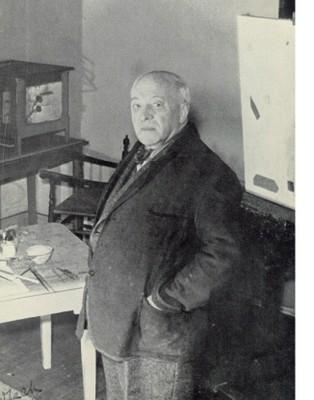
His studios were artworks in themselves. He painted coloured paper rectangles and pinned them to white walls, constantly rearranging them between painting sessions. In his final Manhattan studio, he built furniture from fruit crates and fashioned a cardboard cover for his radio-phonograph. The walls were white. There was a red-glossed metal stool. Visitors described it as a three-dimensional Mondrian.
Broadway Boogie Woogie (1942[7]-43) replaced the black grid lines with pulsing blocks of colour, the rhythm of Manhattan traffic and jazz clubs translated into geometry. Victory Boogie Woogie, begun the same year, was unfinished when he died of pneumonia in February 1944[7]. Nearly 200 artists attended his memorial in New York, among them Chagall and Duchamp.
Timeline
- 1872Born
- 1913Painted "Composition XIV"
- 1916Painted "Composition in line, second state"
- 1942Painted "Victory Boogie Woogie"
- 1942Painted "Broadway Boogie Woogie"
- 1944Died
Notable Works
Tap to view larger.
Where to See Piet Mondrian
26 museums worldwide.
-
 296 works
Kunstmuseum Den Haag
The Hague, Netherlands
Tue–Sun 10:00–17:00, closed Mondays · €22 adults
-

-
 24 works
Museum of Modern Art
New York City, United States
Daily 10:30–17:30 (Sat until 19:00; first Fri of month until 20:00) · Adults $30, students $17
-
 13 works
Kröller-Müller Museum
Otterlo, Netherlands
Tue–Sun 10:00–17:00, open Mondays only during summer period (July 6–Aug 24)
-

Next stop
Modernism →
Explore the artists and ideas of Modernism.
Piet Mondrian prints
Hand-finished archival prints from Piet Mondrian's body of work.
 Avond (Evening): The Red Tree - Piet Mondrian
From £28.00
Avond (Evening): The Red Tree - Piet Mondrian
From £28.00
 Composition with Red, Yellow, and Blue - Piet Mondrian
From £37.00
Composition with Red, Yellow, and Blue - Piet Mondrian
From £37.00
 Field with Young Trees in the Foreground - Piet Mondrian
From £30.00
Field with Young Trees in the Foreground - Piet Mondrian
From £30.00
 Trafalgar Square - Piet Mondrian
From £28.00
Trafalgar Square - Piet Mondrian
From £28.00
 Alberi (Trees) - Piet Mondrian
From £28.00
Alberi (Trees) - Piet Mondrian
From £28.00
 Going Fishing - Piet Mondrian
From £28.00
Going Fishing - Piet Mondrian
From £28.00
Related Artists




Take Piet Mondrian home.
See all Piet Mondrian prints →Frequently Asked Questions
Did piet mondrian use a ruler?
His rigorously abstract style looks extremely simple. In painting the straight line is certainly the most precise and appropriate means to express free rhythm.How did piet mondrian die?
Piet Mondrian died in 1944[7] at the age of 72.How did piet mondrian make his art?
Mondrian's rigorously abstract style looks extremely simple. He was one of the greatest and certainly most single-minded exponents of abstract art.Is piet mondrian abstract art?
Piet Mondrian was a pioneer of purely abstract art. He developed completely new methods in the field.Piet mondrian art style for kids?
Piet Mondrian's grid-like paintings are unrecognisable from the lifelike paintings of his early career. After training in a traditional, naturalistic style, he became inspired by the exciting new ideas of abstract art.What is piet mondrian best known for?
Piet Mondrian is known as a pioneer of purely abstract art. He developed completely new methods.When did piet mondrian start painting?
Piet Mondrian studied at the Rijksakademie van Beeldende Kunsten, Amsterdam, from 1892[7] to 1897. Until 1908, his work was naturalistic, incorporating successive influences of academic art.Who was piet mondrian inspired by?
Piet Mondrian was fascinated by theosophy, a religious philosophy that advocates a spiritual reality beyond the physical world. He shared utopian views on freeing paintings from the constraints of the material world with Kazimir Malevich.Piet mondrian art style name?
Piet Mondrian led a Dutch[7] group of Modernists called De Stijl, which means "The Style". This movement of artists and architects advocated a severe art of pure geometry.Was piet mondrian an abstract artist?
Piet Mondrian was a pioneer of purely abstract art. He developed completely new methods.What is piet mondrian most famous for?
Piet Mondrian is most famous for his simple black grid pattern interspersed with vivid sections of pure line and colour. His connection of primary colour is boldly displayed in his geometrical composition.
Sources
Editorial draws on the following primary and tertiary references for Piet Mondrian.
- [1] museum Toledo Museum of Art Used for: museum holdings.
- [2] museum Buffalo AKG Art Museum Used for: museum holdings.
- [3] museum Kaiser Wilhelm Museum Used for: museum holdings.
- [4] museum Allen Memorial Art Museum Used for: museum holdings.
- [5] museum San Francisco Museum of Modern Art Used for: museum holdings.
- [6] museum Van Abbemuseum Used for: museum holdings.
- [7] wikipedia Wikipedia: Piet Mondrian Used for: biography, birth dates, death dates, identifiers, movement attribution, nationality.
- [8] book Susie Hodge, Art Used for: biography, stylistic analysis.
- [9] book Susie Hodge, Artistic Circles Used for: biography.
- [10] book Dorling Kindersley, Artists: Inspiring Stories of the World's Most Creative Minds Used for: stylistic analysis.
- [11] book guggenheim-guhe00solo Used for: biography.
- [12] book guggenheim-handboo00pegg Used for: biography, stylistic analysis.
- [13] book guggenheim-moder00artg Used for: biography.
- [14] book guggenheim-museum00solo Used for: biography.
- [15] book Masterpieces of western art : a history of art in 900 individual studies from the Gothic to the present day Used for: biography.
- [16] book Post-impressionism : cross-currents in European painting Used for: biography.
- [17] book Post-impressionism : cross-currents in European painting Used for: biography.
- [18] book Anfam, David A;Callen, Anthea. Techniques of the impressionists, Techniques of the great masters of art Used for: biography.
- [19] book Carol Strickland and John Boswell, The Annotated Mona Lisa Used for: biography.
- [20] book Carol Strickland and John Boswell, The Annotated Mona Lisa Used for: biography.
Editorial overseen by Solis Prints. Sources verified 2026-08-29. Click a source for details, or hover over [N] in the page above to preview.
Editorial standardsMethodologyCorrectionsAI disclosureAbout the editorial team