



Botong Francisco
- portrait
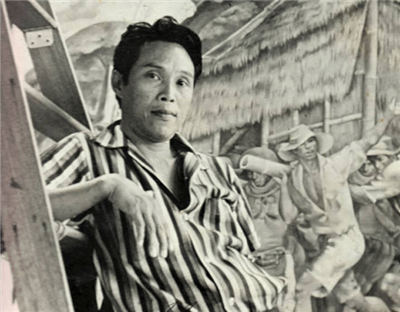
Carlos "Botong" Francisco gave enduring visual form to the scenes that the Philippines tells itself about its past: the Blood Compact between Rajah Sikatuna and Miguel López de Legazpi, the first mass at Limasawa, the martyrdom of José Rizal. Born on 4 November 1912[1] in Angono, Rizal, a town that has produced more Filipino[1] artists per capita than anywhere else in the country, he trained as a muralist and spent much of his career on large-scale public commissions.
Biography
His style broke deliberately with the romantic landscape painting that dominated Philippine art under Fernando Amorsolo's long influence. Where Amorsolo bathed scenes in soft golden light, Francisco worked in a more graphic register: restorers described his method as linear painting where lines and contours appear like cutouts, the forms clearly bounded and the composition built to hold attention across a wall rather than an easel-scale canvas.
The range of his historical subjects was considerable. "The Progress of Medicine in the Philippines," now held at the National Museum of Fine Arts, underwent three separate restorations and required a replica for the Philippine General Hospital, indicating both the physical demands placed on his murals and their institutional importance. In 1965[1], working far outside the studio, he discovered the Angono Petroglyphs, rock carvings estimated to be 3,000 years old and recognised as the oldest known artwork in the Philippines. He is credited with bringing them to public attention.
Francisco died on 31 March 1969[1], his final canvas, "Camote Diggers," unfinished. Four years later, the Philippine government designated him a National Artist, one of the first to receive the honour.
Timeline
- 1912Born Carlos 'Botong' Francisco on 4 November in Angono, Rizal.
- 1949Completed the mural "Blood Compact" in 1949 at the request of Mayor Mariano Yenko in Pasig.
- 1953Completed the mural "First Mass at Limasawa" for the Philippine International Fair.
- 1953Completed the mural "The Martyrdom of Rizal" for the Philippine International Fair.
- 1953Completed the mural "Magpupukot" for the Philippine International Fair.
- 1953Completed the mural "Bayanihan" for the Philippine International Fair.
- 1953Completed the mural "Planting of the First Cross" for the Philippine International Fair.
- 1965Discovered the Angono Petroglyphs, ancient rock carvings, and brought them to public attention.
- 1969Died on 31 March. His final work, "Camote Diggers," was unfinished.
Notable Works
Tap to view larger.
Next stop
Browse the movements →
Every movement in the collection, from the Renaissance to Pop art.
Related Artists



Frequently Asked Questions
What is Botong Francisco known for?
Botong Francisco is known for giving enduring visual form to scenes from the Philippines' past, such as the Blood Compact between Rajah Sikatuna and Miguel López de Legazpi, the first mass at Limasawa, and the martyrdom of José Rizal. He is also credited with bringing the Angono Petroglyphs to public attention in 1965[1].What is Botong Francisco's most famous work?
It is difficult to identify a single "most famous work" by Botong Francisco, as opinions on his most important pieces can vary. Some sources might point to his large murals, many of which depict scenes from Philippine history. These murals, often public works, reach a wide audience and are appreciated for their nationalist themes. He completed works for private residences as well as public buildings. However, without specific titles or further information, it is impossible to definitively name one particular piece as his most well-known. The relative accessibility and prominence of his various works likely influence perceptions of which is most famous. More research into specific pieces and their reception would be needed to provide a more concrete answer.What should I know about Botong Francisco's prints?
Botong Francisco did not produce many prints during his career; most of his work was on murals and paintings. However, some print workshops are worth knowing about if you are interested in fine art prints. Universal Limited Art Editions (ULAE) in Long Island, New York, became known from the late 1950s onward for publishing some of the finest work in the print field. Gemini GEL, founded in Los Angeles in 1966[1], gained a reputation for its technological skill, use of new materials and processes, and production of large-format images. Tyler Graphics Ltd, established in 1975, became known for handmade paper. Printmaking involves diverse supplies and equipment, such as woodblocks for relief printing, metal plates for etching, and limestone or metal plates for lithography. Screenprints use screens of silk or synthetic fibres. The processes use greasy liquids, crayons, blocking materials, acids, gums, and waxes. Different inks are used for different printing processes, along with driers and additives to adjust ink consistency. Various papers are used.What style or movement did Botong Francisco belong to?
Botong Francisco is best associated with the modern art movement in the Philippines, particularly his development of a distinct mural style. He is known for his historical works, often large-scale murals, that depict scenes from Philippine history and culture. While not strictly belonging to a specific Western art movement, Francisco's style incorporates elements of narrative, a concern with movement, and the use of compositional skills to create a sense of life within his pictures. Narrative movement requires strategies to give the impression of movement. His work does not fit neatly into categories such as Impressionism or Futurism, movements concerned with capturing movement, but his large murals certainly create a sense of dynamism. Francisco's emphasis on local subject matter and his distinctive visual language mark him as a key figure in the development of a modern Philippine artistic identity.What techniques or materials did Botong Francisco use?
Botong Francisco was a muralist, and his technique reflects this. Mural painting, especially fresco, demands a methodical approach. Fresco involves painting on fresh, wet lime plaster, a technique known since classical antiquity. The artist applies pigment mixed with water to the wet plaster (buon fresco). As the plaster dries, the pigment becomes bound within its crystalline structure. A second method, secco fresco, involves applying pigment to dry plaster using an organic medium like egg or glue. Buon fresco is more durable, as secco fresco paint tends to flake off. The fresco process starts with a coarse plaster layer (arriccio) applied to the wall. The design, or sinopia, is then drawn. Next, a smooth layer (intonaco) is applied, and the painting commences while the plaster is still wet. Only the area that can be painted in a single day (giornata) is prepared. Alterations are difficult, requiring the removal of plaster sections. Minor changes can be made using secco fresco. The fresco painter needs a skilled, quick hand due to the time constraints.When did Botong Francisco live and work?
Carlos Modesto "Botong" Villaluz Francisco (1912[1]-1969[1]) was a muralist from the Philippines. He is best known for his historical works. Francisco was born in Angono, Rizal. He later studied at the University of the Philippines School of Fine Arts. There, he was taught by Fernando Amorsolo. He was one of the first Philippine modernists, moving away from Amorsolo's romantic style. Francisco returned to Angono after his studies. He became a professor at the University of Santo Tomas. Francisco's art often depicted scenes from Philippine history and folklore. He used dynamic compositions and bold colours. His murals can be seen in public buildings and private collections. These include *Filipino[1] Struggles Through History* (1964[1]) at Manila City Hall. He was named a National Artist of the Philippines in 1973, after his death. His work continues to influence Filipino art.Where was Botong Francisco from?
Botong Francisco was born in 1911 in Binangonan, in the province of Rizal. He is known for his murals and historical scenes, often depicting Philippine history. Francisco studied at the University of the Philippines School of Fine Arts, and he became a professor there in 1930[1]. He was one of the first Filipino[1] modernists and had a strong interest in folk traditions. Francisco was part of a group of artists who moved away from European academic painting styles, developing a new visual language that reflected Filipino culture and identity. He worked as a set designer in the film industry, which influenced his compositional style. Francisco died in 1969[1], and he was named a National Artist of the Philippines in 1973.Who did Botong Francisco influence?
Botong Francisco, a muralist, influenced many artists through his work and teaching. He is considered a major figure in Philippine art history. Francisco taught at the University of Santo Tomas, where he helped shape the next generation. Among his students were several artists who went on to achieve prominence. These included Antonio Austria, Ibarra de la Rosa, and Angelito David. Francisco's style, characterised by dynamic compositions and historical themes, also had a broader impact. Many artists working after him adopted similar approaches in their own pieces. His influence can be seen in the increased interest in historical and cultural subjects among Filipino[1] artists. He promoted a sense of national identity through his art. Francisco's emphasis on large-scale public art also inspired later artists to explore mural painting as a medium for social commentary and cultural expression. He is remembered as a significant figure in the development of Philippine art.Who influenced Botong Francisco?
Botong Francisco, a National Artist of the Philippines, absorbed a range of influences that shaped his artistic style. He studied at the University of the Philippines School of Fine Arts, where he was taught by Fabian de la Rosa and Fernando Amorsolo. Amorsolo's influence is particularly noticeable in Francisco's early works, which share a similar romanticism and attention to detail. Francisco also drew inspiration from the art of Diego Rivera, the famous Mexican muralist. Rivera's large-scale, socially conscious murals encouraged Francisco to explore similar themes in his own work. In his murals, Francisco often depicted scenes from Philippine history and mythology; he aimed to create a distinctly Filipino[1] artistic identity. Beyond these figures, Francisco was influenced by the cultural traditions of his native Angono, Rizal. The town's rich folklore and its celebration of the arts provided a constant source of inspiration for his paintings and murals. He combined academic training with folk traditions.Who was Botong Francisco?
Carlos "Botong" Francisco was a Filipino[1] muralist born in Angono, Rizal. He is known for his large-scale public commissions and his role in bringing attention to the Angono Petroglyphs.Why are Botong Francisco's works important today?
Botong Francisco (1912[1]-1969[1]) was a muralist from the Philippines. He is important because of his large-scale depictions of Philippine history and culture. Francisco's works often portray historical events, rural life, and traditional customs. He aimed to promote a sense of national identity through his art. His style combined Western techniques with local subject matter, creating a distinct visual language. Francisco's murals can still be seen in public buildings and museums in the Philippines. They offer insights into the country's past and its cultural values. His art is a reminder of the Philippines' rich heritage, especially during a period of fast modernisation. Francisco's art remains relevant as a source of inspiration for contemporary Filipino[1] artists.What was Botong Francisco's art style?
Botong Francisco broke with the romantic style of painting that was popular in the Philippines under Fernando Amorsolo. His style is described as linear, with lines and contours appearing like cutouts, and compositions designed to hold attention across a wall.
Sources
Editorial draws on the following primary and tertiary references for Botong Francisco.
- [1] wikipedia Wikipedia: Botong Francisco Used for: biography, birth dates, death dates, identifiers, movement attribution, nationality.
- [2] book Judith Anne Testa, An Art Lover's Guide to Florence Used for: stylistic analysis.
- [3] book guggenheim-berriarei00bilb Used for: biography.
- [4] book guggenheim-guhe00solo Used for: biography.
- [5] book guggenheim-handboo00pegg Used for: biography.
- [6] book guggenheim-latinamericanpai00catl Used for: biography.
- [7] book Masterpieces of western art : a history of art in 900 individual studies from the Gothic to the present day Used for: biography.
- [8] book Gabriele Mandel, The complete paintings of Botticelli Used for: stylistic analysis.
- [9] book Gabriele Mandel, The complete paintings of Botticelli Used for: stylistic analysis.
Editorial overseen by Solis Prints. Sources verified 2026-09-30. Click a source for details, or hover over [N] in the page above to preview.
Editorial standardsMethodologyCorrectionsAI disclosureAbout the editorial team