

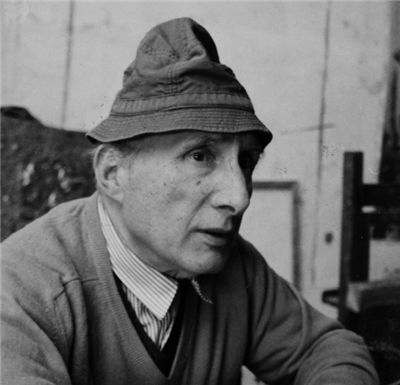
Bruno Canova
Bruno Canova was nineteen when he was arrested in La Spezia for attempting to organise a partisan resistance group, then sent to a labour camp in the Sudetenland. That experience never left him in any political sense: the violence of that period became the literal subject of his most sustained body of work.
Biography
Born in Bolognano, Abruzzi, in 1925[1], Canova studied graphic design after the liberation in the postwar Convitti della Rinascita schools in Rome and Milan, where his teachers included the designers Luigi Veronesi, Max Huber, and Albe Steiner. He debuted in 1949[1] in Prague, in an exhibition of Italian[1] graphic work, and for several years worked as the political cartoonist for the Communist daily 'L'Unità.' Through those years he moved through Rome's artistic circles, spending time with Mario Mafai, Alberto Ziveri, Renato Guttuso, Renzo Vespignani, and Pier Paolo Pasolini.
In 1965[1] he won the Premio Suzzara and participated in the Rome Quadrennial, where his work attracted a letter of appreciation from the critic Carlo Ludovico Ragghianti. From 1966 he devoted sustained attention to 'The Art of War,' an exhibition that toured public spaces across Italian[1] cities for decades. His series 'The Massacre of the Innocents' became the best known expression of this concern.
By the early 1980s his practice shifted towards colour painting, where the influence of the Roman School met his analytical approach and an interest in the Northern Renaissance. He continued working until his death in Lacco Ameno in 2012[1].
Timeline
- 1925Born in Bolognano, Abruzzi.
- 1944Arrested in La Spezia at 19 for attempting to organise a partisan resistance group; sent to a labour camp in the Sudetenland.
- 1949Debuted in Prague, in an exhibition of Italian graphic work.
- 1949Began working as the political cartoonist for the Communist daily 'L'Unità'.
- 1965Won the Premio Suzzara.
- 1965Participated in the Rome Quadrennial, where his work attracted a letter of appreciation from Carlo Ludovico Ragghianti.
- 1966Devoted sustained attention to 'The Art of War', an exhibition that toured public spaces across Italian cities for decades.
- 2012Died in Lacco Ameno.
Notable Works
Tap to view larger.
Next stop
Browse the movements →
Every movement in the collection, from the Renaissance to Pop art.
Related Artists


Frequently Asked Questions
What is Bruno Canova known for?
Bruno Canova is known for his sustained body of work addressing the violence of the period in which he was arrested and sent to a labour camp. His series 'The Massacre of the Innocents' became the best known expression of this concern, and his exhibition 'The Art of War' toured public spaces across Italian[1] cities for decades.Who was Bruno Canova?
Bruno Canova was born in Bolognano, Abruzzi, in 1925[1]. He studied graphic design after the liberation in the postwar Convitti della Rinascita schools in Rome and Milan, and he worked as a political cartoonist for the Communist daily 'L'Unità.' He continued working until his death in Lacco Ameno in 2012[1].What was Bruno Canova's art style?
By the early 1980s, Bruno Canova's practice shifted towards colour painting. The influence of the Roman School met his analytical approach and an interest in the Northern Renaissance.When was Bruno Canova born?
Bruno Canova was born in 1925[1].
Sources
Editorial draws on the following primary and tertiary references for Bruno Canova.
- [1] wikipedia Wikipedia: Bruno Canova Used for: biography, birth dates, death dates, identifiers, movement attribution, nationality.
- [2] book Alison West, From Pigalle to Préault Used for: biography.
- [3] book guggenheim-handboo00pegg Used for: biography.
- [4] book guggenheim-mariomerz00cela Used for: biography.
- [5] book guggenheim-masterp00solo Used for: biography.
- [6] book Palmer, Allison Lee, Historical Dictionary of Neoclassical Art and Architecture Used for: biography, stylistic analysis.
- [7] book Allison Lee Palmer, Historical Dictionary of Neoclassical Art and Architecture Used for: stylistic analysis.
- [8] book Victoria Charles, Le Rococo Used for: biography, stylistic analysis.
Editorial overseen by Solis Prints. Sources verified 2026-10-14. Click a source for details, or hover over [N] in the page above to preview.
Editorial standardsMethodologyCorrectionsAI disclosureAbout the editorial team