



Cameron Platter
Cameron Platter's work operates in the space where visual culture cannibalises itself. The Johannesburg-born artist studied at the Michaelis School of Fine Art in Cape Town and works across drawing, video, painting, and printmaking, combining imagery from popular culture, internet vernacular, advertising, and pulp narrative with a deadpan absurdism that a critic once described as 'the delinquent love child of Quentin Tarantino and Dr Seuss'. The images are simultaneously lurid and deflating.
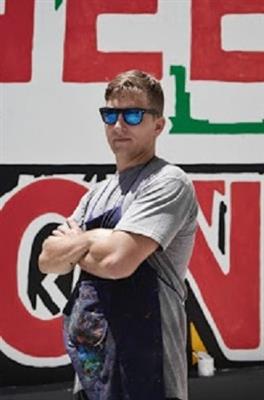
Biography
His work entered the collection of the Museum of Modern Art in New York after a 2011 exhibition, 'Impressions from South Africa, 1965 to Now', and he appeared in the 55th Venice Biennale in 2013 as part of the South African presentation 'Imaginary Fact: Contemporary South African Art and the Archive'. The Zeitz Collection, the Iziko South African National Gallery, the FRAC des Pays de la Loire in France, and the Margulies Collection in Miami also hold his work. A solo presentation at the San Francisco Museum of Modern Art followed in 2017.
Platter's practice reflects a generation of South African artists who came of age after apartheid, free to engage with global visual culture but also aware of the tensions it carries. His images do not resolve those tensions; they amplify them, sometimes to comic effect, sometimes to something more discomfiting.
Born in 1978[1], he remains based in South Africa.
Timeline
- 1978Born in Johannesburg, South Africa.
- 2011Platter's work was included in the Museum of Modern Art exhibition, 'Impressions from South Africa, 1965 to Now', in New York.
- 2013Participated in the 55th Venice Biennale as part of the South African presentation 'Imaginary Fact: Contemporary South African Art and the Archive'.
- 2017Had a solo presentation at the San Francisco Museum of Modern Art.
Notable Works
Tap to view larger.
Next stop
Browse the movements →
Every movement in the collection, from the Renaissance to Pop art.
Related Artists
Frequently Asked Questions
What is Cameron Platter known for?
Cameron Platter is known for work that operates in the space where visual culture cannibalises itself. He combines imagery from popular culture, internet vernacular, advertising, and pulp narrative with a deadpan absurdism.What should I know about Cameron Platter's prints?
Cameron Platter is a South African artist known for work that blends pop culture with social commentary. His prints often incorporate bold colours, humour, and references to contemporary life in South Africa. Platter's subject matter ranges widely, from consumerism and politics to nature and technology. His style combines hand-drawn elements with digital techniques, resulting in layered compositions. Recurring motifs include animals, food, and everyday objects, which he uses to explore themes of identity, inequality, and cultural hybridity. When acquiring a Platter print, consider the edition size, print quality, and paper type. Look for details such as the artist's signature and any accompanying documentation. His prints offer a view into South African society, using satire and visual puns to engage with complex issues.What style or movement did Cameron Platter belong to?
It is difficult to assign Cameron Platter to a single style or movement. Styles are retrospective labels, and contemporary artists often combine different elements. However, some context may be helpful. The eighteenth-century artist William Hogarth analysed how lines and movement create different effects. He noted that the eye follows lines, whether still or moving, and that certain shapes and motions are more pleasing than others. Hogarth thought that movements using serpentine lines were more graceful, especially if not overdone. He also observed how repetition and habit affect movement, and how the speed of a movement changes its impact. Platter's work might be analysed using Hogarth's ideas about line and movement, but it is not possible to place him within a historical movement based on these passages.What was Cameron Platter known for?
Cameron Platter is a South African artist working primarily in drawing, printmaking, painting, and sculpture. His work often combines disparate elements, such as consumerist imagery, popular culture, and traditional African motifs. Platter's style is characterised by bold lines, bright colours, and a dense, almost chaotic composition. His subject matter ranges from the mundane to the satirical, often exploring themes of globalisation, consumerism, and cultural identity. He frequently incorporates text and graphic elements into his pieces, creating a visual language that is both accessible and complex. Platter has exhibited his work extensively both in South Africa and internationally, and his pieces can be found in numerous public and private collections. He is known for his distinctive visual style and his commentary on contemporary society.When did Cameron Platter live and work?
Cameron Platter is a contemporary South African artist. He was born in 1978[1] in Johannesburg. Platter works in a variety of media. These include drawing, printmaking, painting, sculpture, and animation. His work often incorporates popular culture and commercial imagery. He frequently uses humour and satire to explore social and political themes. Platter's work has been exhibited widely. He has had solo shows in Cape Town, Johannesburg, and Durban. Internationally, his art has been seen in New York, London, Paris, and Berlin. Platter represented South Africa at the 55th Venice Biennale in 2013. He has received several awards and residencies. These include the ABSA L’Atelier Gerard Sekoto Award in 2005. He was also an artist-in-residence at the Nirox Foundation in 2012. Platter continues to live and work in South Africa.Where can I see Cameron Platter's work?
I am unable to provide a specific list of places where you can view Cameron Platter's work. My current knowledge base lacks the detailed exhibition history and gallery representation information needed to answer this question accurately. However, here is a list of museums that hold art.  In the United Kingdom, you can visit the Bakelite Museum, Brighton Museum & Art Gallery, the Geffrye Museum, Manchester Art Gallery, the National Museums of Scotland, and the Victoria & Albert Museum. In the United States, you can visit the Charles Hosmer Morse Museum of American Art, the Los Angeles County Museum of Art (LACMA), the Metropolitan Museum of Art, the Minneapolis Institute of Arts, the Museum of Modern Art, the Royal Ontario Museum, the Virginia Museum of Fine Arts, and the Wolfsonian at Florida International University.Who did Cameron Platter influence?
Cameron Platter's artistic influence is most visible among younger South African artists who engage with themes of consumerism, social inequality, and cultural identity. His work has opened avenues for artists to explore similar subject matter using a range of media, from printmaking to sculpture. Platter's impact can be seen in the increasing acceptance of satirical and critical perspectives within the South African art scene. His willingness to confront difficult topics has encouraged others to use their art as a form of social commentary. This is particularly evident in the work of artists who address issues of race, class, and gender in post-apartheid South Africa. Furthermore, Platter's experimentation with different styles and techniques has inspired artists to push the boundaries of traditional art forms. His influence extends to those who are interested in creating art that is both visually appealing and intellectually stimulating. He has helped to create a more diverse and dynamic art world in South Africa, where artists are free to express themselves without fear of censorship or reprisal.Who influenced Cameron Platter?
Cameron Platter's artistic influences are diverse. They range from contemporary art to popular culture. His work frequently incorporates elements of South African culture, where he lives and works. Platter has mentioned several artists whose work he admires. These include outsider artists and cartoonists. He also draws inspiration from the patterns and designs of everyday objects. Examples include textiles and packaging. This interest in the mundane is a recurring theme in his art. Platter's style is also informed by his interest in printmaking. He uses bold lines and flat areas of colour, similar to silkscreen prints. These techniques create a distinctive visual language. His work often combines humour and satire with social commentary. This approach reflects his engagement with current events and issues.Who was Cameron Platter?
Cameron Platter is an artist born in Johannesburg in 1978[1]. He studied at the Michaelis School of Fine Art in Cape Town and works across drawing, video, painting, and printmaking. He remains based in South Africa.Why are Cameron Platter's works important today?
Cameron Platter's art is important because it reflects contemporary South African culture and its global connections. Born in 1981, Platter creates prints, sculptures, and animations that blend consumerism, politics, and humour. His work often uses bright colours and cartoon-like imagery, but addresses serious themes, such as inequality, violence, and environmental issues. Platter's art is not simply critical; it also celebrates the energy and diversity of South Africa. Platter's work has been exhibited internationally, including at the Museum of Modern Art (New York) and the Victoria and Albert Museum (London). His inclusion in these collections demonstrates his position in contemporary art. Platter's art provides insight into South Africa's post-apartheid society, and speaks to global concerns about consumer culture and its impact.When was Cameron Platter born?
Cameron Platter was born in 1978[1].
Sources
Editorial draws on the following primary and tertiary references for Cameron Platter.
- [1] wikipedia Wikipedia: Cameron Platter Used for: biography, birth dates, death dates, identifiers, movement attribution, nationality.
- [2] book Arteditissue28may2021 Used for: biography.
- [3] book downmagaz.net, downmagaz.net Used for: biography.
- [4] book guggenheim-australianvision00wald Used for: biography.
Editorial overseen by Solis Prints. Sources verified 2026-10-07. Click a source for details, or hover over [N] in the page above to preview.
Editorial standardsMethodologyCorrectionsAI disclosureAbout the editorial team