Bo Kaap by David Botha
Rural Scene, 1954 by David Botha
Washing Day, 1944 by David Botha
Die Pienk Huis - DinksFãStan Private Collection by David Botha
Bo Kaap 2 by David Botha
Bo Kaap Street Scene   1945, Watercolour by David Botha
LABOURIE - Paarl by David Botha
Trees by David Botha

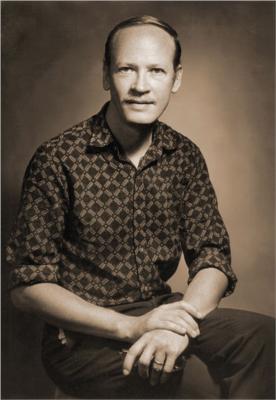
David Botha

1921–1995 · South African

Born in December 1921[1] in Graaff-Reinet in the Eastern Cape, David Botha spent nearly all his working life in Paarl, where the soft winter light and rain-slicked streets became his signature subject. He trained as an art teacher at the Cape Town Teachers Training College, graduating in 1941[1], and from 1946 taught at high schools in Paarl until his retirement in 1979. That teaching career ran in parallel with a prolific studio practice: his first solo exhibition opened in Cape Town in 1944, and by the end of his life he had mounted more than fifty.
Key facts

Lived
1921–1995, South African[1]
Wikipedia
View article

Biography

Botha sharpened his eye abroad. From 1950[1] to 1952 he studied at the Camberwell School of Art in London, using the opportunity to travel through France, Italy and Spain, encounters that deepened his understanding of European Impressionism without pulling him away from the Cape. He returned to South Africa with a clearer sense of what he wanted to paint: not the Mediterranean, but the Boland winter.

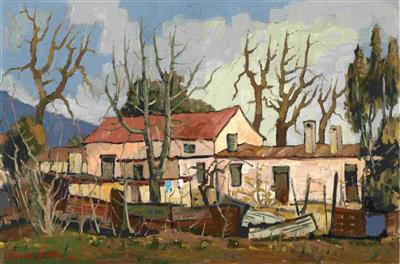
He is regarded as a second-generation Cape Impressionist, working in a lineage established by Pieter Wenning, Hugo Naudé and Strat Caldecott. His most collected paintings are the Paarl and Stellenbosch street scenes, white-washed Cape Dutch gables reflected in wet cobblestones, bare oaks silhouetted black against a flat grey sky. The palette is deliberately muted: pewter, ochre, the pale cream of wet lime plaster. There is none of the postcard prettiness that traps lesser painters of the same scenes.

Botha also worked as a graphic artist and exhibited in group shows across South Africa and abroad on more than a hundred occasions. He died in Paarl on 8 August 1995[1].

Timeline

  1. 1921Born in Graaff-Reinet, Eastern Cape, in December.
  2. 1941Graduated from the Cape Town Teachers Training College.
  3. 1944Held his first solo exhibition in Cape Town.
  4. 1946Began teaching at high schools in Paarl.
  5. 1950Began studying at the Camberwell School of Art in London.
  6. 1952Returned to South Africa after travelling through France, Italy, and Spain.
  7. 1979Retired from teaching.
  8. 1995Died in Paarl on 8 August.

Frequently Asked Questions

  • What is David Botha known for?
    David Botha is known for his paintings of Paarl and Stellenbosch street scenes. These paintings often depict white-washed Cape Dutch gables reflected in wet cobblestones, with bare oaks silhouetted against a grey sky.
  • What is David Botha's most famous work?
    Jacques-Louis David's most famous work is "Death of Marat". Completed in 1793, it depicts the radical revolutionary Jean-Paul Marat after his assassination. A close friend of Marat, David portrayed him as a modern-day Christ, referencing Michelangelo's "Pieta". David, a supporter of the French Revolution, aimed to "electrify" the public with his art. He also sought to "plant the seeds of glory and devotion to the fatherland". In "Death of Marat", David focused on specific details, such as the bloodstained towel and knife, transforming them into holy relics for the public. The painting is now held at the Musees Royaux des Beaux-Arts de Belgique, in Brussels. Other significant works by David include "Oath of the Horatii" (1784) and "Coronation of Napoleon and Josephine". David also began, but did not finish, a portrait of Napoleon Bonaparte in 1798. David claimed that Napoleon's impatience prevented him from completing it.
  • What should I know about David Botha's prints?
    When considering David Botha's prints, bear in mind that edition sizes affect value. Handmade, signed, unique prints with good provenance usually command higher prices. 'Vintage' prints, made shortly after the negative is created, also tend to be more valuable. A print is an image conceived and executed solely as a print, usually in a numbered edition, and signed by the artist. Each print in the edition is an original, printed individually from a plate, stone, screen, or block created for that purpose. The artist decides the number of prints in the edition, and sequential numbering accounts for the prints. Each print has a specific number; for example, 12/25 means it is print number 12 of an edition of 25. The edition claim is written as a pair of numbers on the left bottom margin of the print, the title in the middle, and the signature on the right. These are always signed in pencil. Photographs are robust if properly cared for, but they are subject to conditional issues like foxing, creasing, and UV degradation. Collecting art involves passion for the work, engagement, and understanding of various print types and their condition.
  • What style or movement did David Botha belong to?
    Without specific information about David Botha, I can offer insight into the artistic context of Gianlorenzo Bernini, a sculptor whose work displays a synthesis of influences and a departure from established norms. Bernini's sculpture David (1623-1624[1]) draws from Leonardo da Vinci's theories on motion, particularly his description of a man throwing. Bernini aimed to create a three-dimensional model of Leonardo's ideas, exceeding the example set by Annibale Carracci's Polyphemus. Bernini's David also relates to the antique sculpture of Myron's Discobolus, though its influence was mediated through Renaissance interpretations. The figure's extreme torsion, described by Alberti as "troppo fervente e furioso", reflects Bernini's emphasis on thematic decorum over artistic convention. The emotional intensity of David is further conveyed through his facial expression, informed by traditional physiognomy and Bernini's own mimetic techniques. This combination of intellectual, historical, and emotional elements marks Bernini's distinctive position in the history of art.
  • What techniques or materials did David Botha use?
    Information about David Botha's techniques is not present in the provided passages. However, the passages do discuss the techniques and materials used by other South African artists working during the same period, and in some cases, in the same workshops. Kay Hassan, for example, created large-scale collages from unused advertisement sheets acquired from printing companies. Patrick Mautloa, who collaborated with Hassan on installations, constructed abstract images from township refuse, incorporating scrap wood and metal, and adding minimal pigment and washes of colour. Mautloa learned welding with Peter Bradley at the Thupelo workshop and began using found materials after Bradley's example. Durant Sihlali created handmade paper pieces with pigment-imbedded pulp, reminiscent of rural home decoration. The Thupelo workshop is mentioned as a place where many artists identified as painters, typically using acrylics. The passages suggest a trend among South African artists of using readily available materials and techniques that reflect their environment and social context.
  • What was David Botha known for?
    David Botha is not mentioned in the provided passages. However, the passages do discuss the sculptor Job Kekana, who trained numerous woodcarving students at his school at St. Faith’s Mission after 1965[1]. Kekana’s school received support from Longmans (providing money and art supplies) and Imperial Tobacco (providing funds). By this time, Kekana had a growing list of clients, including Rhodesian enthusiasts. He often returned to making busts, particularly for the South African and Rhodesian governments. Kekana taught his students two artistic approaches: the simplified bas-relief style he learned at Grace Dieu, and realism with an understanding of the wood grain. Two of his best-known students were David Chituku and Barnabas Ndudzo. Chituku produced bas-relief panels and furniture for southern African churches after the 1950s, while Ndudzo became known as a skilled wood sculptor working in a realistic style.
  • When did David Botha live and work?
    David Nash was born in Esher, Surrey, in 1945[1]. Educated at Kingston College of Art, Kingston-upon-Thames (1963-1967[1]), Brighton College of Art (1964-1965), and Chelsea School of Art, London (1969-1970), he began lecturing at art colleges and universities in 1967. These included Newcastle Polytechnic, the Royal College of Art, Newport College of Art, and Dublin College of Art. Nash moved to Blaenau Ffestiniog, North Wales, in 1967, and in 1973 established a field centre there. This enabled visiting students to work with the space and elements of the land. In 1975, he was awarded a Major Bursary by the Welsh Arts Council. He was Resident Sculptor at Grizedale Forest in spring 1978 and attended the International Symposium of Sculpture, Macedonia, Yugoslavia, in 1978. In 1979, he undertook a Planting Project Commission at Southampton University. He continues to live and work in Blaenau Ffestiniog.
  • Where can I see David Botha's work?
    It is difficult to pinpoint exactly where you can view David Botha's work. However, many major museums feature art deco works and prints, so these would be a good place to start. Museums that feature art deco include the Charles Hosmer Morse Museum of American Art (Winter Park, Florida), the Los Angeles County Museum of Art (Los Angeles), the Metropolitan Museum of Art (New York), the Minneapolis Institute of Arts (Minneapolis), and the Museum of Modern Art (New York). Other museums include the Royal Ontario Museum (Toronto), the Virginia Museum of Fine Arts (Richmond), the Wolfsonian at Florida International University (Miami Beach), the Bakelite Museum (Williton, UK), the Brighton Museum & Art Gallery (Brighton, UK), the Geffrye Museum (London), the Manchester Art Gallery (Manchester, UK), the National Museums of Scotland, Royal Museum (Edinburgh), and the Victoria & Albert Museum (London).
  • Who did David Botha influence?
    Jacques-Louis David (1748-1825[1]) influenced several generations of painters. He is considered the unrivalled painter of the era. David's academic style of history painting instigated a shift in taste from the Rococo style toward a more classical sobriety; this was more in keeping with the mood of the period. After the French Revolution in 1789, David actively participated in political life. He used his art as propaganda for the new republic. Once Napoleon had restored order to France, David became devoted to him. The Emperor commissioned many works, including portraits and large paintings glorifying his life. David taught many great artists, including Gros, Gérard, and Ingres. His descriptive, polished, and noble style continued to influence many other painters until the middle of the 19th century.
  • Who influenced David Botha?
    Jacques-Louis David (1748-1825[1]) was a Neoclassical painter who had a significant impact on multiple generations of artists. David initially studied with François Boucher, a distant relative who was a leading painter. However, Boucher felt his Rococo style was unsuitable for David, so he directed him to Joseph-Marie Vien (1716-1809). Vien, who had a more modern approach, taught at the Académie Royale de Peinture et de Sculpture in Paris. David's early work was rooted in Rococo painting. He was raised by two uncles, who were an architect and a builder, and they encouraged his artistic talent. In 1766, he began studying under Vien. After several unsuccessful attempts, he won the Academy Prize in 1774, which allowed him to go to Rome. There, he copied antiquities and transitioned from Rococo to Neoclassicism. David's influence is evident in his historical works with classical themes, such as "Oath of the Horatii" (1784). He became a follower of Napoleon, who appointed him first painter to the Emperor in 1804. David's legacy extends beyond his own work, as he taught some of the most important painters of 19th-century France.
  • Who was David Botha?
    I am sorry, but the provided texts do not contain information about an artist named David Botha. However, the texts do mention two artists named David: David Nash and David Smith. David Nash is a British artist born in Esher, Surrey, in 1945[1]. He studied at Kingston College of Art and Chelsea School of Art. Nash is known for his sculpture, with solo exhibitions at the Queen Elizabeth Hall, Oriel Gallery, Arnolfini Gallery, and Rijksmuseum Kroller-Müller, among others. David Smith was an American artist born in Decatur, Indiana, in 1906 and died in South Shaftsbury, Vermont, in 1965. Originally a painter, Smith was inspired by Picasso and Julio Gonzalez to work with welded metal. He created large abstract forms using steel plates and rods. His work Australia (1951) is in the collection of the Museum of Modern Art, New York.
  • Why are David Botha's works important today?
    David Botha's art provides insight into South Africa's complex history, particularly the apartheid era and its aftermath. His work prompts reflection on themes of memory, complicity, and resistance, all of which remain relevant in contemporary society. The struggle against apartheid involved various forms of violence, and Botha's art may engage with the unassimilable aspects of this history, such as the treatment of women in liberation movements. Some South African artists explore the contrast between heroic narratives of male fighters and the experiences of women who faced sexual abuse and marginalisation. Botha's pieces may contribute to a wider discussion about the silences and erasures in official accounts of the past. Moreover, Botha's art could examine the continuities between apartheid and the post-apartheid era, including issues of inequality and social justice. By engaging with these themes, his work encourages critical examination of South Africa's political transformation and its ongoing challenges.

Sources

Editorial draws on the following primary and tertiary references for David Botha.

  1. [1] wikipedia Wikipedia: David Botha Used for: biography, birth dates, death dates, identifiers, movement attribution, nationality.
  2. [2] book Förster, Till.,Kasfir, Sidney Littlefield., African Art and Agency in the Workshop Used for: biography.
  3. [3] book John Peffer, Art and the End of Apartheid Used for: biography.
  4. [4] book guggenheim-hugob00gugg Used for: biography.

Editorial overseen by Solis Prints. Sources verified 2026-06-18. Click a source for details, or hover over [N] in the page above to preview.

Keep exploring