

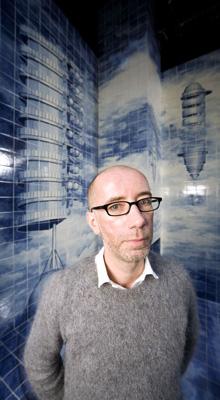
Carsten Holler
- relational art
Carsten Höller holds a doctorate in agricultural science from the University of Kiel, where he specialised in insect olfactory communication. He worked as a research entomologist until 1994, and the scientific habit of mind has never left his art: his installations are consistently framed as experiments, with visitors as subjects and altered perception as the variable being tested.
Biography
Born in Brussels in December 1961[1], he began making art in the late 1980s while still a scientist. His most visible recurring motif, the giant tubular slide, first appeared at the 1998 Berlin Biennale. The logic is straightforward and unsettling: a slide is a fairground object designed for children that, when scaled up and installed in a gallery or museum, produces in adult bodies a vertiginous, briefly uncontrolled descent. The 2006 commission *Test Site* installed five enormous slides in the Turbine Hall at Tate Modern, running from October 2006 to April 2007 as part of the Unilever Series, and became his defining public statement.
The fly agaric mushroom (*Amanita muscaria*) is another persistent reference: *Upside Down Mushroom Room* (2000), shown at Fondazione Prada and later at MOCA Los Angeles, installed large spinning replicas of the hallucinogenic fungus hanging inverted from the ceiling. His interest connects directly to his scientific background, and to anthropological research on psychoactive substances in ritual contexts.
In 2008, Fondazione Prada commissioned *Double Club* (Islington, London, November 2008 to July 2009), a functioning bar and nightclub that divided its space equally between 'Congo' and 'West' cultural zones, with separate music, food, furnishings, and décor on each side. Nothing in either zone was mixed or combined. The project made the terms of cultural encounter into a physical condition the visitor moved through and chose between. His survey exhibition at the Hayward Gallery, London, followed in 2015.
Timeline
- 1961Born in Brussels in December.
- 1994Stopped working as a research entomologist.
- 1998The giant tubular slide motif first appeared at the Berlin Biennale.
- 2000*Upside Down Mushroom Room* was shown at Fondazione Prada.
- 2006Commissioned to create *Test Site*, which installed five enormous slides in the Turbine Hall at Tate Modern, London.
- 2008Fondazione Prada commissioned *Double Club* in Islington, London; it ran from November 2008 to July 2009.
- 2015A survey exhibition was held at the Hayward Gallery, London.
Next stop
Browse the movements →
Every movement in the collection, from the Renaissance to Pop art.
Related Artists


Frequently Asked Questions
What is Carsten Holler known for?
Carsten Höller is known for his installations framed as experiments, with visitors as subjects. His most visible recurring motif is the giant tubular slide, and he is also known for his *Double Club* project and his use of the fly agaric mushroom (*Amanita muscaria*) as a persistent reference.What is Carsten Holler's most famous work?
Carsten Höller is best known for his large-scale interactive installations. These works often involve perceptual experiences, such as disorientation and sensory alteration. One of his most recognised projects is the series of giant slides he has installed in various museum and gallery settings. These slides are not merely decorative; they are functional artworks intended to be used by visitors. One example is his installation at the Turbine Hall of the Tate Modern in London (2006). Titled "Test Site", it featured several large metal slides that patrons could ride. Another notable work is "Upside Down Mushroom Room" (2000), which presents an environment filled with rotating, oversized, hallucinogenic mushrooms suspended from the ceiling. This installation plays with scale and perspective. It creates a disorienting and somewhat surreal experience for viewers. Höller's interest in perception and altered states of consciousness is a recurring theme throughout his work. He often explores the effects of chemicals and other stimuli on the human mind.What style or movement did Carsten Holler belong to?
Carsten Holler's work resists easy categorisation within a single artistic movement. Born in Brussels in 1961[1], Holler trained as an agricultural entomologist before turning to art in the 1990s. This scientific background informs his artistic practice, which often involves experiments and explorations of perception. His installations frequently incorporate elements of play and interaction, inviting viewers to become active participants. Slides, carousels, and altered states are recurring motifs. These participatory works align, to some extent, with relational aesthetics, a theory popularised in the 1990s by Nicolas Bourriaud. Relational aesthetics focuses on art that creates human encounters and social situations. However, Holler's interest in the science of subjective experience sets him apart. His art explores the boundaries between rationality and irrationality, often inducing disorientation or altered sensory input. Some critics have associated him with Neo-Conceptualism, given his emphasis on ideas and dematerialised art forms. Ultimately, Holler's unique blend of scientific inquiry and playful interaction makes him a difficult artist to classify neatly.What techniques or materials did Carsten Holler use?
Carsten Holler's art incorporates a wide array of materials and techniques, often with a focus on viewer interaction and perceptual experiences. He is known for his use of unusual or unexpected elements. Examples include disused fairground attractions, upside-down furniture, flashing lights, and pharmaceutical drugs. His practice explores the effects of these stimuli on human perception and behaviour. Holler frequently employs scientific methodologies in his artistic process. He conducts experiments, gathers data, and presents his findings through installations and interactive environments. These works often invite the audience to participate directly, blurring the lines between art, science, and play. His better-known works include giant slides installed in museums and galleries, which offer participants a physical and psychological experience. He also creates sensory deprivation tanks and other devices that alter perception. Through these diverse methods, Holler investigates the subjective nature of reality and the potential for art to challenge our understanding of the world.What was Carsten Holler known for?
Carsten Holler is associated with participatory art through the idea of 'relational aesthetics'. This concept, advanced by the French curator Nicolas Bourriaud, involves the audience in realising the artwork, rather than passively viewing a completed object. Bourriaud's ideas appeared in an essay accompanying the 1996 exhibition 'Traffic' at the CAPC musée d’art contemporain de Bordeaux; his essays were collected in a 1998 book, translated as *Relational Aesthetics* in 2002. Holler is among a group of artists whose careers became connected with Bourriaud's curatorial success during the 1990s, including Liam Gillick, Rirkrit Tiravanija, Philippe Parreno, Vanessa Beecroft, Pierre Huyghe, Maurizio Cattelan, and Dominique Gonzalez-Foerster. Relational aesthetics proposes that art should create free social relations, separate from the alienation of modern life. Bourriaud suggests that social life has become increasingly commodified, leading to a 'society of extras'. He sees 'an art of encounter' as a way to avoid this reification, whether through conviviality, mimicking professional services, or staging ephemeral appointments as artworks.Where can I see Carsten Holler's work?
It is difficult to provide a comprehensive list of locations for Carsten Holler's work, as displays can be temporary. However, many major museums and galleries have collections of modern and contemporary art, and may hold pieces by this artist. In the United States, you might check the collections of the Metropolitan Museum of Art or the Museum of Modern Art in New York, the Los Angeles County Museum of Art, the Minneapolis Institute of Arts, the Virginia Museum of Fine Arts, the Wolfsonian in Miami Beach, or the Charles Hosmer Morse Museum of American Art in Winter Park, Florida. In Canada, the Royal Ontario Museum in Toronto may be worth a visit. In the United Kingdom, possible locations include the Victoria & Albert Museum, the Geffrye Museum in London, the Manchester Art Gallery, the Brighton Museum & Art Gallery, the National Museums of Scotland in Edinburgh, Towneley Hall Art Gallery in Burnley, the Fitzwilliam Museum in Cambridge, the National Museum of Wales in Cardiff, the Scottish National Gallery of Modern Art in Edinburgh, the Burrell Collection in Glasgow, or the Leeds City Art Gallery.Where was Carsten Holler from?
Carsten Holler was born in Brussels, Belgium, in 1961[1]. He is of German[1] origin. Holler's artistic practice involves experiment and research, often using scientific processes. After gaining a doctorate in agricultural science, he began making art in the early 1990s. His work has been exhibited internationally in both solo and group exhibitions. He is known for large-scale installations that alter the viewer's perception of space, and for his use of light and technology. One famous example is the series of slides he has installed in various museums, allowing visitors to slide from a high point to a lower one. These works invite interaction and play, and encourage viewers to reconsider their relationship with the surrounding environment. Holler lives and works in Stockholm, Sweden.Who did Carsten Holler influence?
Carsten Holler's artistic influence is difficult to measure directly, as his work often exists outside traditional art forms. His installations, such as slides and amusement park rides, are designed to provoke subjective experiences in viewers. This focus on experiential art distinguishes him from artists who create objects for contemplation. Holler's background in phytopathology (the study of plant diseases) and his scientific approach to art set him apart. He explores themes of perception, illusion, and the effects of psychoactive substances. These interests connect him to a broader history of artists experimenting with altered states of consciousness, but Holler's methods are rooted in systematic research. While it is challenging to identify specific artists directly influenced by Holler, his work has contributed to the acceptance of interactive and participatory art. His large-scale installations have broadened the definition of what constitutes an artwork, opening doors for artists who prioritise audience engagement and sensory experience. Holler's impact is perhaps most evident in the increasing popularity of experiential art in contemporary museums and galleries.Who influenced Carsten Holler?
Carsten Holler's artistic approach has been shaped by a diverse range of influences, blending scientific inquiry with artistic expression. His background in agricultural entomology, the study of insect-plant interactions, informs his interest in systems, observation, and the manipulation of perception. Marcel Duchamp is an important predecessor. Holler's readymades and altered objects share a connection with Duchamp's ideas about art and the artist's role. Holler's interactive installations, often involving slides, swings, or other participatory elements, owe a debt to the work of Lygia Clark. Clark's exploration of sensory experiences and audience participation as a means of artistic creation is echoed in Holler's manipulation of viewers' physical and psychological states. Maurizio Cattelan's playful, often subversive approach to art also resonates with Holler's practice. Both artists employ humour and absurdity to question social norms and challenge conventional expectations of art.Who was Carsten Holler?
Carsten Holler is a contemporary artist known for his experiential installations that often explore perception, control, and human behaviour. Born in Brussels in 1961[1], Holler initially studied agricultural science, receiving a doctorate in phytopathology, before turning to art in the 1990s. This scientific background informs his artistic practice, which frequently incorporates elements of research and experimentation. His work includes large-scale slides, mirrored carousels, and sensory deprivation experiences. One celebrated piece, *The Unilever Series: Test Site*, was installed in Tate Modern's Turbine Hall in 2006. It featured a series of giant slides that visitors could ride, transforming the gallery into an amusement park. Another notable installation, *Upside Down Mushroom Room*, presents viewers with an inverted environment filled with giant, rotating mushrooms. Holler's art prompts questions about how we perceive our surroundings and the effects of disorientation and play. He lives and works in Stockholm, Sweden.Why are Carsten Holler's works important today?
Carsten Holler's art is important because it explores the viewer's experience, often through perceptual manipulation and playful interaction. Holler's work aligns with a late 20th- and early 21st-century trend of relaxing traditional boundaries between artistic media. Many contemporary artists create multimedia installations that are often site-specific. Holler's installations frequently involve elements of disorientation and altered states. He utilises simple, pragmatic, mechanical actions or interventions. Olafur Eliasson, for example, creates perceptual play by exposing the methods of fabrication, freeing us from romantic notions of nature as a superior force. He allows us to take as much pleasure in his man-made phenomena as we do in their "natural" counterparts. These artists mimic, manipulate, and deconstruct our experience. They allow us to assume other guises, live out fears and fantasies, and experience both victory, loss, pleasure, and pain, at a safe remove.When was Carsten Holler born?
Carsten Holler was born in 1961[1].
Sources
Editorial draws on the following primary and tertiary references for Carsten Holler.
- [1] wikipedia Wikipedia: Carsten Holler Used for: biography, birth dates, death dates, identifiers, movement attribution, nationality.
- [2] book Beard, Lee, 1973- author, Butler, Adam, author; Van Cleave, Claire, author; Fortenberry, Diane, author; Stirling, Susan, author, Beard, Lee, 1973- author, Butler, Adam, author; Van Cleave, Claire, author; Fortenberry, Diane, author; Stirling, Susan, author - The Art Book_ New Edition, Mini Format Used for: biography, stylistic analysis.
- [3] book guggenheim-hugo00newy Used for: biography, stylistic analysis.
- [4] book guggenheim-refigur00kren Used for: biography.
- [5] book Alison Stace;, Sculpture Parks and Trails of Britain & Ireland Used for: biography, stylistic analysis.
Editorial overseen by Solis Prints. Sources verified 2026-09-30. Click a source for details, or hover over [N] in the page above to preview.
Editorial standardsMethodologyCorrectionsAI disclosureAbout the editorial team