



Charles Sprague Pearce
- Orientalism
- Naturalism
- academic art
- Japonisme
Charles Sprague Pearce arrived in Paris in 1873[1] and went straight to Léon Bonnat's studio, the same training ground that shaped John Singer Sargent and many of the Americans who would dominate the Paris Salon in the following decades. He remained in France for the rest of his life, eventually settling at Auvers-sur-Oise, the village outside Paris associated with Daubigny and later with Van Gogh's final months.
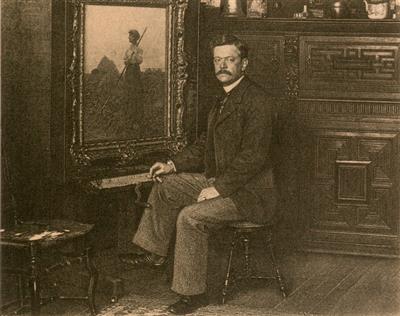
Biography
His early reputation came from Orientalist work. He travelled to Egypt and Algeria in the 1870s and 1880s, and paintings such as 'Prayer' (1884[1]) and 'The Decapitation of St John the Baptist' (1881) drew critical attention at the Salon. He collected medals in Paris and received decorations from France, Belgium, Prussia, and Denmark; the French Chevalier's cross came alongside the wider international recognition that placed him among the most decorated American[1] artists working abroad.
In the 1890s Pearce was commissioned to contribute decorative murals to the Thomas Jefferson Building at the Library of Congress in Washington: a prestigious public commission that placed him among the Americans called back across the Atlantic for the building's celebrated interior programme. He died in Auvers-sur-Oise in 1914[1], the village he had made his home for nearly three decades.
Timeline
- 1851Born in the United States.
- 1873Arrived in Paris and entered Léon Bonnat's studio for training.
- 1881Painted "The Decapitation of St John the Baptist".
- 1884Painted "Prayer".
- 1890Commissioned to create decorative murals for the Thomas Jefferson Building at the Library of Congress in Washington.
- 1914Died in Auvers-sur-Oise, France, where he had lived for nearly three decades; aged 63.
Notable Works
Tap to view larger.
Next stop
Browse the movements →
Every movement in the collection, from the Renaissance to Pop art.
Related Artists



Frequently Asked Questions
What is Charles Sprague Pearce known for?
Charles Sprague Pearce is known for his Orientalist works, such as 'Prayer' and 'The Decapitation of St John the Baptist', which gained critical attention at the Salon. Later in his career, he was commissioned to create decorative murals for the Thomas Jefferson Building at the Library of Congress in Washington.What is Charles Sprague Pearce's most famous work?
Charles Sprague Pearce is best known for his mural decorations in the Thomas Jefferson Building of the Library of Congress in Washington, D.C. Pearce was one of a group of American[1] artists who received commissions for the building's interior, which opened to the public in 1897[1]. Pearce created three large lunettes (semi-circular panels) for the north corridor of the second floor. These murals form a series titled "The Evolution of the Book". Each depicts a different stage in the creation, preservation, and dissemination of knowledge through written works. The titles are "Writing," "Illustration," and "Printing." "Writing" shows a seated man inscribing on a tablet, with figures representing tradition and imagination nearby. "Illustration" presents a group of artists decorating a manuscript. "Printing" depicts the operation of an early printing press. Pearce's murals are executed in a classical style, reflecting his academic training in Paris. They remain on display in the Library of Congress.What should I know about Charles Sprague Pearce's prints?
Charles Sprague Pearce's prints were sold through organisations like the Printsellers’ Association (PSA). These organisations maintained catalogues and tracked declared editions of prints. Records of Pearce's prints may be found in the Printsellers’ Association catalogues (1847-1911[1]). The British Museum Department of Prints and Drawings (BM) may also hold relevant pieces. Prints were issued in various states. Artist Proofs lacked an engraved title, bearing the Association stamp on the lower left margin. Lettered Proofs had a lightly engraved title, easily erased for the final print state, and the Association stamp was placed on the lower right. Presentation Proofs, limited to twenty-five, were identical to Artist Proofs, intended for the painter and engraver. Proofs before letters omitted the engraved title but included the artist's and engraver's names, along with the Association stamp on the lower right. Remarque Artist Proofs often featured a device in the margin.What style or movement did Charles Sprague Pearce belong to?
Charles Sprague Pearce is associated with Naturalism[1], an artistic movement that gained traction from the 1820s to the 1880s. Naturalism emerged in France before spreading internationally. The term was first used in 1868[1] by the French writer Émile Zola to define the literary and artistic trend. Naturalist artists, including members of groups such as the Norwich School, the French Barbizon School, the American[1] Hudson River School, and the Peredvizhniki in Russia, shared a rejection of idealisation. They worked in diverse ways, but they all focused on depicting subjects realistically. Naturalism has been used to describe realist art since the seventeenth century. The art of ancient civilizations has sometimes been misconstrued as unnatural, but this is not due to ignorance. The ability of artists to reproduce appearances often outstrips the general status of human knowledge in their society.What techniques or materials did Charles Sprague Pearce use?
Charles Sprague Pearce was an American[1] artist who spent much of his career in France. He is known for his paintings, murals, and illustrations. Pearce received academic training, and his painting technique reflects this. He usually worked in oil paint on canvas. His style is characterised by careful attention to detail and a smooth finish. Pearce often employed a muted colour palette, favouring browns, greys, and creams. However, he also used brighter colours in some of his works, particularly in his depictions of exotic subjects. Pearce's murals, such as those in the Thomas Jefferson Building of the Library of Congress, demonstrate his ability to work on a large scale. For his illustrations, he used a variety of media, including pen and ink, watercolour, and gouache. These works show his skill as a draughtsman and his ability to capture the character of his subjects. He also produced a number of etchings and lithographs. These prints demonstrate his interest in exploring different artistic media.What was Charles Sprague Pearce known for?
Charles Sprague Pearce (1849-1914[1]) was an American[1] painter who spent much of his career in France. He is known for his academic and often allegorical paintings, as well as his portraits and genre scenes. Pearce received his initial training in the United States before moving to Paris, where he studied with Léon Bonnat. He quickly assimilated into the French art world, exhibiting regularly at the Salon and winning several awards. His work often featured historical or literary themes, executed in a realistic style. Pearce received commissions to paint murals for the Library of Congress and other public buildings. These paintings cemented his reputation as a leading American artist of his generation.When did Charles Sprague Pearce live and work?
Charles Sprague Pearce was born on 13 October 1849 in Boston, Massachusetts. He died on 18 May 1914[1] in Auvers-sur-Oise, France. Pearce was an American[1] artist who spent much of his career working in France. He studied with Léon Bonnat in Paris during the late 1860s. He maintained a studio in Paris and painted genre scenes of French peasant life, portraits, and some historical subjects. His work gained recognition in both France and the United States. Pearce received several awards at the Paris Salon and other international exhibitions. He also undertook decorative commissions, including murals for the Library of Congress in Washington, D.C., during the 1890s. Although American by birth, Pearce became closely associated with the French art world and spent most of his working life in France.Where can I see Charles Sprague Pearce's work?
To view the work of Charles Sprague Pearce, visit several museums in the United States, Canada, and the United Kingdom. In the United States, you can find his pieces at the Metropolitan Museum of Art (New York), the Los Angeles County Museum of Art (California), the Minneapolis Institute of Arts (Minnesota), the Virginia Museum of Fine Arts (Richmond), the Wolfsonian at Florida International University (Miami Beach), and the Charles Hosmer Morse Museum of American[1] Art (Winter Park, Florida). In Canada, his work is displayed at the Royal Ontario Museum (Toronto). Within the United Kingdom, you might see Sprague Pearce's art at the Victoria & Albert Museum (London), the Brighton Museum & Art Gallery (Brighton), the Manchester Art Gallery (Manchester), and the National Museums of Scotland (Edinburgh).Where was Charles Sprague Pearce from?
Charles Sprague Pearce was an American[1] painter. He was born in Boston, Massachusetts, on 13 October 1849. Pearce's parents were wealthy. His father, Shadrach Hueston Pearce, was a businessman and co-owner of S.H. Pearce & Company. Pearce began his artistic training in Boston. He then moved to Paris, France, in 1873[1]. There, he studied with Léon Bonnat, a well-known academic painter. Pearce spent much of his career in France. He maintained a studio in Paris and also had a home in Auvers-sur-Oise. This village was popular with artists, including Vincent van Gogh. Although Pearce lived abroad, he maintained ties to the United States. He exhibited his work in American galleries and received commissions for public buildings. Pearce died in Auvers-sur-Oise on 18 May 1914[1]. He was 64 years old.Who did Charles Sprague Pearce influence?
It is difficult to identify specific artists who were directly influenced by Charles Sprague Pearce. However, some contextual information can be gleaned from the sources. Analysis of art from the period suggests some general trends. Following the Hudson River School painters such as Asher B. Durand, artists started to move away from a linear style. Some, such as George Inness, were influenced by Corot, adopting a more atmospheric approach to painting. Others like James Abbott McNeill Whistler, after studying in Paris, developed a flat, decorative style, drawing inspiration from Velazquez and Japanese prints. Whistler's approach involved a refined style of grey harmonies, and he often titled his paintings as symphonies or arrangements to emphasise their decorative aspects. During this period, artists like Frederic Edwin Church aimed to depict nature in its untouched state, reflecting a belief in the elemental powers of the New World.Who influenced Charles Sprague Pearce?
Charles Sprague Pearce (1849-1914[1]) was an American[1] artist who spent much of his career in France. He received early training at the Boston studio of Walter Gay, a painter of genre scenes and interiors. Pearce moved to Paris in 1872[1] and studied with Léon Bonnat, a successful portraitist and history painter. Bonnat's academic style and emphasis on realism had a definite impact on Pearce's early work. Bonnat's other students included Gustave Caillebotte, Jean Béraud, and Edvard Munch. Pearce's subject matter moved from genre to allegorical paintings and mural decoration. He received commissions to paint murals for the Library of Congress in Washington, D.C., and the Hôtel de Ville in Paris. His later work shows an interest in orientalism, reflecting the influence of travels in Egypt and Palestine. Pearce's style remained rooted in academic tradition, but he also incorporated elements of symbolism and exoticism into his art.Who was Charles Sprague Pearce?
Charles Sprague Pearce (1849-1914[1]) was an American[1] painter who spent much of his career in France. Born in Boston, Massachusetts, he studied with Léon Bonnat in Paris during the 1870s. Bonnat's academic realism had a strong influence on Pearce's style. Pearce painted portraits, genre scenes, and large-scale decorative works. He received commissions for murals in public buildings, including the Library of Congress in Washington, D.C. (1896[1]). These murals often depicted allegorical or historical subjects. Pearce gained recognition in France, becoming a member of the Société Nationale des Beaux-Arts. He exhibited regularly at the Paris Salon, earning medals in 1883 and 1889. His paintings often featured figures in carefully arranged compositions, with attention to detail and realistic representation. Although American, Pearce's artistic career was largely based in France, and his work reflects the academic training he received there. He died in Auvers-sur-Oise in 1914.
Sources
Editorial draws on the following primary and tertiary references for Charles Sprague Pearce.
- [1] wikipedia Wikipedia: Charles Sprague Pearce Used for: biography, birth dates, death dates, identifiers, movement attribution, nationality.
- [2] book Howard Simon, 500 Years of Illustration Used for: biography.
- [3] book Alfred Frankenstein, After the Hunt _ William Harnett and Other American Still Life Painters, 1870-1900 Used for: stylistic analysis.
- [4] book Beard, Lee, 1973- author, Butler, Adam, author; Van Cleave, Claire, author; Fortenberry, Diane, author; Stirling, Susan, author, Beard, Lee, 1973- author, Butler, Adam, author; Van Cleave, Claire, author; Fortenberry, Diane, author; Stirling, Susan, author - The Art Book_ New Edition, Mini Format Used for: biography.
- [5] book John Rewald;, Czanne and America Used for: biography.
- [6] book Masterpieces of western art : a history of art in 900 individual studies from the Gothic to the present day Used for: biography.
- [7] book Christensen, Erwin Ottomar, 1890-, The history of Western art Used for: stylistic analysis.
- [8] book Landauer, Susan, The not-so-still life : a century of California painting and sculpture Used for: biography.
Editorial overseen by Solis Prints. Sources verified 2026-09-22. Click a source for details, or hover over [N] in the page above to preview.
Editorial standardsMethodologyCorrectionsAI disclosureAbout the editorial team