



About Charles Sprague Pearce
American · 1851–1914
- Orientalism
- Naturalism
- academic art
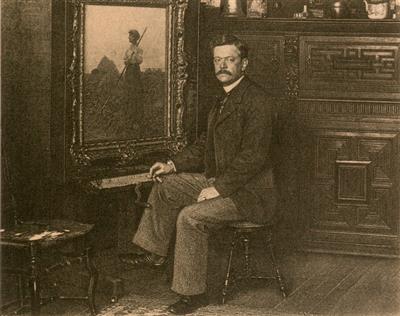
American[1] Orientalist painter and muralist trained under Léon Bonnat in Paris; contributed murals to the Library of Congress.
Museums6
Countries2
Largest reported holdingNational Gallery of Art, Washington D.C. · 90 recorded works
Loading map…
Where to see Charles Sprague Pearce
Collection holdings are reported here; current display varies. Check with each museum before visiting.
-
90 recorded works
National Gallery of Art
Washington D.C., United States
-
1 recorded work
Pennsylvania Academy of the Fine Arts
Philadelphia, United States


-
1 recorded work
Groninger Museum
Groningen, Netherlands
-
1 recorded work
Indianapolis Museum of Art
Indianapolis, United States
-
1 recorded work
Metropolitan Museum of Art
New York City, United States
-
1 recorded work
Smithsonian American Art Museum
Washington D.C., United States


Frequently Asked Questions
Where can I see Charles Sprague Pearce's work?
To view the work of Charles Sprague Pearce, visit several museums in the United States, Canada, and the United Kingdom. In the United States, you can find his pieces at the Metropolitan Museum of Art (New York), the Los Angeles County Museum of Art (California), the Minneapolis Institute of Arts (Minnesota), the Virginia Museum of Fine Arts (Richmond), the Wolfsonian at Florida International University (Miami Beach), and the Charles Hosmer Morse Museum of American[1] Art (Winter Park, Florida). In Canada, his work is displayed at the Royal Ontario Museum (Toronto). Within the United Kingdom, you might see Sprague Pearce's art at the Victoria & Albert Museum (London), the Brighton Museum & Art Gallery (Brighton), the Manchester Art Gallery (Manchester), and the National Museums of Scotland (Edinburgh).What should I know about Charles Sprague Pearce's prints?
Charles Sprague Pearce's prints were sold through organisations like the Printsellers’ Association (PSA). These organisations maintained catalogues and tracked declared editions of prints. Records of Pearce's prints may be found in the Printsellers’ Association catalogues (1847-1911[1]). The British Museum Department of Prints and Drawings (BM) may also hold relevant pieces. Prints were issued in various states. Artist Proofs lacked an engraved title, bearing the Association stamp on the lower left margin. Lettered Proofs had a lightly engraved title, easily erased for the final print state, and the Association stamp was placed on the lower right. Presentation Proofs, limited to twenty-five, were identical to Artist Proofs, intended for the painter and engraver. Proofs before letters omitted the engraved title but included the artist's and engraver's names, along with the Association stamp on the lower right. Remarque Artist Proofs often featured a device in the margin.Why are Charles Sprague Pearce's works important today?
Charles Sprague Pearce was an American[1] artist who spent much of his career in France. He achieved considerable success during his lifetime, and his works offer insights into the art world and cultural values of the late 19th century. Pearce's portraits, genre scenes, and history paintings reflect academic training and an interest in realism. He often depicted everyday life, particularly in rural settings, showing an appreciation for the common person. Works such as "The Shepherdess" (1889[1]) demonstrate his ability to capture light and texture, while also presenting an idealised view of pastoral existence. His murals for the Library of Congress in Washington, D.C., are perhaps his most visible works in the United States. These murals, which depict themes of labour, science, and art, show the influence of French academic painting on American public art. They also provide a glimpse into the aspirations and ideals of American society at the turn of the century. Although Pearce is not as well known today as some of his contemporaries, his paintings and murals remain valuable for their historical and artistic merit. They offer a window into the artistic tastes and cultural values of his time.What techniques or materials did Charles Sprague Pearce use?
Charles Sprague Pearce was an American[1] artist who spent much of his career in France. He is known for his paintings, murals, and illustrations. Pearce received academic training, and his painting technique reflects this. He usually worked in oil paint on canvas. His style is characterised by careful attention to detail and a smooth finish. Pearce often employed a muted colour palette, favouring browns, greys, and creams. However, he also used brighter colours in some of his works, particularly in his depictions of exotic subjects. Pearce's murals, such as those in the Thomas Jefferson Building of the Library of Congress, demonstrate his ability to work on a large scale. For his illustrations, he used a variety of media, including pen and ink, watercolour, and gouache. These works show his skill as a draughtsman and his ability to capture the character of his subjects. He also produced a number of etchings and lithographs. These prints demonstrate his interest in exploring different artistic media.Who did Charles Sprague Pearce influence?
It is difficult to identify specific artists who were directly influenced by Charles Sprague Pearce. However, some contextual information can be gleaned from the sources. Analysis of art from the period suggests some general trends. Following the Hudson River School painters such as Asher B. Durand, artists started to move away from a linear style. Some, such as George Inness, were influenced by Corot, adopting a more atmospheric approach to painting. Others like James Abbott McNeill Whistler, after studying in Paris, developed a flat, decorative style, drawing inspiration from Velazquez and Japanese prints. Whistler's approach involved a refined style of grey harmonies, and he often titled his paintings as symphonies or arrangements to emphasise their decorative aspects. During this period, artists like Frederic Edwin Church aimed to depict nature in its untouched state, reflecting a belief in the elemental powers of the New World.Who influenced Charles Sprague Pearce?
Charles Sprague Pearce (1849-1914[1]) was an American[1] artist who spent much of his career in France. He received early training at the Boston studio of Walter Gay, a painter of genre scenes and interiors. Pearce moved to Paris in 1872[1] and studied with Léon Bonnat, a successful portraitist and history painter. Bonnat's academic style and emphasis on realism had a definite impact on Pearce's early work. Bonnat's other students included Gustave Caillebotte, Jean Béraud, and Edvard Munch. Pearce's subject matter moved from genre to allegorical paintings and mural decoration. He received commissions to paint murals for the Library of Congress in Washington, D.C., and the Hôtel de Ville in Paris. His later work shows an interest in orientalism, reflecting the influence of travels in Egypt and Palestine. Pearce's style remained rooted in academic tradition, but he also incorporated elements of symbolism and exoticism into his art.What is Charles Sprague Pearce's most famous work?
Charles Sprague Pearce is best known for his mural decorations in the Thomas Jefferson Building of the Library of Congress in Washington, D.C. Pearce was one of a group of American[1] artists who received commissions for the building's interior, which opened to the public in 1897[1]. Pearce created three large lunettes (semi-circular panels) for the north corridor of the second floor. These murals form a series titled "The Evolution of the Book". Each depicts a different stage in the creation, preservation, and dissemination of knowledge through written works. The titles are "Writing," "Illustration," and "Printing." "Writing" shows a seated man inscribing on a tablet, with figures representing tradition and imagination nearby. "Illustration" presents a group of artists decorating a manuscript. "Printing" depicts the operation of an early printing press. Pearce's murals are executed in a classical style, reflecting his academic training in Paris. They remain on display in the Library of Congress.What style or movement did Charles Sprague Pearce belong to?
Charles Sprague Pearce is associated with Naturalism[1], an artistic movement that gained traction from the 1820s to the 1880s. Naturalism emerged in France before spreading internationally. The term was first used in 1868[1] by the French writer Émile Zola to define the literary and artistic trend. Naturalist artists, including members of groups such as the Norwich School, the French Barbizon School, the American[1] Hudson River School, and the Peredvizhniki in Russia, shared a rejection of idealisation. They worked in diverse ways, but they all focused on depicting subjects realistically. Naturalism has been used to describe realist art since the seventeenth century. The art of ancient civilizations has sometimes been misconstrued as unnatural, but this is not due to ignorance. The ability of artists to reproduce appearances often outstrips the general status of human knowledge in their society.
Sources
Where to See guide aggregates verified holdings of Charles Sprague Pearce's works across the following collections.
- [1] wikipedia Wikipedia: Charles Sprague Pearce Used for: biography.
- [2] book Howard Simon, 500 Years of Illustration Used for: biography.
- [3] book Alfred Frankenstein, After the Hunt _ William Harnett and Other American Still Life Painters, 1870-1900 Used for: stylistic analysis.
- [4] book Beard, Lee, 1973- author, Butler, Adam, author; Van Cleave, Claire, author; Fortenberry, Diane, author; Stirling, Susan, author, Beard, Lee, 1973- author, Butler, Adam, author; Van Cleave, Claire, author; Fortenberry, Diane, author; Stirling, Susan, author - The Art Book_ New Edition, Mini Format Used for: biography.
- [5] book John Rewald;, Czanne and America Used for: biography.
- [6] book Masterpieces of western art : a history of art in 900 individual studies from the Gothic to the present day Used for: biography.
- [7] book Christensen, Erwin Ottomar, 1890-, The history of Western art Used for: stylistic analysis.
- [8] book Landauer, Susan, The not-so-still life : a century of California painting and sculpture Used for: biography.
Editorial overseen by Solis Prints. Sources verified 2026-09-30. Click a source for details, or hover over [N] in the page above to preview.
Editorial standardsMethodologyCorrectionsAI disclosureAbout the editorial team