



Christina Robertson
- portrait
Christina Robertson built one of the most unlikely careers of any British[1] painter of her era: a Scottish woman who trained as a miniaturist, opened her own London studio at a time when few women did so, and ended up as a favourite portraitist of the Russian imperial family. Born in Kinghorn, Fife in 1796[1], she learned from her uncle George Sanders before establishing herself in London, where her practice eventually surpassed his.
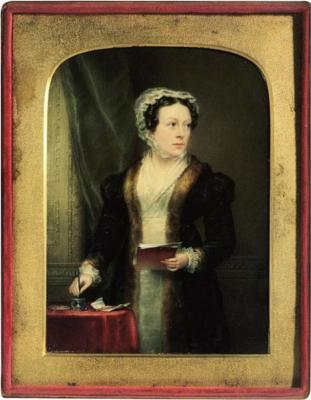
Biography
By 1828[1] she had her own studio, and in 1829 she became the first honorary woman member of the Royal Scottish Academy. Her portraits of wealthy British[1] sitters, painted in a polished academic manner, earned her a reputation substantial enough to attract the attention of the Russian court. She arrived in Saint Petersburg in 1839 and spent much of the following decade there, painting Tsar Nicholas I, Empress Alexandra Feodorovna, and their daughters. In 1841 she became the first, and only, woman to receive honorary membership of the Imperial Academy of Arts.
Her later work for the court included updated portraits of the Empress in 1852[1]. She died in Saint Petersburg in April 1854[1], having spent her final years in the city that had given her the most distinguished commissions of her career. Many of the portraits from her Russian period were believed destroyed during the Bolshevik revolution, which accounts in part for the relative obscurity into which her reputation has since fallen, despite a career that by any measure was exceptional.
Timeline
- 1796Born in Kinghorn, Fife. She was trained by her uncle, George Sanders.
- 1828Opened her own studio in London.
- 1829Became the first honorary woman member of the Royal Scottish Academy.
- 1839Arrived in Saint Petersburg and began painting portraits for the Russian court.
- 1841Became the first woman to receive honorary membership of the Imperial Academy of Arts.
- 1852Painted updated portraits of Empress Alexandra Feodorovna.
- 1854Died in Saint Petersburg in April.
Notable Works
Tap to view larger.
Next stop
Browse the movements →
Every movement in the collection, from the Renaissance to Pop art.
Related Artists


Frequently Asked Questions
What is Christina Robertson known for?
Christina Robertson is known for her portraits of wealthy British[1] sitters and the Russian imperial family. Her portraits of Tsar Nicholas I, Empress Alexandra Feodorovna, and their daughters gained her considerable recognition. In 1841[1], she became the first, and only, woman to receive honorary membership of the Imperial Academy of Arts.What is Christina Robertson's most famous work?
Christina Robertson was a prolific portrait[1] painter; pinpointing one single "most famous" work is difficult. However, her 1842[1] portrait of Nicholas I, Emperor of Russia, is certainly among her best-known pieces. Robertson gained considerable recognition for her portraits of the Russian Imperial family and aristocracy. She moved to St. Petersburg in 1839, quickly becoming a sought-after artist within the Russian court. Her ability to capture likenesses, combined with a flattering style, made her popular with her high-society clientele. The portrait of Nicholas I is a full-length depiction of the Emperor in military attire. It demonstrates Robertson's skill in rendering textures and details, from the gold braid on the uniform to the Emperor's facial features. The painting was widely reproduced, further cementing Robertson's reputation and the image of Nicholas I in the public imagination. Other notable works include her portraits of Empress Alexandra Feodorovna and other members of the Russian elite; these contributed significantly to her success and recognition.What style or movement did Christina Robertson belong to?
Christina Robertson (1796[1]-1854[1]) was a Scottish portrait[1] painter who primarily worked in the style of portraiture popular in the first half of the 19th century. This period saw a shift from the more theatrical and allegorical styles of earlier portraiture toward a focus on naturalism and the individual likeness of the sitter. Robertson's career developed during a time when Romanticism influenced art, with its emphasis on emotion, individualism, and the idealisation of the subject. However, her work is more closely aligned with Neoclassicism, which favoured order, clarity, and a certain degree of formality in portraiture. Robertson's portraits often feature elegant poses, attention to detail in costume and setting, and a refined approach to capturing the likeness and character of her subjects. She achieved considerable success as a portrait painter, particularly among the Russian aristocracy, and her style reflects the tastes and preferences of her clientele, who favoured sophisticated and flattering representations.What techniques or materials did Christina Robertson use?
Christina Robertson (1796[1]-1854[1]) was a Scottish artist, mainly known for her portrait[1] paintings. She worked primarily in oils, producing portraits that were admired for their attention to detail and colour. Robertson gained recognition for her ability to capture likenesses and textures, which she achieved through careful observation and skilled brushwork. Her technique involved building up layers of paint to create depth and dimension in her subjects' faces and costumes. She paid close attention to the play of light and shadow, using subtle gradations to model forms and create a sense of realism. In addition to her oil paintings, Robertson also worked with other media, including watercolour and pastel. These works display her versatility as an artist and her willingness to experiment with different techniques. Her success as a portrait painter can be attributed to her technical skill, combined with her ability to capture the character and personality of her sitters.What was Christina Robertson known for?
Christina Robertson was a portrait[1] artist. Portraiture aims to capture a person's likeness, psychological character, and essence. Hans Holbein the Younger was commissioned to paint Christina of Denmark, Duchess of Milan, in 1538. Henry VIII considered her as a prospective bride. Holbein was granted only three hours with the sixteen-year-old duchess to sketch her. The full-length format was considered desirable for portraits of potential brides. Henry VIII wanted informative portraits after the King of France refused to parade bridal candidates at Calais. Holbein presented her face and hands clearly against her black costume. He suppressed the sense of space around Christina. The placing of her shadow and the strong vertical shadow subtly implies movement, as though Christina sways forward. The marriage did not occur; Henry VIII retained the portrait, the only Holbein portrait certainly identifiable in his collection.When did Christina Robertson live and work?
Christina Robertson (née Saunders) was a Scottish portrait[1] painter. She was born in Kinghorn, Fife, in 1796[1] and died in St. Petersburg, Russia, in 1854[1]. Robertson is known for her work as a miniaturist and portraitist, and she gained international recognition during her career. Robertson spent a significant portion of her working life in Russia, where she became a celebrated artist. She was invited to the Russian Imperial Court in 1841[1], and she served as portrait painter to Tsar Nicholas I. She lived and worked in St. Petersburg for many years, creating portraits of the Russian aristocracy and other prominent figures. Robertson's paintings are in several collections, including the Scottish National Portrait Gallery.Where can I see Christina Robertson's work?
You can find Christina Robertson's work in several museums and galleries. These include institutions in both the United Kingdom and the United States. In the UK, you can view her pieces at the Brighton Museum & Art Gallery, located in Brighton, and the Manchester Art Gallery in Manchester. Additionally, the National Museums of Scotland, specifically the Royal Museum in Edinburgh, holds examples of her work. The Victoria & Albert Museum, situated in London, also has pieces available for viewing. In the United States, museums that house her art include the Charles Hosmer Morse Museum of American Art in Winter Park, Florida; the Los Angeles County Museum of Art (LACMA) in Los Angeles; and the Metropolitan Museum of Art in New York. Further locations are the Minneapolis Institute of Arts in Minneapolis; the Royal Ontario Museum in Toronto; the Virginia Museum of Fine Arts in Richmond; and the Wolfsonian at Florida International University in Miami Beach.Where was Christina Robertson from?
Christina Robertson was a Scottish artist, born in Kinghorn, Fife, in 1796[1]. Details of her early life are scarce, but by the early 1820s she was working as a professional portrait[1] painter. Robertson established herself in Edinburgh, where she exhibited regularly at the Royal Scottish Academy. She gained a solid reputation for her skill in capturing likenesses and for her sensitive portrayals of women and children. Her success in Scotland provided a foundation for her later international career. In 1829[1], Robertson moved to London. This relocation marked a significant step in her career, allowing her to access a larger and more diverse clientele. London offered greater opportunities for patronage and exposure, and she quickly became a sought-after portraitist among the city's elite. Robertson's career reached its zenith when she was invited to work in Russia. She served as a portrait painter to the Russian Imperial Court during the reigns of Nicholas I and Alexander II. This position further solidified her international reputation and provided her with financial security.Who did Christina Robertson influence?
Christina Robertson's direct influence is difficult to trace, but the broader artistic movements of her time, such as Neoclassicism and Romanticism, impacted many artists. Later, in California, a reliance on eastern models developed alongside an attempt at independence. This is similar to the relationship between the Hudson River School and European academies. California's geography had an enormous impact on its art. With perpetual sunshine and year-round outdoor painting conditions, the state became a mecca for plein air painters. Consequently, plein air Impressionism reigned supreme among still life artists well into the 1920s, long after the movement had faded elsewhere. Modernist still life manifestations tended to be idiosyncratic. Some artists developed hybrid forms of abstraction that melded Cubism, Orphism, Synchromism, and Futurism. Others created mystical, highly personal strains of still life, reflecting Southern California's propensity toward theosophy and other utopian cults.Who influenced Christina Robertson?
Christina Robertson (1796[1]-1854[1]) was a Scottish artist, primarily known for her portrait[1] paintings. While specific influences are not well documented, we can infer some artistic connections from her career. Robertson studied in Edinburgh at the Trustees' Academy, an institution that promoted a particular style of draughtsmanship. The Academy's emphasis on line and form likely shaped her early artistic development. Her later career as a portraitist suggests the influence of artists such as Sir Henry Raeburn (1756-1823[1]). Raeburn was the leading portrait painter in Edinburgh during Robertson's formative years. His work would have been highly visible to any aspiring portraitist in the city. Robertson adopted a similar focus on direct, realistic portrayals of her sitters. Robertson's time in London and, later, St Petersburg also exposed her to a wider range of artistic styles. While it is difficult to pinpoint exact influences, these experiences broadened her artistic horizons and contributed to the development of her mature style.Who was Christina Robertson?
Christina Robertson (1796[1]-1854[1]) was a Scottish portrait[1] painter who gained recognition for her work in Russia. Born Christina Saunders, she later adopted Robertson as her professional name. She married James Robertson, an eye surgeon, in 1822[1]. Robertson travelled to St Petersburg in the early 1840s, where she became a successful artist, painting portraits of the Russian Imperial family and members of the aristocracy. She was named an honorary member of the Imperial Academy of Arts in 1841. Her sitters included Tsar Nicholas I and Empress Alexandra Feodorovna. Robertson's portraits are known for their attention to detail, capturing the likenesses and social status of her subjects. She returned to the United Kingdom in 1847, continuing her work as a portrait painter until her death in 1854.Why are Christina Robertson's works important today?
Christina Robertson (1796[1]-1854[1]) was a Scottish portrait[1] painter who achieved considerable success during her lifetime, particularly in Russia. She became the first woman to be an honorary member of the Imperial Academy of Arts in St. Petersburg. Robertson's works offer insights into the lives and appearances of the European aristocracy and Russian Imperial family during the first half of the 19th century. Beyond their historical value, Robertson's paintings contribute to the ongoing reassessment of women's roles in the arts. Often, women artists were either excluded from the art historical narrative or their contributions were minimised. Robertson's career demonstrates that women could achieve professional success and recognition as artists, even within the patriarchal societies of 19th-century Europe. Her body of work adds to the growing understanding of women's artistic agency and professional accomplishments.
Sources
Editorial draws on the following primary and tertiary references for Christina Robertson.
- [1] wikipedia Wikipedia: Christina Robertson Used for: biography, birth dates, death dates, identifiers, movement attribution, nationality.
- [2] book Graham-Dixon, Andrew, Caravaggio : a life sacred and profane Used for: biography.
- [3] book Penny Olsen, Collecting Ladies: Ferdinand Von Mueller and Women Botanical Artists Used for: biography.
Editorial overseen by Solis Prints. Sources verified 2026-09-30. Click a source for details, or hover over [N] in the page above to preview.
Editorial standardsMethodologyCorrectionsAI disclosureAbout the editorial team