

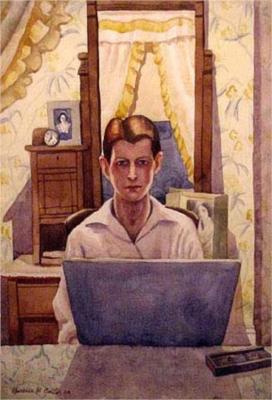
Clarence Holbrook Carter
Clarence Holbrook Carter lived long enough, 96 years, from 1904[1] to 2000[1], to watch American[1] art move through almost every major shift of the twentieth century, and his own work moved with it, sometimes ahead of it. Known to friends as "Cartie," he was born in Portsmouth, Ohio, and trained at the Cleveland School of Art under Henry Keller and Paul Travis before travelling to Capri to study with Hans Hofmann, a trip arranged personally by William Millikin, director of the Cleveland Museum of Art.
Biography
His early reputation rested on plainspoken Depression-era subjects: rural workers, industrial Ohio, the worn-down ordinary. In 1935[1] the Metropolitan Museum of Art bought his painting *The Creepers* for $225, making Carter the first Ohioan to enter that collection. That same year he won first prize in the Cleveland Museum's May Show. He went on to teach at Carnegie-Mellon University through the late 1930s and into the 1940s, and served as a WPA mural supervisor for northeast Ohio.
Where Carter diverges from his regionalist contemporaries is in the later decades of his career, when he turned hard toward surrealism: egg motifs, suspended figures, architectural forms that seem both ancient and unsettling. The shift struck some critics as jarring, but it produced work that now seems genuinely prescient. By then his canvases were held by MoMA, the Whitney, and more than two dozen other major institutions.
He also spent years as a commercial illustrator for *Vogue*, *Fortune*, *Time*, and *Newsweek*, treating illustration not as a concession but as another arena. He was elected to the National Academy of Design in 1949[1] and received the Cleveland Arts Prize for Visual Arts in 1972.
Timeline
- 1904Born in Portsmouth, Ohio. Known to friends as "Cartie."
- 1930Studied with Hans Hofmann in Capri, a trip arranged by William Millikin, director of the Cleveland Museum of Art.
- 1930Trained at the Cleveland School of Art under Henry Keller and Paul Travis.
- 1935His painting "The Creepers" was purchased by the Metropolitan Museum of Art for $225; Carter was the first Ohioan to enter that collection.
- 1935Won first prize in the Cleveland Museum's May Show.
- 1940Taught at Carnegie-Mellon University through the late 1930s and into the 1940s.
- 1940Served as a WPA mural supervisor for northeast Ohio.
- 1949Elected to the National Academy of Design.
- 1972Received the Cleveland Arts Prize for Visual Arts.
- 2000Died at 96.
Notable Works
Tap to view larger.
Next stop
Browse the movements →
Every movement in the collection, from the Renaissance to Pop art.
Related Artists




Frequently Asked Questions
What is Clarence Holbrook Carter known for?
Clarence Holbrook Carter is known for his Depression-era subjects and his later shift toward surrealism. His early work depicted rural workers and industrial Ohio, while his later work featured egg motifs and unsettling architectural forms.What is Clarence Holbrook Carter's most famous work?
It is difficult to name Clarence Holbrook Carter's single most famous work, as his career spanned many decades and styles. During the 1930s, he was known for Regionalist paintings, such as *January Thaw* (1939[1]). These works often depicted scenes of American[1] life and the Midwest. Later, he moved into Surrealism, producing pieces like *War Bride* (1940) and *The Spider Web* (1941). Carter also experimented with abstraction later in his career. His work is held in the collections of the Metropolitan Museum of Art, the Whitney Museum of American Art, and the Museum of Modern Art, among others. This reflects the breadth of his artistic output and the recognition he received across different phases of his career.What should I know about Clarence Holbrook Carter's prints?
Clarence Holbrook Carter (1904[1]-2000[1]) was an American[1] painter, printmaker, and educator. His artistic output includes a variety of printmaking techniques, such as lithographs, etchings, and serigraphs. Carter's prints often explore themes of surrealism, abstraction, and social commentary. He moved through different styles, from early regionalism to later abstraction. His prints from the 1930s and 1940s frequently depict American scenes and industrial subjects. Later works show a move toward more symbolic and abstract imagery. Carter studied at the Cleveland School of Art. He travelled extensively in Europe, which influenced his artistic style. He taught at several institutions, including the Carnegie Institute of Technology and the Philadelphia Museum School of Art. Carter received numerous awards and his work has been exhibited widely. His prints are held in many public and private collections.What style or movement did Clarence Holbrook Carter belong to?
Clarence Holbrook Carter's work does not fit neatly into one specific artistic movement. During the 1930s, he was involved with Federal Art Projects, which were relief programmes for unemployed artists. These projects encouraged the decoration of public buildings with murals, paintings, prints, and sculptures. Carter's early style involved flowing washes within crisp linear patterns. His subjects ranged from architecture, as seen in *My Egypt* (1925[1]), to the vaudeville stage. Some classify him as an American[1] Scene Painter, a movement that gained traction during the 1930s. These artists, including Thomas Hart Benton, Grant Wood, and John S. Curry, focused on native elements and regional subjects in the United States. However, Carter's style evolved over his career, incorporating surrealist and abstract elements later on.What techniques or materials did Clarence Holbrook Carter use?
Clarence Holbrook Carter (1904[1]-2000[1]) was an American[1] painter, printmaker, and draughtsman. He worked in several styles and media during his long career. In the 1930s and 1940s, Carter was known for his Regionalist paintings, often executed in egg tempera on panel. These paintings typically depicted rural scenes and architecture of the American Midwest. An example is *October in Ohio* (1935[1]), which shows a farm scene in meticulous detail. Later, Carter moved toward Surrealism and abstraction. He experimented with watercolour, collage, and mixed media. His "War Bride" series (1941) combined watercolour with pen and ink. The "Transformer" series (1950s) used abstract forms and symbolic imagery. In the 1960s and 1970s, Carter created hard-edge abstract paintings using acrylic paint on canvas. These works often featured geometric shapes and bold colours. Carter also produced prints, including lithographs and etchings. He explored different techniques, such as aquatint and soft-ground etching, to achieve varied textures and tonal effects.What was Clarence Holbrook Carter known for?
Clarence Holbrook Carter (1904[1]-2000[1]) was an American[1] painter, printmaker, and draughtsman. His style evolved considerably through his long career. He is known for his early American Scene paintings, his surrealist works of the 1930s and 1940s, and his later abstract expressionist pieces. Carter studied at the Cleveland School of Art, and travelled in Europe in the 1930s, on a Louis Comfort Tiffany Foundation grant. His early work often depicted rural and industrial scenes in Ohio. During the Depression era, he was employed by the Public Works of Art Project. This project was a US government programme designed to employ artists during the economic crisis. Carter later explored surrealism, incorporating dreamlike imagery and symbolism into his art. His style shifted again towards abstraction in the latter part of his career. Carter taught at several institutions, including the Carnegie Institute of Technology and Tulane University. His work has been exhibited widely and is held in numerous museum collections.When did Clarence Holbrook Carter live and work?
Clarence Holbrook Carter was born in Troy, Ohio, in 1904[1]. He died in 2000[1]. He is known for his surrealist works. Carter studied at the Cleveland School of Art, receiving a BS in Education in 1927[1]. He obtained an MA from the same school in 1929. He continued his studies in Italy and France between 1937 and 1938. Carter's early work from the 1930s included regionalist subjects, such as rural architecture and landscapes. During World War II, his art shifted toward the surreal. He explored themes of technology and modern anxiety. Carter's style evolved further in the 1950s, incorporating abstract elements and geometric forms. He travelled extensively throughout his life, drawing inspiration from different cultures and environments.Where can I see Clarence Holbrook Carter's work?
Clarence Holbrook Carter's work can be viewed in several locations. In the United States, these include the Los Angeles County Museum of Art (LACMA); the Metropolitan Museum of Art in New York; the Minneapolis Institute of Arts; the Museum of Modern Art, also in New York; the Virginia Museum of Fine Arts in Richmond; the Wolfsonian at Florida International University in Miami Beach; the Amon Carter Museum of Western Art, Fort Worth, Texas; and the Oakland Museum of California. In Canada, Carter's work is held at the Art Gallery of Ontario, Toronto, and the Royal Ontario Museum, also in Toronto. In the UK, you can view Carter's art at the Brighton Museum & Art Gallery; the Geffrye Museum, London; the Manchester Art Gallery; the National Museums of Scotland, Royal Museum, Edinburgh; and the Victoria & Albert Museum, London.Where was Clarence Holbrook Carter from?
Clarence Holbrook Carter was an American[1] artist, born in Troy, Ohio, in 1904[1]. He spent much of his life in Ohio, studying at the Cleveland School of Art from 1923[1] to 1927. Carter then travelled in Europe for a year, on a scholarship. Carter returned to the United States and taught at the Carnegie Institute of Technology in Pittsburgh, from 1930 to 1937. He then worked as an artist for the Federal Art Project (FAP), a division of the Works Progress Administration. During the Second World War, Carter served in the US Army, after which he lived in New Jersey. Carter's style changed considerably over the course of his career. His early works often depicted rural scenes in a realist style. Later, he became known for surrealist and abstract paintings, often incorporating geometric shapes and symbolic imagery. Carter continued to produce art until his death in 2000[1], at the age of 96.Who did Clarence Holbrook Carter influence?
Clarence Holbrook Carter's direct influence on other artists is difficult to trace, as his style shifted considerably throughout his long career. He moved through American[1] Regionalism, Surrealism, and abstraction. Therefore, any influence would likely be specific to a particular period of his work. Early in his career, Carter absorbed influences from Charles Burchfield and Edward Hopper. His Depression-era works share subject matter with the American Scene painters. These paintings often depict rural Ohio. Later, Carter explored dreamlike imagery. These works bear some resemblance to Surrealism, although Carter developed his personal symbolism. His abstract paintings from the 1950s and onward place him in dialogue with the broader Abstract Expressionist movement, although he maintained a distinct approach to colour and form. Carter taught at several institutions, including the Carnegie Institute of Technology and the Philadelphia Museum School of Art. His instruction would have impacted his students, but further research is needed to determine the nature and extent of his influence as an educator.Who influenced Clarence Holbrook Carter?
Clarence Holbrook Carter's artistic development involved several influences. Early in his career, he gained skills in draughtsmanship, colour theory, and composition from his instructors at the Cleveland School of Art, where he studied from 1923[1] to 1927. Carter's time in Europe on a Reinberger Travelling Scholarship (1927-1929[1]) exposed him to modernism. He studied at the Académie de la Grande Chaumière in Paris. His exposure to European art during this period affected his artistic style. Later, travels in the United States and Mexico further shaped Carter's artistic vision, leading to diverse subjects and approaches. His work moved through phases of realism, surrealism, and abstraction. Carter himself acknowledged the impact of travels and studies on his evolving artistic output. He synthesised various elements, creating a distinctive style that defies simple categorisation.Why are Clarence Holbrook Carter's works important today?
Clarence Holbrook Carter's works are important because they participate in larger discussions about the role of art in social progress, particularly regarding racial equality. During the Harlem Renaissance, figures such as W.E.B. Du Bois saw art as a form of propaganda, a means to advocate for the rights of Black people. Du Bois stated in 1926[1] that he did not care for any art that was not used for propaganda. The businessman Albert C. Barnes, who collected European avant-garde art and African art, aimed to use his collection to combat racial inequality. He established the Barnes Foundation in 1922 with plans to promote social progress through art. Barnes believed that appreciating the quality of art could challenge racial prejudices about cultural inferiority. Alain Locke, a philosopher and critic, engaged with Barnes's ideas, seeing the potential of the primitivist movement. Locke organised a special issue of *Opportunity: A Journal of Negro Life* to emphasise the importance of Barnes's collection for the "negro cause".
Sources
Editorial draws on the following primary and tertiary references for Clarence Holbrook Carter.
- [1] wikipedia Wikipedia: Clarence Holbrook Carter Used for: biography, birth dates, death dates, identifiers, movement attribution, nationality.
- [2] book Nicolas Lampert, A People’s Art History of the United States_ 250 Years of Activist Art and Artists Working in Social Justice Movements (New Press People's History) Used for: biography.
- [3] book Getty, Getty - Claiming the Stones Naming the Bones Used for: biography.
- [4] book Fred S. Kleiner, Helen Gardner, Kleiner & Mamiya, Gardner's Art through the Ages, Western Perspective, 16th edition, Vol. 2, Harcourt Brace Jovanovich, Used for: biography.
- [5] book Masterpieces of western art : a history of art in 900 individual studies from the Gothic to the present day Used for: biography.
- [6] book Landauer, Susan, The not-so-still life : a century of California painting and sculpture Used for: biography.
Editorial overseen by Solis Prints. Sources verified 2026-09-30. Click a source for details, or hover over [N] in the page above to preview.
Editorial standardsMethodologyCorrectionsAI disclosureAbout the editorial team