



Clementine Hunter
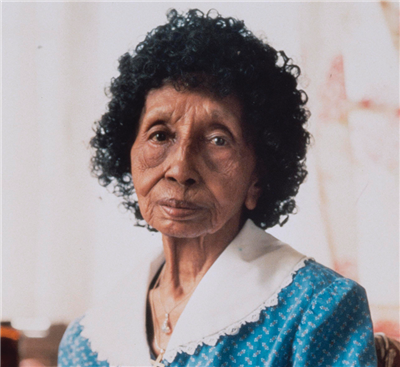
- portrait
Clementine Hunter picked up a discarded brush in the late 1930s and began painting the world she had always lived in. She was in her early fifties, had spent most of her life working the fields and kitchen of Melrose Plantation in Natchitoches Parish, Louisiana, and had never learned to read or write. She estimated she made between 5,000 and 10,000 paintings before she died in 1988[1], aged 101.
Biography
She started with leftover paint tubes abandoned by artists visiting Melrose, working on cardboard, bottles, window shades, and whatever flat surface came to hand. Her subjects were the rhythms of Black Southern rural life: cotton picking, baptisms, funerals, Saturday-night dances, church processions. The palette grew brighter over time; early earth-toned scenes gradually gave way to the vivid colour she became known for. Arthritis from the 1950s onward changed her line, loosening it toward something more impressionistic without losing the specificity of gesture and scene.
In 1955[1], the New Orleans Museum of Art gave her the first solo exhibition it had ever offered an African American[1] artist. That same year she completed the murals at the African House on the Melrose grounds, the most ambitious work of her career. The paintings are now held by the Smithsonian and the Minneapolis and Dallas museums of fine art.
Her commercial success eventually attracted forgers. A 2009 FBI investigation deployed fingerprint analysis and pigment testing to separate authentic works from counterfeits, resulting in prosecutions. Northwestern State University awarded her an honorary doctorate in 1986[1]. She died two days after her 101st birthday, having started painting at an age when most artists have stopped.
Timeline
- 1886Born in Natchitoches Parish, Louisiana.
- 1936Began painting in her early fifties, using discarded brushes and leftover paint at Melrose Plantation.
- 1955The New Orleans Museum of Art held the first solo exhibition for an African American artist, featuring her work.
- 1955Completed the murals at the African House on the Melrose grounds.
- 1986Awarded an honorary doctorate by Northwestern State University.
- 1988Died in Natchitoches Parish, Louisiana, two days after her 101st birthday.
Notable Works
Tap to view larger.
Next stop
Browse the movements →
Every movement in the collection, from the Renaissance to Pop art.
Related Artists




Frequently Asked Questions
What is Clementine Hunter known for?
Clementine Hunter is known for painting the rhythms of Black Southern rural life. Her subjects included cotton picking, baptisms, funerals, Saturday-night dances, and church processions. Her palette grew brighter over time, with early earth-toned scenes gradually giving way to the vivid colour she became known for.Who was Clementine Hunter?
Clementine Hunter began making art in her fifties, drawing from her memories of everyday life on the Melrose Plantation in Louisiana. She worked as a farm labourer from a young age, picking cotton and pecan nuts, and later in the main house. Hunter had many memories to draw from when she began making art.What was Clementine Hunter's art style?
Arthritis from the 1950s onward changed Clementine Hunter's line, loosening it toward something more impressionistic. However, this did not affect the specificity of gesture and scene within her works. Her early works used earth tones, but her palette grew brighter over time.How did Clementine Hunter die?
Clementine Hunter died in 1988[1] at the age of 102.
Sources
Editorial draws on the following primary and tertiary references for Clementine Hunter.
- [1] wikipedia Wikipedia: Clementine Hunter Used for: biography, birth dates, death dates, identifiers, movement attribution, nationality.
- [2] book Dorling Kindersley, Artists: Inspiring Stories of the World's Most Creative Minds Used for: biography, stylistic analysis.
Editorial overseen by Solis Prints. Sources verified 2026-10-07. Click a source for details, or hover over [N] in the page above to preview.
Editorial standardsMethodologyCorrectionsAI disclosureAbout the editorial team