



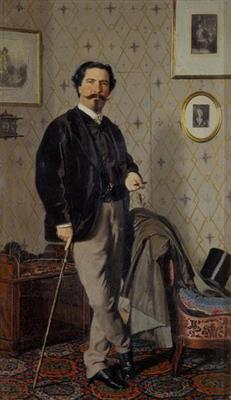
Biography
The Caffe was the nerve centre of the movement, and Banti's encounters there with artists including Giovanni Fattori, Silvestro Lega, and Telemaco Signorini changed the direction of his career entirely. His early masterpiece, Galileo Facing the Inquisition (1857[1]), had been painted in a Neo-Classical style he came to despise; he later petitioned to have it removed from display, saying it "dishonoured art without knowing it." The Macchiaioli used patches of colour and tone to capture natural light directly, working outdoors against the conventions of the academies.
Born in Santa Croce sull'Arno, Tuscany, in 1824[1], Banti had trained initially at the Accademia di belle arti di Siena before arriving in Florence. In 1861[1] he travelled to Paris to study with Constant Troyon and Camille Corot, then retreated to Castelfranco di Sopra for sustained landscape work. His later domestic interiors and terrace scenes, such as Woman Sewing on the Terrace (1882), show a particular sensitivity to Mediterranean light falling on quiet figures.
Constitutionally shy about exhibiting, Banti ruptured with Signorini in 1870[1] and withdrew further from public life. He spent much of his later years collecting art at his family's properties near Castelfiorentino and Montemurlo, assembling a substantial holding from the Macchiaioli circle. He accepted a professorship at the Accademia di Belle Arti in Florence and sat on the commission reorganising the Uffizi. On a trip to London in 1879, he met James McNeill Whistler. He died at Montemurlo in 1904[1]; his collection was auctioned a decade later.
Timeline
- 1824Born in Santa Croce sull'Arno, Tuscany.
- 1854Began frequenting the Caffe Michelangiolo in Florence, where he met Giovanni Fattori, Silvestro Lega, and Telemaco Signorini.
- 1857Painted "Galileo Facing the Inquisition" in a Neo-Classical style.
- 1861Travelled to Paris to study with Constant Troyon and Camille Corot.
- 1870Banti ruptured with Signorini and withdrew from public life.
- 1879Met James McNeill Whistler on a trip to London.
- 1882Painted domestic interiors and terrace scenes, such as "Woman Sewing on the Terrace".
- 1904Died at Montemurlo at 80.
Notable Works
Tap to view larger.
Next stop
Browse the movements →
Every movement in the collection, from the Renaissance to Pop art.
Related Artists


.jpg!Portrait.jpg)
Frequently Asked Questions
What is Cristiano Banti known for?
Cristiano Banti is known for his association with the Macchiaioli movement and his later domestic interiors and terrace scenes. He assembled a substantial art collection from the Macchiaioli circle and met James McNeill Whistler in London in 1879[1].Who was Cristiano Banti?
Cristiano Banti was a Tuscan painter who converted to the Macchiaioli style after encountering Giovanni Fattori, Silvestro Lega, and Telemaco Signorini at the Caffe Michelangiolo in Florence. Born in 1824[1], Banti initially trained at the Accademia di belle arti di Siena before becoming a professor at the Accademia di Belle Arti in Florence.What was Cristiano Banti's art style?
Cristiano Banti initially painted in a Neo-Classical style, but he later rejected it in favour of the Macchiaioli style, which used patches of colour and tone to capture natural light directly. He also produced landscape work and later domestic interiors, demonstrating a sensitivity to Mediterranean light.How did Cristiano Banti die?
Cristiano Banti died in 1904[1] at the age of 80.
Sources
Editorial draws on the following primary and tertiary references for Cristiano Banti.
- [1] wikipedia Wikipedia: Cristiano Banti Used for: biography, birth dates, death dates, identifiers, movement attribution, nationality.
- [2] book Masterpieces of western art : a history of art in 900 individual studies from the Gothic to the present day Used for: biography.
- [3] book Post-impressionism : cross-currents in European painting Used for: biography.
- [4] book Post-impressionism : cross-currents in European painting Used for: biography.
- [5] book Eisenbichler, Konrad;, The Boys of the Archangel Raphael Used for: biography, stylistic analysis.
- [6] book Eisenbichler, Konrad, The Boys of the Archangel Raphael _ A Youth Confraternity in Florence, 1411-1785 Used for: biography, stylistic analysis.
- [7] book Eisenbichler, Konrad, The Boys of the Archangel Raphael _ A Youth Confraternity in Florence, 1411-1785 Used for: biography, stylistic analysis.
Editorial overseen by Solis Prints. Sources verified 2026-09-22. Click a source for details, or hover over [N] in the page above to preview.
Editorial standardsMethodologyCorrectionsAI disclosureAbout the editorial team