



Dana Levin
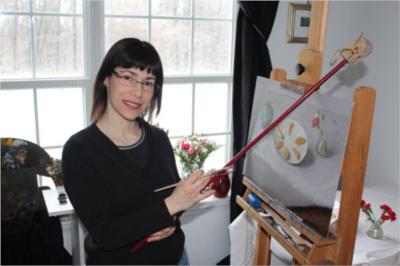
- portrait
Dana Levin began drawing seriously at fourteen, attending the Belvoir Terrace arts programme in Lenox, Massachusetts, before moving on to the New World School of the Arts in Miami. She graduated early from the Art Institute of Chicago with a BFA, then travelled to Florence to study under Daniel Graves at the Florence Academy of Art. The atelier method, with its emphasis on sight-size drawing and the direct inheritance of European studio practice, shaped everything that followed.
Biography
She joined the Florence Academy's teaching staff in 1999, running the academic drawing programme for sculpture students and teaching the same sight-size method she had absorbed as a pupil. In 2002 she returned to the United States and founded the New School of Classical Art in Pawtucket, Rhode Island, with the specific aim of making atelier-level instruction available outside the handful of established academies.
Her paintings concentrate on portraiture, figures, still lifes, and interiors, executed in oil on white cloth. The approach is rooted in close observation rather than photographic transcription: the influence of the Flemish and Italian masters is audible in the tonal build-up, even when the subject is contemporary. Works are in the permanent collections of the Everson Museum of Art in Syracuse and the New Britain Museum of American[3] Art in Connecticut.
Since 2008 she has worked from her own studio in Reading, Massachusetts, where she accepts portrait[3] commissions alongside independent exhibition work.
Timeline
- 1969Born in 1969.
- 1983Began drawing seriously at 14.
- 1983Attended the Belvoir Terrace arts programme in Lenox, Massachusetts, at 14.
- 1999Joined the Florence Academy of Art's teaching staff in Florence, running the academic drawing programme for sculpture students.
- 2002Returned to the United States and founded the New School of Classical Art in Pawtucket, Rhode Island.
- 2008Began working from her own studio in Reading, Massachusetts, accepting portrait commissions and working on independent exhibitions.
Notable Works
Tap to view larger.
Next stop
Browse the movements →
Every movement in the collection, from the Renaissance to Pop art.
Related Artists



Frequently Asked Questions
What is Dana Levin known for?
Dana Levin is known for her paintings, which include portraiture, figures, still lifes, and interiors. Her work is rooted in close observation, and she employs a tonal build-up technique influenced by Flemish and Italian masters.What is Dana Levin's most famous work?
It is difficult to identify Dana Levin's single most famous work, as the provided material does not contain information about this artist. The passages do, however, include alphabetical lists of paintings by Gustav Klimt and Jacques-Louis David. Klimt's body of work includes paintings such as *Adam and Eva* (unfinished), *Death and Life*, *Danae*, *Hope I*, *Hope II*, *Judith and Holofernes*, *Judith II (Salome)*, *Leda*, *Medicine*, and *Nuda Veritas*. He also produced many landscapes, for example *After the Rain (Garden with Chickens in St Agatha)* and *Avenue of Schloss Kammer Park*. David's paintings include *Andromache Mourning Hector*, *Belisarius Receiving Alms*, *Cupid and Psyche*, *Leonidas at Thermopylae*, *Napoleon Crossing the Alps* (five versions), *Napoleon I in His Imperial Robes*, and *Oath of the Horatii*. He also painted portraits, such as *Portrait of Antoine-Laurent and Marie-Anne Lavoisier* and *Portrait of Madame Raymond de Verninac*.What should I know about Dana Levin's prints?
When considering Dana Levin's prints, bear in mind a few key aspects of the fine art print market. An original print is conceived as a print, executed solely as a print, and is usually part of a numbered edition, signed by the artist. Each print in the edition is an original, created from a plate, stone, screen, or block made for that purpose. The artist decides the number of prints in the edition. Prints are often numbered to account for the total in the edition; for example, 12/25 means it is print number 12 of an edition of 25. Some artists also create artist's proofs, marked "AP", which are a small percentage of the total. The numbering of prints is a relatively recent convention. The value of a print is determined by several factors, including the quantity available, the artist’s reputation, the image's popularity, and the quality of materials. Plates for original prints are made by hand, which limits the number of impressions possible before the plate degrades. Most printmakers limit their editions, and these claims add value if truthful.What style or movement did Dana Levin belong to?
Dana Levin is a contemporary American[3] artist whose work defies easy categorisation within a single art movement. Her practice encompasses painting, drawing, and sculpture; it explores themes of memory, identity, and the human condition. While Levin's art shares some affinities with figurative and abstract expressionism, she does not align herself strictly with either. Her approach is more personal and intuitive, drawing on a range of influences and experiences. Some critics have noted a connection to surrealism in her dreamlike imagery and juxtaposition of unexpected elements. Others observe a dialogue with feminist art through her exploration of the female body and subjective experience. Ultimately, Levin's artistic style is unique. It reflects her individual vision and ongoing exploration of form, colour, and meaning. She resists simple classification, preferring to create work that is open to interpretation and engages with viewers on a personal level.What techniques or materials did Dana Levin use?
Dana Levin's practice involves a range of materials and techniques. Oil paint is a consistent element, often mixed with a medium of wax and turpentine. The wax medium is kept warm to maintain a liquid state, and then mixed with the oil paint immediately before application. The application process involves brushes, painting spatulas, and knives to achieve a satisfactory surface. Levin aims for consistency in the surfaces of her paintings, although variations can occur due to factors such as the heating of the wax medium, which can affect the paint's consistency. Solvents, such as odourless mineral spirits, are employed, mainly for cleaning brushes. The artist may sometimes use mediums to dilute oil colours, increasing their flow and decreasing drying time, especially for underpainting layers. A final varnish coat can protect the painting's surface.When did Dana Levin live and work?
Dana Levin is an American[3] poet, essayist, and teacher, active in the late 20th and early 21st centuries. She was born in 1965 in California. Levin received a BA from the University of Southern California. She then gained an MFA from the Iowa Writers' Workshop in 1995. She has taught at various institutions, including the College of Santa Fe, Warren Wilson College, and Maryville University in St Louis. Levin's work often explores themes of identity, trauma, and spirituality. Her collections include *In the Surgical Theatre* (2000), *Wedding Day* (2005), and *Sky Burial* (2011). *Banana Palace* appeared in 2016, and *Now Do You Know Where You Are* in 2022. Her poems have appeared in journals such as *The Paris Review*, *Ploughshares*, and *The American Poetry Review*. She has received awards and recognition for her writing, including a Guggenheim Fellowship and a Rona Jaffe Writers' Award. Levin served as a judge for the National Book Awards in 2023. She lives and works in St Louis, Missouri.Where can I see Dana Levin's work?
Dana Levin (born 1965) is an American[3] poet, not a visual artist. Levin is the author of four books of poetry: *In the Surgical Theatre*, *Wedding Day*, *Sky Burial*, and *Banana Palace*. Her poems have appeared in many journals and anthologies, including *The Best American Poetry 2015*, *The New England Review*, *The American Poetry Review*, and *Ploughshares*. Levin has received awards and fellowships from the Rona Jaffe Foundation, the Bread Loaf Writers' Conference, the National Endowment for the Arts, and the Guggenheim Foundation. She is currently a faculty member at Warren Wilson College's MFA Program for Writers. She also teaches for the Colrain Manuscript Conference. Those interested in her work should seek out her published collections or literary journals that feature poetry. Information about her readings and appearances can often be found on literary websites and social media.Where was Dana Levin from?
Information about Dana Levin's place of origin is not available in the provided reference passages. However, the passages do offer details on the backgrounds and origins of other artists: Nan Goldin was born in Washington, D.C., in 1953. She later moved to Boston, where she studied art, and then relocated to New York in the late 1970s. Barry Le Va was born in Long Beach, California, in 1941 and later resided in New York. Phoebe Adams was born in Greenwich, Connecticut, in 1953 and later lived and worked in Philadelphia. Ana Mendieta was born in Havana, Cuba, in 1948, and came to the United States as a refugee. Marcel Duchamp was born in Blainville-Crevon, France, in 1887. Claude Cahun summered on the Isle of Jersey as a child and eventually moved there in 1937.Who influenced Dana Levin?
It is difficult to summarise Dana Levin's influences, as the artist's biography and exhibition catalogues are not widely available. However, some information can be gleaned from related sources. Patricia Norvell's book on conceptual art mentions an artist named Dana Levin who studied sculpture at Bennington College with Lyman Kipp, Tony Smith, Anthony Caro, and David Smith. This Dana Levin's master's thesis became a collection of oral histories documenting artists’ ideas and approaches to art. Robert Morris, Levin's graduate advisor, helped compile a list of possible artists to interview, including Carl Andre, Robert Smithson, and Richard Serra. Penelope Rosemont's book *Surrealist Women* mentions Lucy Lippard, Frida Kahlo, and Marcel Duchamp as influences on female surrealist artists.When was Dana Levin born?
Dana Levin was born in 1969[3].
Sources
Editorial draws on the following primary and tertiary references for Dana Levin.
- [1] museum Harvard Art Museums Used for: museum holdings.
- [2] museum Victoria and Albert Museum Used for: museum holdings.
- [3] wikipedia Wikipedia: Dana Levin Used for: biography, birth dates, death dates, identifiers, movement attribution, nationality.
- [4] book Artmarketissue66january2022 Used for: biography.
- [5] book Edith Young, Color Scheme Used for: biography.
- [6] book downmagaz.net, downmagaz.net Used for: biography.
Editorial overseen by Solis Prints. Sources verified 2026-09-30. Click a source for details, or hover over [N] in the page above to preview.
Editorial standardsMethodologyCorrectionsAI disclosureAbout the editorial team