



Edmund Blair Leighton
- Pre-Raphaelite Brotherhood
Edmund Blair Leighton spent four decades painting a Middle Ages that never quite existed, and the Victorian and Edwardian public loved him for it. Born in London in 1852[1], the son of painter Charles Blair Leighton, he studied at University College School and the Royal Academy Schools before beginning a remarkably consistent exhibition career at the Royal Academy from 1878[1] onward. He rarely missed a year, yet he was never elected to full RA membership, a slight that seemed not to trouble his commercial fortunes in the least.
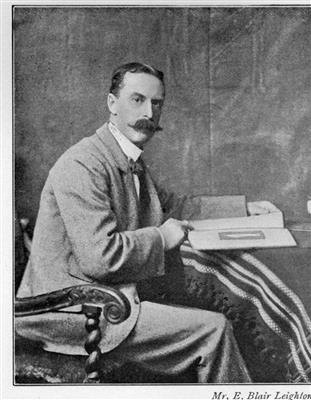
Biography
Leighton's work occupied a particular niche in late Victorian painting: scenes of knights, ladies, and chivalric ceremony rendered with meticulous period detail but suffused with a sentimental warmth that kept them accessible to a broad audience. He was not strictly a Pre-Raphaelite, though the influence is visible in his medievalist subjects and careful attention to costume and interior detail. His palette was somewhat softer than the Brotherhood's, and his moods leaned toward yearning rather than symbolism. Works such as "God Speed" (1900[1]), "The Accolade" (1901), and "Stitching the Standard" (1911) depicted farewell scenes, acts of honour, and the domestic ceremonies of a romanticised feudalism that Edwardian England found deeply comforting.
He was widely reproduced as prints, which extended his reach well beyond gallery-goers, and his paintings entered middle-class homes across Britain in engraved form. He continued exhibiting into old age, showing "The Wedding Register" as late as 1920[1], two years before his death in London. Leighton sits in the crowded space between John William Waterhouse and the later Millais: commercially successful, critically undervalued, and unexpectedly well-loved a century on.
Timeline
- 1852Born in London, the son of painter Charles Blair Leighton.
- 1878Began exhibiting at the Royal Academy, London.
- 1900Painted "God Speed".
- 1901Painted "The Accolade".
- 1911Painted "Stitching the Standard".
- 1920Exhibited "The Wedding Register".
- 1922Died in London at 70.
Notable Works
Tap to view larger.
Next stop
Browse the movements →
Every movement in the collection, from the Renaissance to Pop art.
Related Artists



Frequently Asked Questions
What is Edmund Blair Leighton known for?
Edmund Blair Leighton is known for his paintings of knights, ladies, and chivalric ceremony. His work, while rendered with period detail, had a sentimental warmth that appealed to a broad audience, and his paintings were widely reproduced as prints.What is Edmund Blair Leighton's most famous work?
Edmund Blair Leighton was an English painter of historical genre scenes, active in the late 19th and early 20th centuries. While he produced many well-regarded works, his most recognised painting is likely *The Accolade*, completed in 1901[1]. *The Accolade* depicts a medieval knighting ceremony. A queen or noblewoman bestows a kiss of honour on a newly dubbed knight, who kneels before her. The scene is set in a baronial hall, complete with onlookers, flags, and heraldic symbols. Leighton's attention to detail in the costumes and setting is typical of his style, which often romanticised medieval subjects. Leighton exhibited regularly at the Royal Academy, and his paintings were popular with the public, often reproduced as prints. He is known for his depictions of chivalry, romance, and historical events, rendered in a precise, academic style. Other notable works include *God Speed!* (1900) and *Tristan and Isolde* (1902), both sharing similar themes and aesthetic qualities with *The Accolade*.What should I know about Edmund Blair Leighton's prints?
Edmund Blair Leighton's paintings were often reproduced as prints, a common practice for popular artists of his time. These reproductions allowed a wider audience to access and appreciate his artwork. Several methods existed for creating these prints, including etching, mezzotint, and photogravure. The Art Union (later the Art Journal) often reviewed new engravings, effectively attaching some of the original artist's reputation to the engraver's work. Some artists, such as Burne-Jones and Leighton, maintained strict control over their print publications. Printmakers typically marked each print with an edition claim, written as a pair of numbers indicating the print number and the total edition size. The title of the print was usually placed in the centre of the bottom margin, with the signature on the right. The Trade Descriptions Act of 1968 required commercial print sellers to accurately describe their products. The rise of photoengraving led to mass production, sometimes overshadowing the quality of earlier fine art engravings. However, these earlier prints have since gained social, historical, and artistic value for collectors and art historians.What style or movement did Edmund Blair Leighton belong to?
Edmund Blair Leighton is generally associated with the later Pre-Raphaelite movement. This artistic brotherhood began in London in 1848. Reacting against what they viewed as the frivolous art of the period, the Pre-Raphaelites sought a return to greater truth to nature. They admired early 15th-century art, before what they saw as Raphael's theatricality. Figures such as Rossetti, Holman Hunt, and Millais initially comprised the group. They adopted the initials 'PRB'. Pre-Raphaelite paintings initially faced criticism for their departure from conventional techniques. They favoured even lighting, rich colours, and sharp attention to detail, incorporating symbolic objects connected to biblical, literary, or romantic themes. The second wave of Pre-Raphaelite painters, including Frederic Leighton, John William Waterhouse, and Evelyn De Morgan, commonly explored Arthurian and medieval themes, often featuring idealised female figures and themes of spiritual love. Later, engravings of Pre-Raphaelite paintings helped popularise the style.What techniques or materials did Edmund Blair Leighton use?
Information on Edmund Blair Leighton's specific painting techniques is limited; however, we can discuss the practices of British[1] artists during his period. Oil paint was the primary medium for artists of Leighton's generation. Many artists, including Leighton, employed commercially prepared canvases with white priming. This provided a bright surface. Some artists renovated the ground with fresh white mixed with amber or copal varnish. The Pre-Raphaelites, with whom Leighton shared some aesthetic sensibilities, favoured applying colour over a wet ground. This involved applying a thin, even coat of fresh white to the area being worked on. Transparent and semi-transparent colours were then applied with soft brushes, blending with the wet ground to avoid a thin or stained appearance. Constable, a slightly earlier British artist, also influenced painting techniques. He began with preliminary sketches and oil studies, followed by a pencil under-drawing. He established masses with washes of subdued colour, then built up the surface with opaque paint, adding details gradually. Glazes of red lakes and transparent earths added depth to shadows. Touches of off-white gave the effect of reflective light.What was Edmund Blair Leighton known for?
Edmund Blair Leighton (1853[1]-1922[1]) was an English painter known for his historical genre scenes, particularly those depicting chivalry and romance. He was not associated with the Pre-Raphaelite movement. Leighton's paintings often portrayed scenes from the medieval or Regency periods. These works presented an idealised view of the past, with a focus on romantic encounters and acts of heroism. His style was characterised by attention to detail in costumes and settings, lending a sense of authenticity to his depictions. Although Leighton exhibited at the Royal Academy, he never achieved full membership. Nevertheless, his works were popular with the public, and he enjoyed commercial success during his lifetime. His paintings continue to be admired for their aesthetic appeal and their representation of a romanticised past.When did Edmund Blair Leighton live and work?
Edmund Blair Leighton (1852[1]-1922[1]) was a British[1] painter known for his depictions of historical and genre subjects. He was born in London on 21 September 1852[1], the son of artist Charles Blair Leighton. Leighton received his formal artistic training at the Royal Academy Schools. He began exhibiting his work at the Royal Academy in 1878, continuing to do so regularly throughout his career. His paintings often portrayed scenes from the medieval or Regency eras, with a focus on romanticised visions of knights, ladies, and courtship. Leighton's style is characterised by its attention to detail, use of colour, and narrative quality. He produced many paintings during his career, including "The Reconciliation" (1903), "God Speed!" (1900), and "The Accolade" (1901). These paintings proved popular with the public, and he enjoyed commercial success during his lifetime. Leighton died on 1 September 1922, in London. His works remain popular today, reproduced as prints and illustrations.Where can I see Edmund Blair Leighton's work?
To view works by Edmund Blair Leighton, several museums and galleries house collections that include his paintings. In the UK, the Manchester Art Gallery, Brighton Museum & Art Gallery, and the Victoria & Albert Museum in London may have examples of his work. Additionally, the National Museums of Scotland, Royal Museum in Edinburgh might also display his art. Outside the United Kingdom, several North American museums feature collections of decorative arts; these include the Metropolitan Museum of Art in New York, the Los Angeles County Museum of Art (LACMA), the Minneapolis Institute of Arts, the Royal Ontario Museum in Toronto, the Virginia Museum of Fine Arts in Richmond, and the Charles Hosmer Morse Museum of American Art in Winter Park, Florida. Checking these institutions' websites or contacting them directly will provide the most up-to-date information on which pieces are on display.Who did Edmund Blair Leighton influence?
Edmund Blair Leighton's paintings, with their focus on historical genre scenes, proved popular during his lifetime and continue to appeal to audiences. However, tracing direct influence from Leighton to later artists is difficult. Leighton belonged to a generation of British[1] artists who embraced narrative painting, often drawing inspiration from history, literature, and romantic ideals. His work shares similarities with that of his contemporaries, such as John William Waterhouse and Arthur Hughes; all three artists favoured historical subjects and a detailed, realistic style. Later painters who worked in related genres likely knew Leighton's output. The Pre-Raphaelites, active before Leighton, established many of the themes and aesthetic approaches that he adopted. Later artists working in illustration or historical fiction might have looked to Leighton's compositions and subject matter as source material or inspiration. However, no major artist has explicitly cited Leighton as a direct influence. His contribution lies more in the continuation of a particular style of British historical genre painting than in forging a new artistic path.Who influenced Edmund Blair Leighton?
Edmund Blair Leighton (1852[1]-1922[1]) was an English painter known for his depictions of historical and romantic subjects. While specific influences are not extensively documented, his artistic style and subject matter provide some insight. Leighton's work aligns with the late Pre-Raphaelite style, which suggests influence from artists such as John Everett Millais and Dante Gabriel Rossetti. These painters favoured detailed compositions, intense colours, and themes drawn from literature and legend. Leighton shared these interests, often portraying scenes from Arthurian legend, medieval romance, and historical events. Moreover, Leighton's paintings exhibit academic realism, a style that prioritised accurate representation and technical skill. This indicates he was influenced by the broader artistic trends of his time, which emphasised meticulous detail and historical accuracy. Artists such as Lawrence Alma-Tadema, known for his depictions of Roman life, also worked in this style. Leighton's paintings, with their attention to costume and setting, reflect a similar approach to historical subject matter. In summary, Leighton's artistic development likely involved exposure to Pre-Raphaelite painting and academic realism, shaping his distinctive style.Who was Edmund Blair Leighton?
Edmund Blair Leighton (1852[1]-1922[1]) was a British[1] painter known for his historical genre scenes. He was not associated with any particular school or movement, but his work fits broadly within the late Pre-Raphaelite style and aesthetic. Born in London, Leighton was the son of artist Charles Blair Leighton. He trained at the Royal Academy Schools. Leighton married Katherine Nash in 1885[1]; they had two children. He exhibited at the Royal Academy from 1878 to 1920. Leighton's paintings typically depict scenes from the medieval or Regency eras. These paintings often feature romantic or chivalrous subjects. Examples include "God Speed!" (1900), showing a knight departing for war, and "The Accolade" (1901), depicting the knighting of a soldier. His paintings are characterised by their attention to detail, historical accuracy, and dramatic compositions. Leighton's work was popular during his lifetime, and his paintings remain widely reproduced today as prints and illustrations. He died in London in 1922.Why are Edmund Blair Leighton's works important today?
Edmund Blair Leighton's paintings maintain appeal because they represent an idealised vision of the medieval past, particularly the roles of women within it. His images often depict scenes of courtship, chivalry, and quiet contemplation, rendered with attention to period costume and historical detail. Leighton was not associated with the Pre-Raphaelites directly; however, like them, he drew inspiration from medieval subjects. While some Pre-Raphaelite artists explored more complex or unconventional themes, Leighton focused on romantic narratives that were accessible and popular. The appeal of Leighton's work also lies in its accessibility. His paintings tell stories that are easy to understand, and his style is representational, without the symbolic density found in some contemporary art movements. This has contributed to his continued popularity, with reproductions of his paintings remaining sought after today.
Sources
Editorial draws on the following primary and tertiary references for Edmund Blair Leighton.
- [1] wikipedia Wikipedia: Edmund Blair Leighton Used for: biography, birth dates, death dates, identifiers, movement attribution, nationality.
- [2] book Beard, Lee, 1973- author, Butler, Adam, author; Van Cleave, Claire, author; Fortenberry, Diane, author; Stirling, Susan, author, Beard, Lee, 1973- author, Butler, Adam, author; Van Cleave, Claire, author; Fortenberry, Diane, author; Stirling, Susan, author - The Art Book_ New Edition, Mini Format Used for: biography, stylistic analysis.
- [3] book Masterpieces of western art : a history of art in 900 individual studies from the Gothic to the present day Used for: biography, stylistic analysis.
- [4] book Engen, Rodney K, Pre-Raphaelite prints : the graphic art of Millais, Holman Hunt, Rossetti and their followers Used for: biography, stylistic analysis.
Editorial overseen by Solis Prints. Sources verified 2026-09-16. Click a source for details, or hover over [N] in the page above to preview.
Editorial standardsMethodologyCorrectionsAI disclosureAbout the editorial team