



Edmund Dulac
- Orientalism
- Golden Age of Illustration
Edmund Dulac arrived in London from Toulouse in 1904[1] with a training in fine art and a taste for Persian miniatures, Japanese woodblock prints, and anything that placed colour and pattern above conventional perspective. By the time he became a British[1] subject in 1912, he had already established himself as one of the defining figures of the Golden Age of illustration, his gift-book work for Hodder and Stoughton rivalling Arthur Rackham's in commercial success while being unmistakably different in character.
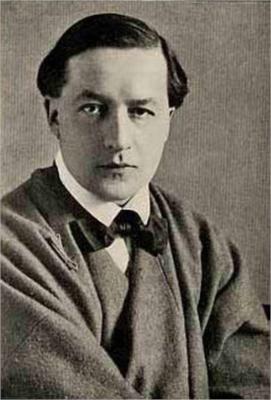
Biography
Where Rackham conjured gnarled, gothic woodland, Dulac produced jewel-like orientalist fantasy: luminous jewel tones, flat decorative patterning, figures borrowed from the tradition of Persian illuminated manuscripts and filtered through a distinctly French sensibility. His illustrated editions of "Stories from the Arabian Nights" (1907[1]), "The Rubaiyat of Omar Khayyam" (1909), "The Sleeping Beauty" (1910), and Edgar Allan Poe's "The Bells and Other Poems" (1912) remain benchmarks of the form. He also illustrated works by Shakespeare and Hans Andersen, each edition designed as a luxury object, the pictures and decorative borders as considered as any element of the text.
The market for gift books collapsed after the First World War, and Dulac moved into adjacent territory with characteristic versatility. He designed theatrical costumes and sets, painted portrait caricatures, created bookplates, and designed postage stamps including British[1] commemorative issues for the coronation of George VI in 1937[1]. He maintained a long friendship with W.B. Yeats, illustrating some of his work, and continued producing for an admirably wide range of clients until his death in London in 1953[1].
Timeline
- 1882Born in Toulouse, France.
- 1904Moved from Toulouse to London, having trained in fine art.
- 1907Illustrated "Stories from the Arabian Nights".
- 1909Illustrated "The Rubaiyat of Omar Khayyam".
- 1910Illustrated "The Sleeping Beauty".
- 1912Became a British subject. Illustrated Edgar Allan Poe's "The Bells and Other Poems".
- 1937Designed British commemorative postage stamps for the coronation of George VI.
- 1953Died in London, aged 71.
Notable Works
Tap to view larger.
Next stop
Browse the movements →
Every movement in the collection, from the Renaissance to Pop art.
Edmund Dulac prints
Hand-finished archival prints from Edmund Dulac's body of work.
 The Tempest: Ariel and the Bee - Edmund Dulac
From £28.00
The Tempest: Ariel and the Bee - Edmund Dulac
From £28.00
 Little Girl in a Book - Edmund Dulac
From £37.00
Little Girl in a Book - Edmund Dulac
From £37.00
 Princess Orchid's Party - Edmund Dulac
From £37.00
Princess Orchid's Party - Edmund Dulac
From £37.00
 Cinderella (from the Picture Book for the Red Cross) - Edmund Dulac
From £37.00
Cinderella (from the Picture Book for the Red Cross) - Edmund Dulac
From £37.00
 Layla (from the Picture Book for the Red Cross) - Edmund Dulac
From £37.00
Layla (from the Picture Book for the Red Cross) - Edmund Dulac
From £37.00
 Asenath (from the Picture Book for the Red Cross) - Edmund Dulac
From £37.00
Asenath (from the Picture Book for the Red Cross) - Edmund Dulac
From £37.00
Related Artists


Take Edmund Dulac home.
See all Edmund Dulac prints →Frequently Asked Questions
What is Edmund Dulac known for?
Edmund Dulac is known as one of the defining figures of the Golden Age of illustration. His gift-book work for Hodder and Stoughton rivalled Arthur Rackham's in commercial success.What is Edmund Dulac's most famous work?
It is difficult to name one single work as Edmund Dulac's most famous, as his notability rests on his prolific output as a book illustrator during the early 20th century. He created artwork for a wide array of publications, including fairy tales, classic literature, and collections of poetry. Dulac's illustrations for stories from "One Thousand and One Nights" (also known as "Arabian Nights") are among his best-known works, as are his illustrations for the fairy tales of Hans Christian Andersen, and the collected stories of the Brothers Grimm. His distinctive style, influenced by both Art Nouveau and Orientalism[1], made him a popular choice for publishers seeking to produce deluxe editions of classic works. These editions helped solidify his reputation as one of the leading illustrators of the period.What should I know about Edmund Dulac's prints?
Edmund Dulac (1882[1]-1953[1]) was a French-born, naturalised British[1] book illustrator, stamp designer, and painter. Prints after Dulac's original art were often produced using methods such as etching. This process involves creating a design on a metal plate with acid, resulting in fine lines. The quality of fine art etchings was highly regarded, and from 1879 onward, magazines devoted to etching emerged. The Printsellers’ Association did not compel etchers to declare the number of proof impressions. This means that full details of edition sizes are not always available, unlike with mezzotints or line engravings. Some publishers turned to the Continent, where talented reproductive etchers were more affordable than their British counterparts. Collectors of wood engravings should look for early proof images. These are the clearest and most accurate, similar to "First State" impressions by Old Masters. Engravers typically printed fewer than ten proofs per image, sending one to the artist for corrections.What style or movement did Edmund Dulac belong to?
Edmund Dulac's career puts him in contact with several movements. Born in 1882[1], his early work has connections to the late stages of French Orientalism[1], a style that had been in vogue since the early 1800s. The appeal of the "East" for European artists grew from events such as Napoleon's Egyptian campaign (1798-1801[1]), the Greek struggle for independence in the 1820s, and France's campaign in Algeria from 1830. Artists created images of North Africa, the Ottoman Empire, and the Levant, sometimes from direct experience, and sometimes from imagination. Orientalist works often presented an imagined combination of exoticism, savagery, and sensuality. By the late nineteenth century, however, the critic Jules Castagnary declared that Orientalism was dead. The opening of the Suez Canal in 1869 made travel to the East more common. This accessibility meant that later Orientalist pictures became less anecdotal, and more infused with mysticism. Dulac's later work moved away from this style, as he became a naturalised British[1] citizen in 1912[1] and worked as a book illustrator in a decorative style, influenced by Art Nouveau.What techniques or materials did Edmund Dulac use?
Edmund Dulac was a painter and book illustrator who worked in watercolour, among other media. The choice of materials available to an artist influences the character of their work; the same colour will appear differently depending on whether it is watercolour, oil, or tempera. Dulac's work demonstrates an understanding of this relationship between matter and form. In the eighteenth century, many artists experimented with different painting methods, including encaustic (using coloured waxes) and eludoric painting (using oil and water). These techniques aimed to improve the durability and appearance of paintings. Some involved fusing the final composition with a hot plate, while others used a thin film of water to judge the quality of brushstrokes. Such experiments reflect a broader interest in rediscovering the techniques of ancient painters and accommodating a growing demand for paintings among the bourgeoisie.What was Edmund Dulac known for?
Edmund Dulac was an illustrator. He is known for his contributions to book illustration, particularly for editions of classic literature and fairy tales. Dulac's work includes illustrations for Edgar Allan Poe's *The Bells and Poems*. His illustrations appeared in books alongside those by artists such as John Austen, Harry Clarke, Arthur Rackham, and Eric Gill. These artists worked on editions of works by Shakespeare, Goethe, and the Brothers Grimm. Dulac's illustrations, along with those of other artists, are discussed in books about the history of illustration. These books trace the development of illustration as an art form, from early woodcuts to more modern styles. One such book includes an image by Edmund Sullivan from the *Rubaiyat of Omar Khayyam*, alongside Dulac's.When did Edmund Dulac live and work?
Edmund Dulac (born Edmond Dulac) was a French-born, naturalised British[1] illustrator. He was born in Toulouse on 22 October 1882[1] and died in London on 25 May 1953[1]. Dulac began his career by studying law, but he soon turned to art. In 1904[1], he moved to London and began working as an illustrator. His early work included illustrations for books such as *Stories from the Arabian Nights* (1907), *Shakespeare's Comedy of the Tempest* (1908), and *The Rubaiyat of Omar Khayyam* (1909). These commissions established his reputation as a leading figure in the "gift book" market. During World War I, Dulac contributed to propaganda efforts, producing illustrations for books and pamphlets that supported the Allied cause. After the war, he continued to work as an illustrator, but he also explored other artistic avenues, including stage design and stamp design. He designed the sets and costumes for a production of *The Sleeping Beauty* at Covent Garden in 1939. Dulac became a naturalised British citizen in 1912.Where can I see Edmund Dulac's work?
Edmund Dulac's work can be viewed in several museums internationally. In the United States, these include the Charles Hosmer Morse Museum of American Art (Winter Park, Florida), the Los Angeles County Museum of Art (Los Angeles), the Metropolitan Museum of Art (New York), the Minneapolis Institute of Arts (Minneapolis), the Museum of Modern Art (New York), and the Wolfsonian at Florida International University (Miami Beach). Another is the Virginia Museum of Fine Arts (Richmond). In Canada, his art may be viewed at the Royal Ontario Museum in Toronto. In the United Kingdom, Dulac's pieces can be seen at the Bakelite Museum (Williton), the Brighton Museum & Art Gallery (Brighton), the Geffrye Museum (London), the Manchester Art Gallery (Manchester), the National Museums of Scotland, Royal Museum (Edinburgh), the Ashmolean Museum (Oxford), the British[1] Museum (London), the Brunei Gallery (London), the Sir Percival David Foundation of Chinese Art (London), and the Victoria & Albert Museum (London). In Europe, one can view Dulac's art at the Brangwyn Museum (Brugge, Belgium), the Clockarium Museum (Brussels), the Musée d’Art et d’Industrie (Roubaix, France), the Musée de l’Ecole de Nancy (Nancy, France), the Musée des Arts Décoratifs (Paris), and the Musée des Beaux-Arts (Nancy, France).Where was Edmund Dulac from?
Edmund Dulac was born in Toulouse, France, on 22 October 1882[1]; his birth name was Edmond Dulac. He later became a naturalised British[1] citizen. Dulac studied law at the University of Toulouse while also attending classes at the École des Beaux-Arts. However, he soon abandoned his legal studies. He moved to Paris to formally study art at the Académie Julian. In 1904[1], at the age of 22, Dulac relocated to London. There, he began his career as an illustrator, initially working for J. M. Dent and publishing his first book, *Stories from the Arabian Nights*, in 1907. This commission marked the beginning of his successful career in Britain. He produced illustrations for various books, including fairy tales, classic stories, and poetry. He also contributed to periodicals and designed theatre costumes. Although he was born and educated in France, Dulac spent most of his working life in England and is considered part of the British school of illustration. He died in London in 1953[1].Who did Edmund Dulac influence?
Edmund Dulac's influence can be traced through various artistic movements and individual artists. In the late 19th century, a renewed interest in wood-engraved illustration led to the emergence of artists like Laurence Housman and Charles Ricketts. They took Pre-Raphaelite illustration in inventive directions. Housman and Ricketts remain important figures in the Private Press movement, which produces limited editions of poetry and literature. This movement is based upon Pre-Raphaelite Brotherhood models of tasteful design and restrained decoration. Additionally, the work of Edmund Sullivan, particularly his woodcut for the *Rubaiyat of Omar Khayyam*, is noted as a source of inspiration for other artists. One artist saw Sullivan's work and thought, "This is cool," and then imitated it. The Pre-Raphaelite style, with its romantic and Italianate elements, also continued to influence artists into the 20th century. Sir Frank Dicksee, for example, created works in this style, while John William Waterhouse transitioned from neoclassicism to a more Pre-Raphaelite approach, echoing Rossetti's themes in paintings such as *Ophelia* and *The Lady of Shalott*.Who influenced Edmund Dulac?
Edmund Dulac's influences included a range of artistic movements and figures. The late 19th century saw a rise in art magazines, such as *The Studio*, the *Magazine of Art*, and *L’Artiste*, reflecting a renewed public interest in decorative arts and illustration. These publications helped to disseminate various styles and approaches. Several English book illustrators, including William Morris, Walter Crane, Dante Gabriel Rossetti, and Aubrey Beardsley, also impacted the artistic environment. Beardsley, in particular, was a driving force behind the spread of the Art Nouveau graphic style. His distinctive pen-and-ink illustrations were widely imitated. Dulac's work also connects to a broader tradition of illustration, where artists like Dürer, Hogarth, Goya, and Toulouse-Lautrec contributed to the development of illustration as an independent art form.Who was Edmund Dulac?
Edmund Dulac (born in Toulouse, France, 22 October 1882[1]; died in London, 25 May 1953[1]) was a naturalised British[1] citizen of French origin. Dulac is known as a magazine, book and stamp illustrator. Dulac's family was middle-class. He studied law at the University of Toulouse. He also studied art, and in 1904[1] he moved to London. His earliest commissions included illustrating Jane Eyre and stories from the Arabian Nights. He also produced illustrations for Edgar Allan Poe’s The Bells and Poems. Dulac designed for the stage, including costumes for productions of the Abbey Theatre in Dublin. He also designed bank notes during World War I, and postage stamps. He became a naturalised British citizen in 1912. During the 1940s, he designed playing cards for the De La Rue company.
Sources
Editorial draws on the following primary and tertiary references for Edmund Dulac.
- [1] wikipedia Wikipedia: Edmund Dulac Used for: biography, birth dates, death dates, identifiers, movement attribution, nationality.
- [2] book Howard Simon, 500 Years of Illustration Used for: biography, stylistic analysis.
- [3] book Beard, Lee, 1973- author, Butler, Adam, author; Van Cleave, Claire, author; Fortenberry, Diane, author; Stirling, Susan, author, Beard, Lee, 1973- author, Butler, Adam, author; Van Cleave, Claire, author; Fortenberry, Diane, author; Stirling, Susan, author - The Art Book_ New Edition, Mini Format Used for: biography.
- [4] book Engen, Rodney K, Pre-Raphaelite prints : the graphic art of Millais, Holman Hunt, Rossetti and their followers Used for: biography, stylistic analysis.
Editorial overseen by Solis Prints. Sources verified 2026-09-27. Click a source for details, or hover over [N] in the page above to preview.
Editorial standardsMethodologyCorrectionsAI disclosureAbout the editorial team