



Eduardo Rosales
Eduardo Rosales completed the painting that would define his reputation in Rome, far from Madrid, at the age of twenty-seven. 'The Testament of Isabella the Catholic' (1864[1]) is a large-scale history painting: the dying queen in bed, surrounded by attendants and courtiers, rendered with a restraint that reads as emotional rather than merely formal. It won the gold medal at the National Exhibition in Madrid that year and brought Rosales European attention, marking a moment when Spanish[1] history painting found a credible alternative to the theatrical bombast of academic convention.
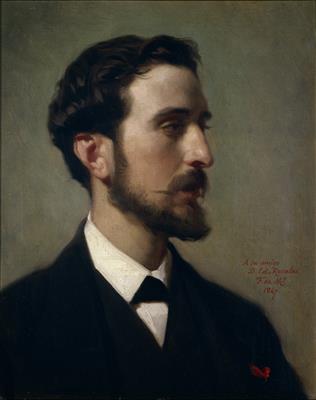
Biography
He had arrived in Rome in 1857[1], initially self-funded, later on a government stipend, and fell into the company of the Antico Caffè Greco circle: Marià Fortuny, José Casado del Alisal, and Dióscoro Puebla among them. The city's collection of old masters pulled him toward Velázquez as a model, not for subject matter but for painterly directness, for the refusal to beautify. That shift carried consequences. Rosales is credited, with some justice, with having redirected nineteenth-century Spanish[1] painting away from the idealising tendencies of the Roman Purismo school.
He never fully escaped tuberculosis. He made repeated trips to the thermal resort at Panticosa in the Pyrenees, seeking a cure that never arrived. By the time he completed 'La Muerte de Lucrecia' in 1871[1], which received harsh critical notices, he was already ill enough that the hostility appears to have discouraged him from further large canvases. He died in Madrid in September 1873[1], aged thirty-six. The Prado holds the bulk of his surviving work.
Timeline
- 1836Born in Madrid.
- 1857Arrived in Rome, initially self-funded, later on a government stipend.
- 1864Completed 'The Testament of Isabella the Catholic' in Rome, at 27.
- 1864'The Testament of Isabella the Catholic' won the gold medal at the National Exhibition in Madrid.
- 1871Completed 'La Muerte de Lucrecia'.
- 1873Died in Madrid in September, aged 36, from tuberculosis.
Notable Works
Tap to view larger.
Next stop
Browse the movements →
Every movement in the collection, from the Renaissance to Pop art.
Related Artists



Frequently Asked Questions
What should I know about Eduardo Rosales's prints?
Eduardo Rosales did not produce a large number of prints. However, like other Pre-Raphaelite artists, Rosales understood that prints could popularise his style and reach a wider audience. Pre-Raphaelite prints can be divided into three main groups: etchings done by the artist, reproductive engravings done by professional engravers (with the artist's approval), and wood-engraved book illustrations. These prints were influential for subsequent printmakers. The images created remain striking works of the Victorian period. They were disseminated throughout the Western world. The Victorian engraving business was large and profitable. Reproductions were produced in large numbers and sold at a fraction of the cost of the original paintings. Exhibitions of paintings were organised to promote sales of engravings by subscription. The press helped make these engravings an integral part of middle-class Britain. Fine art etchings were very much admired. Specialist publications were created, such as *The Etcher*, a London-based journal which ran from 1879 to 1883.What style or movement did Eduardo Rosales belong to?
Eduardo Rosales is usually associated with Realism and Spanish[1] Romanticism. However, his artistic development also shows the influence of other styles. Rosales lived (1836[1]-1873[1]) during a period when Romanticism was evolving. Some painters moved away from Neoclassical subjects and styles. They began to focus on more emotional and dramatic themes, often related to history or contemporary events. Rosales's work, such as "Isabel la Católica dictando su testamento" (Isabella the Catholic Dictating her Will), reflects this interest in historical subjects and emotional intensity. Rosales also spent time in Italy, where he studied the Old Masters. This exposure to classical art influenced his technique and composition. Some scholars note similarities between his work and that of earlier artists, such as Paul Delaroche, who combined historical themes with careful attention to detail. While Rosales's style is not easily categorised, it incorporates elements of Romanticism, Realism, and academic training.What techniques or materials did Eduardo Rosales use?
Eduardo Rosales was a Spanish[1] painter who worked primarily in the academic tradition. He is best known for history paintings and portraits. Rosales's early training at the Real Academia de Bellas Artes de San Fernando in Madrid provided him with a solid foundation in drawing and painting. He initially worked in a precise, detailed style, evident in early works such as "Tobias and the Angel" (1858[1]). Later, during his time in Rome, Rosales adopted a looser, more painterly technique. He was influenced by the Italian Macchiaioli movement, which emphasised capturing light and atmosphere through bold brushstrokes and colour patches. This is visible in "Isabella the Catholic Dictating Her Will" (1864), which uses a more open brushstroke than his earlier paintings. Rosales typically worked with oil paint on canvas. He prepared his canvases with a smooth ground, allowing for fine detail. His palette consisted of earth tones, blacks, and whites, with occasional brighter colours for emphasis. He also produced drawings and watercolour sketches, often as preparatory studies for larger compositions. These studies show his mastery of line and his careful observation of form.Where can I see Eduardo Rosales's work?
It is difficult to say with certainty where you can view works by Eduardo Rosales, as the reference texts do not discuss his art. However, they do list numerous museums and galleries that may hold examples of his work, or that of his contemporaries. These include institutions in both the United States and the United Kingdom. In the United States, you could try the Metropolitan Museum of Art (New York), the Los Angeles County Museum of Art, the Minneapolis Institute of Arts, or the Charles Hosmer Morse Museum of American Art (Winter Park, Florida). In the UK, possible locations are the Brighton Museum & Art Gallery, the Manchester Art Gallery, the National Museums of Scotland (Royal Museum, Edinburgh), or the Victoria & Albert Museum in London. Other museums in Canada, Switzerland and Italy are listed; it may be worth checking their websites or catalogues to see if they hold any works by the artist.Who was Eduardo Rosales?
Eduardo Rosales (1836[1]-1873[1]) was a Spanish[1] painter. He is best known for historical paintings. Rosales's artistic production occurred in the mid-19th century, a period of change in European painting. Artists moved between classicism and romanticism. Some, like Paul Delaroche, satisfied a need for education through art with theatrical compositions and carefully researched historical details. Delaroche's studio was very popular; pupils included Gerome, Daubigny, Millet, Monticelli, and Thomas Couture, who later taught Édouard Manet. Rosales did not work in isolation. Other artists, such as Théodore Chassériau, also explored similar themes and styles during this time. Rossetti trained from 1843[1] and studied at the Royal Academy from 1846. In 1848, he co-founded the Pre-Raphaelite Brotherhood, but soon left it. His themes came from Dante or the Morte d'Arthur, with Symbolist overtones. Later, he concentrated on single studies of allegorical females.Why are Eduardo Rosales's works important today?
Eduardo Rosales (1836[1]-1873[1]) was a Spanish[1] painter whose historical scenes and portraits gained recognition during his lifetime. His works offer insights into the artistic and cultural climate of 19th-century Spain. Rosales's emphasis on realism and dramatic composition, combined with his exploration of Spanish history, contributes to his continuing relevance. One of Rosales's most celebrated paintings is "Isabella the Catholic Dictating Her Will" (1864[1]), which depicts Queen Isabella I of Castile in her final moments. This painting, along with others such as "The Death of Lucretia" (1871), demonstrates Rosales's ability to capture emotional intensity and historical detail. His attention to historical accuracy and his skill in portraying human emotion make his paintings valuable resources for understanding the past. Rosales's influence extended to other Spanish artists of his time. His work contributed to the development of Spanish historical painting and helped to shape the artistic identity of the nation. By studying his paintings, viewers can gain a deeper appreciation for the artistic traditions and historical narratives that have shaped Spanish culture. His focus on realism and his dramatic style continue to resonate with audiences today.What was Eduardo Rosales's art style?
Eduardo Rosales was drawn to Velázquez as a model, not for subject matter, but for painterly directness and the refusal to beautify. This shift is credited with redirecting nineteenth-century Spanish[1] painting away from the idealising tendencies of the Roman Purismo school.How did Eduardo Rosales die?
Eduardo Rosales died in 1873[1] at the age of 37.
Sources
Editorial draws on the following primary and tertiary references for Eduardo Rosales.
- [1] wikipedia Wikipedia: Eduardo Rosales Used for: biography, birth dates, death dates, identifiers, movement attribution, nationality.
- [2] book Beard, Lee, 1973- author, Butler, Adam, author; Van Cleave, Claire, author; Fortenberry, Diane, author; Stirling, Susan, author, Beard, Lee, 1973- author, Butler, Adam, author; Van Cleave, Claire, author; Fortenberry, Diane, author; Stirling, Susan, author - The Art Book_ New Edition, Mini Format Used for: biography.
- [3] book Masterpieces of western art : a history of art in 900 individual studies from the Gothic to the present day Used for: biography.
- [4] book Neoclassicism and romanticism : architecture, sculpture, painting, drawings, 1750-1848 Used for: biography.
- [5] book Robert de la Sizeranne, The Pre-Raphaelites Used for: biography.
Editorial overseen by Solis Prints. Sources verified 2026-09-30. Click a source for details, or hover over [N] in the page above to preview.
Editorial standardsMethodologyCorrectionsAI disclosureAbout the editorial team