



Edwin Henry Landseer
The four bronze lions guarding the base of Nelson's Column in Trafalgar Square are the most viewed public sculptures in Britain, and they were designed by an artist best known for painting dogs with complicated feelings. Edwin Henry Landseer occupied an improbable position in Victorian culture: court favourite, popular printmaker, and producer of works that critics regarded with condescension while the public adored.
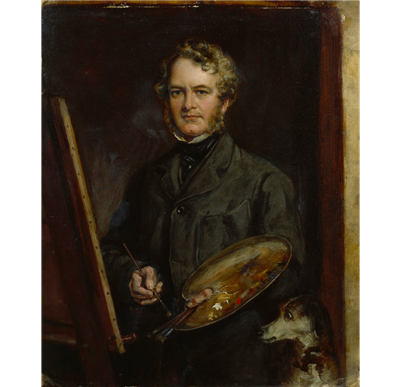
Biography
Landseer was born in London in 1802[1], the son of an engraver who gave him a systematic early education in drawing animals from life. He first exhibited at the Royal Academy aged 12 and was elected an Academician at 24. His subject was the animal world endowed with human emotion: bloodhounds radiating melancholy, stags dying with theatrical dignity, dogs exhibiting loyalty that shamed their owners. Queen Victoria commissioned him repeatedly, as did the aristocratic families who wanted their estates, horses, and hunting trophies recorded in paint.
'Dignity and Impudence' (1839[1]), pairing a grave bloodhound with a perky terrier in a kennel doorway, became one of the most widely reproduced images in Victorian England through commercial prints. 'Wild Cattle at Chillingham' (1867), painted for the Earl of Tankerville and now at the Laing Art Gallery, shows a different register: monumental, confrontational, and genuinely unsettling in a way his more sentimental work rarely manages. A variety of Newfoundland dog, black and white, is named after him because his paintings of the breed were so celebrated.
Landseer suffered a progressive mental breakdown from the 1850s and died in 1873[1], having not worked for years. His estate was valued at £90,000.
Timeline
- 1802Born in London, the son of an engraver who taught him to draw animals.
- 1814First exhibited at the Royal Academy, aged 12.
- 1826Elected an Academician at 24.
- 1839Painted "Dignity and Impudence", which became a widely reproduced image.
- 1850Began to suffer a progressive mental breakdown.
- 1867Painted "Wild Cattle at Chillingham" for the Earl of Tankerville.
- 1873Died in London, aged 71, after not working for years; his estate was valued at £90,000.
Notable Works
Tap to view larger.
Next stop
Romanticism →
Explore the artists and ideas of Romanticism.
Edwin Henry Landseer prints
Hand-finished archival prints from Edwin Henry Landseer's body of work.
 John Allen - Edwin Henry Landseer
From £28.00
John Allen - Edwin Henry Landseer
From £28.00
 Flood in the Highlands - Edwin Henry Landseer
From £28.00
Flood in the Highlands - Edwin Henry Landseer
From £28.00
 Queen Victoria at Osborne House - Edwin Henry Landseer
From £28.00
Queen Victoria at Osborne House - Edwin Henry Landseer
From £28.00
 A Highland Breakfast - Edwin Henry Landseer
From £28.00
A Highland Breakfast - Edwin Henry Landseer
From £28.00
 Deer and Deer Hounds in a Mountain Torrent - Sir Edwin Henry Landseer
From £28.00
Deer and Deer Hounds in a Mountain Torrent - Sir Edwin Henry Landseer
From £28.00
 Queen Victoria on Horseback - Edwin Henry Landseer
From £28.00
Queen Victoria on Horseback - Edwin Henry Landseer
From £28.00
Related Artists


Take Edwin Henry Landseer home.
See all Edwin Henry Landseer prints →Frequently Asked Questions
What is Edwin Henry Landseer known for?
Edwin Henry Landseer is known for his animal paintings and sculptures. He designed the lions at the base of Nelson's Column, and he painted animals, such as horses, dogs, and stags, endowing them with human feelings.What is Edwin Henry Landseer's most famous work?
Sir Edwin Landseer (1802[1]-1873[1]) was a British[1] artist known for his paintings and sculptures of animals. He was particularly popular with Queen Victoria, who commissioned him to paint portraits of her with her pets. Landseer's animal paintings often depicted them with human-like emotions, which appealed to Victorian tastes. His most famous works include the bronze lions at the base of Nelson's Column in Trafalgar Square, London. Landseer also painted horses, dogs, and stags. One of his most recognised paintings is *Dignity and Impudence*, which depicts two dogs, a bloodhound named Grafton and a West Highland terrier named Scratch. Landseer's paintings of dogs were greatly admired; a black and white Newfoundland dog is named after him.What should I know about Edwin Henry Landseer's prints?
Edwin Landseer was a painter and draughtsman, best known for his images of animals, particularly dogs, horses, and stags. During his lifetime, and after his death, prints were made after his popular paintings. These reproductions allowed wider audiences to own and appreciate his work. Many of Landseer's popular paintings were reproduced as engravings. These include "The Monarch of the Glen" (1851[1]), a painting of a red deer stag, and "Dignity and Impudence" (1839), showing a bloodhound and a terrier. These were reproduced as monochrome prints, and sold to a broad audience. Some of Landseer's paintings were also reproduced using other printmaking methods, such as lithography. These allowed for the reproduction of a wider range of tones and colours. Some of these were hand-coloured, adding to their appeal. Queen Victoria, who was a patron of Landseer, owned many of his paintings and prints. Original prints by Landseer are less common than reproductions after his paintings. He produced a small number of etchings and engravings himself, often of animals. These are highly sought after by collectors.What style or movement did Edwin Henry Landseer belong to?
Edwin Henry Landseer was a painter working during the Romantic era, which broadly spanned from 1800 to 1850[1]. Romanticism[1] as a movement followed the Neoclassical period; it saw artists favouring emotion and intuition rather than rational objectivity. As the German Romantic painter Caspar David Friedrich stated, the artist should depict what he sees within himself, not only what is before him. Romanticism gained its name from a renewed interest in medieval tales, termed romances. 'Gothic' horror stories, combining the macabre and occult, were fashionable, as was Gothic Revival architecture. Another aspect of Romanticism was its focus on nature. Painters such as Turner and Constable elevated the status of depictions of the natural world by giving such scenes heroic qualities. Both man and nature were viewed as touched by the supernatural, and one could access this inner divinity by relying on instinct.What techniques or materials did Edwin Henry Landseer use?
Edwin Henry Landseer was primarily an oil painter. Analysis of British[1] paintings from 1775-1875[1] indicates the period saw the introduction of new pigments, and modified paint media. J.M.W. Turner, a contemporary of Landseer, spent a decade as a watercolourist and transferred many techniques to his oil painting. Turner favoured light-toned, absorbent surfaces. He also used new application techniques and pigments in both media at roughly the same time. Some eighteenth-century artists used white grounds to lend luminosity to their oil paintings. After 1820[1], more British artists tended to use white grounds. Turner used white primings for many of his oils, both exhibited and unfinished, in the first decade of the nineteenth century; in later decades most of his supports had white grounds. Constable, another contemporary, made preliminary sketches and oil studies before painting. He then made a pencil under-drawing and established the masses with washes of subdued colour. A thin but opaque building-up of the surface commenced, with details added. Glazings of burnt red lakes and transparent earths were used to add depth and richness to shadows and foreground. Freely knifed and brushed touches of off-white were used to give the quality of reflective light and sparkling of waves.What was Edwin Henry Landseer known for?
Edwin Henry Landseer (1802[1]-1873[1]) was an English painter and sculptor known for his animal paintings. He was particularly celebrated for his depictions of horses, dogs, and stags. Landseer's father, an engraver, taught him to sketch animals from life. He first exhibited at the Royal Academy at the age of twelve. Landseer gained considerable recognition during the Romantic era (circa 1800-1850[1]), a period when artists favoured emotion and intuition. His paintings often portrayed animals with human-like emotions, which appealed to Victorian tastes. Queen Victoria and Prince Albert commissioned portraits of themselves with their pets from Landseer. One of Landseer’s most recognised paintings is *Dignity and Impudence*, which portrays his friend’s dogs. Landseer also created the lion sculptures in Trafalgar Square. So admired were his paintings of dogs that the name 'Landseer' became associated with a type of black and white Newfoundland dog. In 1867[1], he painted *Wild Cattle at Chillingham*. He died in London.When did Edwin Henry Landseer live and work?
Edwin Henry Landseer (1802[1]-1873[1]) was an English painter and sculptor, best known for his paintings of animals, particularly dogs, horses, and stags. Born in London, Landseer benefited from early artistic training from his father, John Landseer, an engraver. He furthered his studies at the Royal Academy Schools. His prodigious talent was quickly recognised; he exhibited at the Royal Academy at the age of 13. Landseer became an Associate of the Royal Academy in 1826[1] and a full Academician in 1831. Queen Victoria and Prince Albert were admirers and patrons of Landseer, commissioning many works from him. He received a knighthood in 1850. His paintings often depicted animals with human-like qualities; this anthropomorphism made his work very popular. Some of his best-known paintings include "The Monarch of the Glen" (1851), "Dignity and Impudence" (1839), and "Alexander and Diogenes" (1848). Landseer also sculpted; his bronze lions at the base of Nelson's Column in Trafalgar Square, London, are perhaps his most famous sculptures. Although offered the post of President of the Royal Academy in 1866, he declined due to declining health. He continued to work until his death in 1873.Where can I see Edwin Henry Landseer's work?
You can find examples of Edwin Henry Landseer's work in several museums. In the United Kingdom, these include the Brighton Museum & Art Gallery (located in the Royal Pavilion Gardens), the Geffrye Museum (Kingsland Road, London), the Manchester Art Gallery (Mosley Street), the National Museums of Scotland (Royal Museum, Chambers Street, Edinburgh), and the Victoria & Albert Museum (Cromwell Road, London). In the United States, museums holding Landseer's art include the Charles Hosmer Morse Museum of American Art (Winter Park, Florida), the Los Angeles County Museum of Art, the Metropolitan Museum of Art (New York), the Minneapolis Institute of Arts, the Museum of Modern Art (New York), the Virginia Museum of Fine Arts (Richmond), and the Wolfsonian at Florida International University (Miami Beach). Landseer's work can also be seen at the Royal Ontario Museum in Toronto, Canada.Where was Edwin Henry Landseer from?
Edwin Henry Landseer was born in London in 1802[1]. His father, an engraver, taught him to sketch animals. Landseer exhibited at the Royal Academy at the age of twelve. He became Queen Victoria's favourite artist. He is known for the bronze lions in Trafalgar Square. Landseer's painting *Wild Cattle at Chillingham* (1867[1]) is held in the Laing Art Gallery, Newcastle upon Tyne. He is also known for paintings of animals, especially horses, dogs, and stags. Landseer spent time with animals to understand their moods and feelings. Wealthy people commissioned his paintings, and less wealthy people bought printed copies. Queen Victoria and Prince Albert asked him to paint their portraits with their pets. One of Landseer’s most recognised paintings is *Dignity and Impudence*, of his friend’s dogs, Grafton the bloodhound and Scratch, a West Highland terrier. Landseer died in London in 1873[1].Who did Edwin Henry Landseer influence?
Edwin Landseer's animal paintings and drawings had a considerable effect on subsequent artists, particularly those specialising in animal subjects. His anthropomorphic style, which gave animals human-like qualities and emotions, proved popular and was widely imitated. Queen Victoria and Prince Albert were enthusiastic patrons of Landseer, commissioning many works and popularising his style among the upper classes. This royal approval increased his visibility and influence. Later animal painters, such as Briton Rivière, incorporated similar sentimental and narrative elements into their work. Rivière's paintings, like Landseer's, often depicted animals in dramatic or emotional situations, appealing to Victorian sensibilities. Furthermore, Landseer's commercial success, demonstrated by the widespread reproduction of his works as engravings, made his style accessible to a broad audience. This accessibility allowed his artistic approach to permeate popular culture and affect the work of illustrators and other commercial artists, solidifying his position as a significant figure in the development of animal painting.Who influenced Edwin Henry Landseer?
Edwin Landseer's artistic development benefited from several influences, including his father, an engraver, who taught him to sketch animals from life. He was only twelve when he first exhibited at the Royal Academy. Landseer's work appealed to Victorian tastes by endowing animals with human emotions. He was inspired by Sir Walter Scott, and he painted animals and scenes that he thought might be threatened. Queen Victoria favoured him, and he is well known for the bronze lions in Trafalgar Square. While not a direct influence, Landseer was part of a broader artistic environment. Figure painters gradually desired more daylight effects in their paintings, differentiating themselves from schools less attracted to nature's teaching. One writer noted Landseer's facility, but felt his animal paintings lacked action and firm structure.Who was Edwin Henry Landseer?
Edwin Henry Landseer (1802[1]-1873[1]) was a London-born painter and sculptor, celebrated for his animal paintings. His father, an engraver, taught him to sketch animals from life. Landseer exhibited at the Royal Academy at the age of twelve. Landseer gained considerable popularity during the Victorian era. He was a favourite of Queen Victoria and Prince Albert, who commissioned portraits of themselves with their pets. He is known for imbuing animals with human-like emotions, appealing to the tastes of the time. His work was inspired by Sir Walter Scott's Romantic novels, and he travelled to remote parts of Britain to paint animals and the scenery. His paintings were commissioned by wealthy patrons, and printed copies were available to a wider audience. One of his most recognised works is *Dignity and Impudence*, showing two dogs. His paintings of dogs were so admired that a black and white Newfoundland dog is now called a "Landseer". He is also known for the lion sculptures in Trafalgar Square. Later in life, Landseer suffered a mental breakdown and died insane.
Sources
Editorial draws on the following primary and tertiary references for Edwin Henry Landseer.
- [1] wikipedia Wikipedia: Edwin Henry Landseer Used for: biography, birth dates, death dates, identifiers, movement attribution, nationality.
- [2] book Susie Hodge, Artists and Their Pets Used for: biography, stylistic analysis.
- [3] book Beard, Lee, 1973- author, Butler, Adam, author; Van Cleave, Claire, author; Fortenberry, Diane, author; Stirling, Susan, author, Beard, Lee, 1973- author, Butler, Adam, author; Van Cleave, Claire, author; Fortenberry, Diane, author; Stirling, Susan, author - The Art Book_ New Edition, Mini Format Used for: biography, stylistic analysis.
Editorial overseen by Solis Prints. Sources verified 2026-08-29. Click a source for details, or hover over [N] in the page above to preview.
Editorial standardsMethodologyCorrectionsAI disclosureAbout the editorial team