



John Linnell
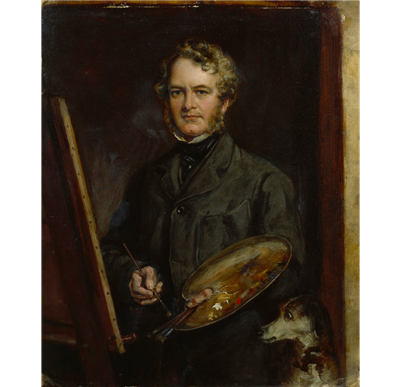
Linnell was drawing and selling portraits by the age of ten. His early teachers included Benjamin West and John Varley. He built a fortune as a fashionable portraitist before abandoning the genre around 1846 to focus on landscape.

Biography
He was born in Bloomsbury, London, in 1792. His most important personal connection was with William Blake: Linnell became Blake's patron and friend, commissioning the Illustrations of the Book of Job and introducing Blake to Samuel Palmer. Linnell's daughter married Palmer in 1837. He settled at Redhill, Surrey, in 1851 and spent three decades painting the pastoral landscape around his home. He died in 1882, at ninety.
Timeline
- 1792Born on 16 June in Bloomsbury, London, the son of a carver and gilder. By the age of ten he was drawing and selling portraits in chalk and pencil.
- 1805At 13, studied under the American-born painter Benjamin West and spent a year in the house of the watercolourist John Varley, alongside fellow pupils William Hunt and William Mulready.
- 1818Aged 26, became one of William Blake's closest friends and most important patrons in London. He later commissioned Blake's illustrations to the Book of Job and Dante's Inferno.
- 1824At 32, introduced the young Samuel Palmer to William Blake, a meeting that proved transformative for Palmer's art. Linnell's daughter Hannah later married Palmer.
- 1851Aged 59, settled at Redhill in Surrey, where he devoted himself almost entirely to painting landscapes of the North Downs and Kentish Weald, commanding high prices for his work.
- 1882Died on 20 January at Redhill, aged 89, having painted with undiminished energy until his final years.
Notable Works
Tap to view larger.
Where to See John Linnell
9 museums worldwide.
-
 2 works
Art Gallery of South Australia
Adelaide, Australia
10:00–17:00 daily, closed Christmas Day · Free
-
2 works
Bolton Museum
Bolton, United Kingdom
-
1 works
Blackburn Museum and Art Gallery
Blackburn, United Kingdom
Tue–Sat 11:00–16:45, closed Sun–Mon · Free
-
 1 works
Cooper Gallery
Barnsley, United Kingdom
Mon–Sat 10:00–16:00, closed Sundays and Bank Holidays · Free
-
1 works
Dundee Art Galleries and Museums
Dundee, United Kingdom
-
 1 works
McLean Museum and Art Gallery
Greenock, United Kingdom


Next stop
Romanticism →
Explore the artists and ideas of Romanticism.
John Linnell prints
Hand-finished archival prints from John Linnell's body of work.


Related Artists



Take John Linnell home.
See all John Linnell prints →Frequently Asked Questions
Does john linnell have kids?
John Linnell had a daughter who married Samuel Palmer in 1837. No other children are mentioned in the provided texts.What is John Linnell's most famous work?
John Linnell is best known for his paintings of rural England. He produced portraits and religious scenes, but his depictions of the countryside gained considerable attention. One work stands out: *The Timber Waggon*, completed in 1855. It exists in several versions. The initial oil sketch is in the Fitzwilliam Museum, Cambridge. Linnell painted at least two finished versions. One is owned by the National Gallery, London. Another is in the Yale Center for British Art. *The Timber Waggon* depicts a rural scene with farm labourers and a large wagon. The composition emphasises the relationship between humanity and nature. The sky is a prominent element, typical of Linnell's style. He carefully observed cloud formations and atmospheric effects. This attention to detail is apparent in many of his rural paintings. Although *The Timber Waggon* is a particularly well known work, Linnell produced art for over sixty years. He created many paintings and watercolours, and he was an active printmaker.What should I know about John Linnell's prints?
John Linnell (1792-1882) was an English painter, engraver, and writer. He is associated with the Shoreham School, a group of artists who drew inspiration from the work of William Blake and who depicted the countryside of Shoreham, Kent. Linnell produced original etchings and engravings, and he also authorised reproductive prints of his paintings. His early original printmaking includes multiple etchings of his patron, William Blake, including one dated 1823. Later, Linnell employed printmakers to create mezzotints of his popular paintings. These included *Sheep at Noon*, after his oil painting of 1850-60, and *The Storm*, after his 1854 painting. These were large-edition prints sold to a wide audience. The British Museum holds a number of Linnell's original prints, plus many reproductive prints after his work. Linnell also made reproductive prints after Old Master paintings. In 1832, he published a series of thirty soft-ground etchings after drawings by Michelangelo in the collection of Sir Thomas Lawrence. These were intended as student aids.What style or movement did John Linnell belong to?
John Linnell (1792-1882) was an English painter associated with the late Romantic movement. He is often linked to William Blake and Samuel Palmer. These artists shared a vision of mystical naturalism. Linnell's early work displays a Pre-Raphaelite attention to detail. Linnell's style is characterised by its detailed observation of nature. He had a strong interest in light and atmosphere. His paintings often depict rural scenes with an almost photographic realism, yet they also possess a sense of idealised beauty. He moved from painting miniatures and portraits to landscapes, which became his primary focus. Linnell was not part of any formal artistic group. He maintained an independent position throughout his career. He exhibited at the Royal Academy, but he also disagreed with its artistic policies. Some consider him a precursor to later movements, such as Impressionism, because of his interest in light and his plein air painting practice. His work influenced later generations of British artists interested in landscape painting.What techniques or materials did John Linnell use?
John Linnell primarily used oil paints. For his initial layers, he would use pure turpentine, gradually adding linseed oil in subsequent sessions, increasing the oil content by about 10% each time. He would finish with pure linseed oil after approximately ten sessions. When preparing his surfaces, Linnell used gessoed MDF, primed canvas adhered to MDF board, and primed canvas. He favoured artist-quality materials. For brushes, Linnell preferred filberts and flats made from hog hair, ranging in size from small to large. He avoided synthetic brushes, as he felt they lacked the springiness of hog hair. He found well-worn, blunt hog hair brushes particularly useful for achieving broad, expansive marks, and for preventing overly delicate or edgy marks.What was John Linnell known for?
John Linnell (1792-1882) was an English painter associated with the Romantic movement. Romanticism valued feeling and imagination over reason and order. Linnell's career spanned a period of change in British art, from the Georgian to the Regency era, and later the Victorian period. Romanticism encompassed poetry, fiction, music, and philosophy, and it promoted individual liberty. Romantic artists explored a higher reality than the everyday. William Blake, a Romantic poet and painter, unified emotion and reason in his work. Linnell's art reflects some Romantic ideals. He moved away from the strict Palladianism that had dominated British architecture, where beauty was considered objective. Instead, Romanticism embraced wildness and energy. Linnell, like other Romantic artists, was part of a shift away from Neoclassicism, with its emphasis on reason, and towards a focus on subjective emotion.When did John Linnell live and work?
John Linnell (1792-1882) was active as a painter and engraver in Britain during the 19th century. He was born in London, and he first exhibited at the Royal Academy in 1807. Linnell's early career involved both portraiture and subject pictures. He painted portraits of figures such as William Blake (c. 1820) and Thomas Robert Malthus (c. 1834). He also produced religious paintings and scenes inspired by the poetry of John Milton. From the 1850s onward, Linnell increasingly concentrated on rural subjects and biblical themes. He often depicted the North Downs near Redhill, Surrey, where he lived from 1852. His later works include "The Shepherd's Home" (1860) and "Under the Hawthorn" (1864). Linnell continued to paint until his death in 1882, leaving behind a substantial body of work that reflects his changing interests and the artistic trends of his time.When was john linnell born?
John Linnell was born in 1792 in United the United Kingdom and Ireland. John Linnell died in 1882, aged 90.Where can I see John Linnell's work?
John Linnell's art can be viewed in numerous public collections. The National Portrait Gallery, London, holds many portraits, including depictions of Thomas Carlyle and William Blake. Other UK institutions with his work include the Tate, the Victoria and Albert Museum, and the British Museum. Outside London, collections such as the Fitzwilliam Museum in Cambridge, the Ashmolean Museum in Oxford, and the National Galleries of Scotland also hold examples. Linnell is represented in several public collections outside the United Kingdom. These include the Metropolitan Museum of Art in New York, the National Gallery of Art in Washington, DC, and the Art Gallery of New South Wales in Sydney. These institutions offer opportunities to view his paintings, drawings, and prints. Examination of collection catalogues online will give details of current holdings and exhibition schedules.Where does john linnell live?
John Linnell settled at Redhill, Surrey, in 1851. He spent three decades painting the pastoral landscape around his home.Where was John Linnell from?
John Linnell (1723-1796) was the son of William Linnell, a furniture maker. John was recorded as attending St Martin’s Lane Academy. There, he was described as ‘an excellent carver in wood’. Linnell was a draughtsman, without parallel among furniture makers, both in his graphic technique and in his sophisticated grasp of design. Linnell executed a watercolour for a client. The comparatively low ceiling suggests that it may have been intended for a London house. As a design for a whole interior, it is something of a rarity among Linnell’s drawings, which are generally for individual pieces of furniture. He made designs for armchairs around 1765. One watercolour by John Linnell is for a ‘French’ armchair of similar character.Who did John Linnell influence?
John Linnell's influence is most apparent in the work of his son-in-law, Samuel Palmer, and other artists in Palmer's circle, sometimes called the Shoreham School. Linnell met Palmer in 1822 and encouraged him. Linnell's emphasis on direct observation from nature, combined with a visionary or religious interpretation, appealed to Palmer. Palmer's early work, such as his sketches and paintings made around Shoreham in Kent during the late 1820s and 1830s, show Linnell's impact. Palmer adopted Linnell's practice of making detailed studies of natural forms and using them as the basis for more imaginative compositions. Later in his career, Palmer moved away from Linnell's style. Other artists, such as George Richmond and Edward Calvert, were also associated with both Linnell and Palmer, and they reflect some of Linnell's artistic ideas in their work. A focus on close observation of nature, combined with a personal spiritual vision, is a characteristic that links these artists.
Sources
Editorial draws on the following primary and tertiary references for John Linnell.
- [1] museum Cleveland Museum of Art Used for: museum holdings.
- [2] museum Bolton Museum Used for: museum holdings.
- [3] museum Cooper Gallery Used for: museum holdings.
- [4] museum Temple Newsam Used for: museum holdings.
- [5] museum Art Gallery of South Australia Used for: museum holdings.
- [6] museum Art Institute of Chicago Used for: museum holdings.
- [7] wikidata Wikidata: Q250732 Used for: identifiers.
- [8] book Penelope J.E. Davies, Walter B. Denny, Frima Fox Hofrichter, Joseph Jacobs, Ann S. Roberts, David L. Simon, Janson's History of Art_ The Western Tradition (8th Edition) Used for: biography.
- [9] book Masterpieces of western art : a history of art in 900 individual studies from the Gothic to the present day Used for: biography.
- [10] book Engen, Rodney K, Pre-Raphaelite prints : the graphic art of Millais, Holman Hunt, Rossetti and their followers Used for: biography.
Editorial overseen by Solis Prints. Sources verified 2026-08-29. Click a source for details, or hover over [N] in the page above to preview.
Editorial standardsMethodologyCorrectionsAI disclosureAbout the editorial team