



Emily Kame Kngwarreye
Born around 1910[1] in the Utopia Homelands region of the Northern Territory, Emily Kame Kngwarreye did not begin painting on canvas until she was approximately 78 years old. An elder of the Anmatyerr people and custodian of ancestral ceremony, she had spent decades working on cattle stations and learning batik, co-founding the Utopia Women's Batik Group in 1978[1]. When the shift to acrylic paint came in 1988, she produced an estimated 3,000 canvases in the eight years before her death.
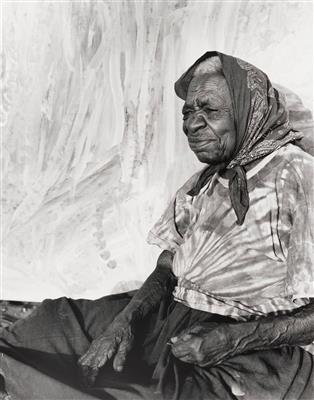
Biography
Her early acrylics drew on the dense dot patterns of Anmatyerr ceremonial body painting; later works moved toward broad, gestural stripes that drew comparisons in Western galleries to Abstract Expressionism. The comparison misses the point, as Kngwarreye made clear when taken to see a painting by the Australian[1] abstract expressionist Tony Tuckson at the Art Gallery of New South Wales. When a companion explained Tuckson's interest in mark-making, she responded: Oh poor fella, he got no story. No dreaming. Her own answer when asked about her work was consistent: My country, my dreaming, my story.
Her three major series include Earth's Creation I (1994[1]), Anwerlarr anganenty (Big Yam Dreaming, 1995, a canvas measuring over eight metres), and My Country: Final Series (1996[1]). In 1993, Prime Minister Paul Keating presented her with an Australian[1] Artist's Creative Fellowship. She was selected to represent Australia at the Venice Biennale, shown posthumously in 1997. Earth's Creation I sold at auction in 2007 for A$1.056 million; in 2017 it resold for A$2.1 million, setting a record for an Australian female artist at auction. A major retrospective at Tate Modern, London opened in 2025.
Kngwarreye died in Alice Springs on 3 September 1996[1], aged around 86.
Timeline
- 1910Born around 1910 in the Utopia Homelands region of the Northern Territory. She was an elder of the Anmatyerr people.
- 1978Co-founded the Utopia Women's Batik Group.
- 1988Began painting on canvas with acrylic paint, at around 78 years old.
- 1993Presented with an Australian Artist's Creative Fellowship by Prime Minister Paul Keating.
- 1994Created "Earth's Creation I".
- 1995Created "Anwerlarr anganenty (Big Yam Dreaming)", a canvas measuring over eight metres.
- 1996Created "My Country: Final Series".
- 1996Died in Alice Springs on 3 September, aged around 86.
- 1997Represented Australia posthumously at the Venice Biennale.
Notable Works
Tap to view larger.
Next stop
Browse the movements →
Every movement in the collection, from the Renaissance to Pop art.
Related Artists




Frequently Asked Questions
What is Emily Kame Kngwarreye known for?
Emily Kame Kngwarreye is known as Australia’s most acclaimed remote Indigenous artist. She produced an estimated 3,000 canvases in the eight years before her death. Her work has been exhibited at the Venice Biennale and Tate Modern.What is Emily Kame Kngwarreye's most famous work?
It is difficult to name one single work as Emily Kame Kngwarreye's "most famous". She is known as one of Australia’s most acclaimed remote Indigenous artists. Kngwarreye began painting on canvas relatively late in life, around the age of 80. Her works often related to her country, her dreaming, and her story; these were not pictures of her country as a representation, but a manifestation of its being. When asked if she painted her works, she said no; they were her country, her dreaming, and her story. Kngwarreye received the Australian[1] Artists Creative Fellowship (later known as "the Keatings") in 1989[1]. In 1993, after collecting her award in Canberra, she was taken to the Art Gallery of New South Wales. There, curators hoped she would relate to a painting by abstract expressionist Tony Tuckson. However, Kngwarreye was worried about her sick dogs back at Utopia and wanted to go home. When someone explained Tuckson’s painting process, Kngwarreye responded that he had "no story, no dreaming".What should I know about Emily Kame Kngwarreye's prints?
Emily Kame Kngwarreye (c.1910[1]-1996[1]) was an Australian[1] Aboriginal artist. While she is best known for her paintings, some prints of her work also exist. These are often screenprints, a printmaking technique using stencils to apply layers of ink to a surface. Screenprints allow for strong colours and bold designs. The prints are sometimes made after her original paintings. For example, Rosalie Gascoigne's Close Owly (1990[1]) is a screenprint made after one of her sculptural works. These types of prints are often collaborative efforts, involving the artist and professional printers. The printer's mark or signature may appear on the print. When examining a Kngwarreye print, check for details such as the print method (screenprint or offset reproduction), the edition number, and any signatures or chop marks. These factors can affect the print's value and authenticity.What style or movement did Emily Kame Kngwarreye belong to?
Emily Kame Kngwarreye (c.1910[1]-1996[1]) was an Australian[1] Aboriginal artist from the Utopia community in the Northern Territory. Although her work has been linked to abstract expressionism by some, this is a Western art-world interpretation. Kngwarreye herself did not relate to abstract expressionist techniques or intentions. Her paintings were deeply connected to her cultural heritage, country, dreaming, and personal story. For Kngwarreye, painting was like performing a ceremony; it connected her to her ancestor Alhalkere. The marks on the canvas were less important than the act of invoking an ancestral narrative. When asked about the meaning of her works, she would say, "My country, my dreaming, my story." This was more than just the subject of the painting; it was a literal manifestation of her being. Kngwarreye's art emerged during a period when Aboriginal art was being recognised outside of anthropological circles. Her work, along with that of other Indigenous women artists, broke away from the established style of dot painting. Her paintings possess an autonomous energy that embodies nature itself.What was Emily Kame Kngwarreye known for?
Emily Kame Kngwarreye (c. 1910[1]-1996[1]) was an Australian[1] Aboriginal artist from the Utopia community in the Northern Territory. She is celebrated as one of Australia's most significant contemporary artists. Kngwarreye's paintings relate to her cultural heritage and country. When questioned about the meaning of her artworks, she would say: "My country, my dreaming, my story." This phrase indicates that her paintings were more than just depictions; they were literal manifestations of her country and her being. For Kngwarreye, painting was a performance, like a ceremony that connected her to her ancestor Alhalkere. The act of painting, often accompanied by singing, was complete once she finished. Her rise in the art world occurred during a period when there was an effort to distinguish Aboriginal art from anthropological interpretations. Kngwarreye received the Australian Artists Creative Fellowship in 1993[1].When did Emily Kame Kngwarreye live and work?
Emily Kame Kngwarreye was born around 1910[1] and died in 1996[1]. She was an Aboriginal Australian[1] artist from the Utopia community in the Northern Territory. Although she had engaged in some art-making for decades, Kngwarreye came to wider notice very late in her life. She began her artistic career producing batik work in the 1980s. These works on silk were commercially successful. However, she soon moved to painting on canvas. Her style is abstract, using colour and form to evoke the Australian outback. Her paintings often relate to her cultural background and personal connection to the land. Kngwarreye's rise to prominence was rapid. She had her first solo exhibition in 1990[1], and her work was soon included in major collections and exhibitions both in Australia and internationally. She produced a large body of work in a relatively short time, creating over 3,000 paintings in the last seven years of her life.Where was Emily Kame Kngwarreye from?
Emily Kame Kngwarreye (circa 1910[1]-1996[1]) was an Australian[1] Aboriginal artist from Utopia, in the Northern Territory. She began painting late in life, after co-founding a communal women's batik group there. Her Anmatyerre language name was Kame-Angwarreye. Kngwarreye's paintings relate to her connection to the land, as expressed in the stories and traditions known as the Dreaming. She stated that her paintings were of "my country, my dreaming, my story", meaning that they were literal manifestations of her country and of herself. Her works do not depict the external appearance of the Australian terrain; instead, they represent its inner being. The vastness of the Australian countryside is suggested by the large size of many of her paintings. Kngwarreye received the Keating Award in 1993[1]. She is regarded as one of Australia’s most important Indigenous artists.Who did Emily Kame Kngwarreye influence?
Emily Kame Kngwarreye's art moved away from the established abstract dotting styles. Other Indigenous women artists also pursued this direction in the Australian[1] art world during the early to mid-1990s. Pantjiti Mary McLean is one such artist. Her work, like Kngwarreye's, reflected a maturity of style not bound to the conventions of its day. McLean shares with Kngwarreye and Tjapartji Bates an autonomous and exuberant energy. This energy seems to embody nature itself; it is not a romantic conception of nature, but one in which nature is constituted by information. Bates' work shifts from iconic representations of the country to a more idiosyncratic mark-making that repeats signs to shift their emphasis. When visiting McLean in Kalgoorlie in 1993[1], she also moved into figuration, painting alongside her as part of Searles’ program. These artists share a sense of rhythm, in which animal typologies hold within themselves the differences and identities of their own mark.Who influenced Emily Kame Kngwarreye?
Emily Kame Kngwarreye's artistic development occurred in a unique cultural context. Although comparisons have been drawn between her works and those of abstract expressionist artists such as Tony Tuckson, Kngwarreye did not acknowledge these connections. When curators tried to draw connections between Tuckson's mark-making and her own work, she responded that he had "no story. No dreaming". She saw only a collection of meaningless marks, as Tuckson's paintings did not relate an ancestral narrative. Kngwarreye's paintings were not pictures of her country; they were the literal manifestation of its being. For Kngwarreye, painting on canvas was like performing ceremony, accompanied by singing, and a means of connecting with her ancestor Alhalkere. Once the performance of painting was over, the job was done. Other influences include the art-making trips with Searles in 1996[1], 1998 and 2002, just as painting materials were becoming more available to artists. Thelma McLean's figurative painting may also have been an influence. McLean's work references cave paintings of Uluru and the Musgrave Ranges, placing her work into a continuum of visual culture.Who was Emily Kame Kngwarreye?
Emily Kame Kngwarreye (c.1910[1]-1996[1]) was an Australian[1] Aboriginal artist from the Utopia community in the Northern Territory. She is considered one of Australia’s most important remote Indigenous artists. Kngwarreye began painting on canvas relatively late in life, but quickly gained national and international recognition. In 1993[1], she received the Keating Award. In 1995, she won the National Aboriginal and Torres Strait Islander Art Award (the Telstra Prize). The following year, she was selected as the Festival of Perth artist. Her paintings relate to her connection with her country, her dreaming, and her story. Kngwarreye saw her paintings as manifestations of her country's being, not simply pictures of it. For her, painting was like performing a ceremony, often accompanied by singing. Touching the surface of the painting connected her to her ancestor Alhalkere. Kngwarreye’s work has been compared to Western abstract expressionism. When curators asked Kngwarreye about which way to hang her works, horizontal or vertical, she would dismiss the question. In her mind, her job was done once she had finished painting. It did not matter to her how or where her paintings were hung, in an art gallery or ethnographic museum.Why are Emily Kame Kngwarreye's works important today?
Emily Kame Kngwarreye (c.1910[1]-1996[1]) is a significant figure in Australian[1] art. One reason is the way her paintings challenge Western art conventions. Kngwarreye's abstract style invites comparisons to Western abstraction; however, her work is rooted in her cultural heritage. Her paintings embody "my country, my dreaming, my story", representing a literal manifestation of her country and her being. When asked if she painted them, she answered, 'no', because they are 'my country, my dreaming, my story'. Another reason for her importance is that her art arose during a shift in the art world, moving Aboriginal art from ethnographic contexts to fine art galleries. This shift involved overcoming political correctness and recognising the transcultural relations that have transformed Aboriginal art since colonisation. Kngwarreye's art demands a relational agency, acknowledging and valuing all players and cultural contexts. Her work highlights the intermeshing of differences, a key feature of contemporary art's discourse, and provides a space where previously incommensurable differences are brought into alignment.What was Emily Kame Kngwarreye's art style?
Emily Kame Kngwarreye's early acrylics featured dense dot patterns reminiscent of Anmatyerr ceremonial body painting. Her later works shifted towards broad, gestural stripes. Some Western galleries have drawn comparisons between her work and Abstract Expressionism.
Sources
Editorial draws on the following primary and tertiary references for Emily Kame Kngwarreye.
- [1] wikipedia Wikipedia: Emily Kame Kngwarreye Used for: biography, birth dates, death dates, identifiers, movement attribution, nationality.
- [2] book McLean, Ian; , Double Desire Used for: biography, stylistic analysis.
- [3] book downmagaz.net, downmagaz.net Used for: biography, stylistic analysis.
- [4] book guggenheim-antipod00benj Used for: biography.
Editorial overseen by Solis Prints. Sources verified 2026-08-29. Click a source for details, or hover over [N] in the page above to preview.
Editorial standardsMethodologyCorrectionsAI disclosureAbout the editorial team