



Felix Nadar
Gaspard-Félix Tournachon — known to the world simply as Nadar — built one of the nineteenth century's most formidable portrait studios without ever intending to become a photographer. He trained briefly as a doctor, worked as a caricaturist and novelist, and only turned seriously to the camera in 1854[1]. Within a decade he had photographed Victor Hugo, Sarah Bernhardt, Franz Liszt, Alexandre Dumas, Baudelaire, Delacroix, and Wagner, producing a visual archive of Second Empire Paris that remains without equal.
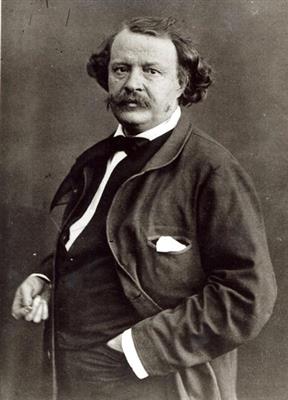
Biography
Nadar's restless ambition refused to stay earthbound. In 1858[1] he became the first person to take aerial photographs, shooting Paris from a hot air balloon using the wet-plate collodion process — a feat requiring considerable nerve given the open flame needed to ignite the magnesium flash beside a hydrogen balloon. He followed this by photographing the Paris catacombs with artificial lighting in 1861, demonstrating that photography could function in total darkness. Both achievements were decisive technical firsts.
His studio at 35 Boulevard des Capucines became one of the most fashionable addresses in Paris, and in April 1874[1] he lent the second-floor space to a group of painters who had been rejected by the Salon. That group — Monet, Pissarro, Degas, Renoir, Morisot among them — held what became known as the first Impressionist exhibition. The natural side lighting and modest scale of Nadar's rooms, the critics later noted, suited the small-format, intimately observed canvases perfectly.
During the Franco-Prussian War of 1870[1]-71, Nadar organised the balloon post that carried mail and dispatches out of besieged Paris over German lines, personally supervising the extraction of the war minister Léon Gambetta. He lived until 1910[1], long enough to conduct what is considered one of the first photo-interviews and to see aviation move from balloon to aeroplane. He was ninety when he died.
Timeline
- 1820Born Gaspard-Félix Tournachon in Paris.
- 1854Turned to photography as a profession.
- 1858Took the first aerial photographs of Paris from a hot air balloon.
- 1861Photographed the Paris catacombs using artificial lighting.
- 1870Organised the balloon post during the Franco-Prussian War to carry mail out of besieged Paris.
- 1874Lent his studio at 35 Boulevard des Capucines to a group of painters, including Monet and Renoir, for the first Impressionist exhibition.
- 1910Died at 90. He lived long enough to see aviation move from balloon to aeroplane.
Notable Works
Tap to view larger.
Next stop
Browse the movements →
Every movement in the collection, from the Renaissance to Pop art.
Related Artists



Frequently Asked Questions
What is Felix Nadar's most famous work?
Gaspard Felix Tournachon (pen name Nadar) was a noted journalist, writer, and cartoonist. He gained considerable recognition as a photographer, particularly for his portraits of contemporary figures. Nadar's photographic subjects included Alexander Dumas, George Sand, Charles Baudelaire, Eugene Delacroix, Honoré Daumier, Gustave Doré, Giacomo Meyerbeer, Charles Gounod, Richard Wagner, and Sarah Bernhardt, among others. Beyond portraiture, Nadar was an adventurous airman. During the Franco-Prussian War, he flew over German troops to deliver mail from besieged Paris. In 1871[1], he transported Gambetta out of the city via balloon. Nadar pioneered aerial photography, capturing bird's-eye views of Paris from his balloon. He also photographed the Parisian catacombs, which had been discovered in the mid-19th century.What should I know about Felix Nadar's prints?
Nadar, a 19th-century photographer, gained fame for his wet-plate photographic portraits. He also produced the first aerial photographs of Paris in 1858[1] from his balloon Le Géant. When considering Nadar's prints, it is useful to understand photographic print terminology. A "vintage print" is made around the time the negative was taken. A "period print" is one made within roughly 10 to 15 years after. If the printing time is unknown or more than 15 years after the shot, it is termed an "old print". A "modern print" is a recent print from the original negative. An "original print" is made by the artist or under their supervision. The market considers the individual execution of a photographic print to be a sign of originality. A photographer's signature acknowledges the print's conformity with their idea. The number of prints in a run is less important.What techniques or materials did Felix Nadar use?
Gaspar-Félix Tournachon (1820[1]-1910[1]), known as Nadar, was a French photographer, caricaturist, journalist, novelist, and balloonist. Nadar's photographic studies for his caricatures led him to open a portrait studio. Nadar was an early master of an improved calotype photography. He used glass negatives and albumen printing paper (prepared with egg white). This combination could record finer detail and a wider range of light and shadow than Talbot’s calotype process. The wet-plate technology, where the photographic plate was exposed, developed, and fixed while wet, quickly became the universal way of making negatives until 1880[1]. However, wet-plate photography had drawbacks. The plates had to be prepared and processed on the spot. Working outdoors meant taking along a portable darkroom, such as a wagon, tent, or box with light-tight sleeves. The calotype photographic process made possible the range of tones in Nadar’s images.What was Felix Nadar known for?
Gaspard Felix Tournachon, known as Nadar, was a prominent figure in 19th-century France. He worked as a journalist, writer, and cartoonist. Nadar gained recognition as a photographer, creating portraits of notable contemporaries. His subjects included Alexander Dumas, Georges Sand, Charles Baudelaire, Eugene Delacroix, Honoré Daumier, Gustave Doré, Giacomo Meyerbeer, Charles Gounod, Richard Wagner, and Sarah Bernhardt. Beyond his artistic pursuits, Nadar was a courageous airman. During the Franco-Prussian War, he flew over German troops to deliver mail from besieged Paris. In 1871[1], he transported Gambetta out of the city via balloon. Nadar pioneered aerial photography, capturing bird's-eye views of Paris from his balloon. He also photographed the Parisian catacombs after their mid-19th century discovery. His work was known in locations such as London, Paris, and Australia.When did Felix Nadar live and work?
Gaspard Félix Tournachon, known as Nadar, was active in Paris and London during the 19th century. He was a man of many talents: journalist, writer, draughtsman, caricaturist, photographer, and aeronaut. Nadar is remembered as a distinguished photographer, creating portraits of notable contemporaries. His subjects included Alexandre Dumas, George Sand, Charles Baudelaire, Eugène Delacroix, Honoré Daumier, and Sarah Bernhardt. His photography studio was located at 35, boulevard des Capucines, in Paris. The future Impressionists found optimal conditions for the “free expression of individual talents” there. Beyond photography, Nadar was a fearless aeronaut. In 1863[1], he founded the Société Générale d'Aérostation et d'Autolocomotion Aérienne and launched a newspaper called L'Aéronaute. He constructed Le Géant, the world's largest hot-air balloon. During the Franco-German war, Nadar used balloons to deliver mail from besieged Paris. He also enabled Léon Gambetta, the French war minister, to escape from the capital in 1871. Nadar pioneered aerial photography, capturing the first bird's-eye view of Paris from an aerostat. He also photographed the catacombs of Paris after they opened to the public in the mid-1800s.Where can I see Felix Nadar's work?
Nadar's photographs can be viewed in several public collections. Many are held by museums in the United States, such as the Metropolitan Museum of Art (New York), the Museum of Modern Art (New York), the Museum of Photographic Arts (San Diego), and the National Gallery of Art (Washington). Other US institutions holding his work include the Philadelphia Museum of Art, the Seattle Art Museum, and the Toledo Museum of Art (Ohio). In Europe, Nadar's works can be seen at the Musée d'Orsay in Paris, the National Gallery of Canada (Ottawa), and the Maison de Victor Hugo (Paris). Other collections are held by the National Museum of Photography, Film & Television (Bradford, England), the Victoria and Albert Museum (London), and the Rijksmuseum (Amsterdam).Where was Felix Nadar from?
Gaspard Felix Tournachon (1820[1]-1910[1]), known as Nadar, worked as a journalist, writer, cartoonist, and photographer. He was known in London and Paris, as well as in Australia and other parts of Europe. He photographed many important people of his time, including Alexander Dumas, Georges Sand, Charles Baudelaire, Eugene Delacroix, Honoré Daumier, Gustave Doré, Giacomo Meyerbeer, Charles Gounod, Richard Wagner, and Sarah Bernhardt. Nadar was also an aeronaut. In 1863[1], he created the Société generate d'Aerostation et d'Autolocomotion Aerienne and a newspaper called L'Aeronaute. He also built the world's largest hot-air balloon. It stood 180 feet tall, used almost twelve miles of silk, and was inflated with 200,000 cubic feet of hydrogen. The balloon's wicker gondola included a photographic laboratory, a refreshment room, a lavatory, and a billiard table.Who did Felix Nadar influence?
Nadar, a French novelist, journalist, balloonist, and caricaturist, opened a portrait studio after using photography for his caricatures. His talent for capturing his subjects' essence attracted important French figures, including Delacroix, Daumier, Courbet, and Manet, who had their portraits taken by him. His photographic portraits gained such recognition that Daumier created a lithograph in response to a court decision in 1862[1] acknowledging photography as an art form. The lithograph depicts Nadar energetically taking pictures from his balloon over Parisian rooftops, a reference to his aerial photographs of Paris taken in 1858 from his balloon Le Géant (The Giant). The flattening of spatial perspective and emphasis on the relationships between figures in Nadar's work intrigued the Impressionists, especially Degas.Who influenced Felix Nadar?
Gaspard Félix Tournachon (1828[1]-1910[1]), known as Nadar, was a French novelist, journalist, caricaturist, and photographer. His photographic portraiture was among the first to use improved calotype technology. Nadar's photographic studies for his caricatures led him to open a portrait studio. He sought to capture the essence of his subjects, aiming for "that instant of understanding that puts you in touch with the model". His talent attracted important figures in France, including Eugène Delacroix, Honoré Daumier, Gustave Courbet, and Édouard Manet, all of whom sat for portraits in his studio. Nadar's portraits flatten spatial perspective and emphasise the relationships of figures; the Impressionists, especially Edgar Degas, found this approach intriguing. Nadar was also an enthusiastic balloonist. During the Franco-German war, he used balloons to deliver mail from besieged Paris. He was the first person to photograph Paris from above, capturing a bird's-eye view from an aerostat. He also photographed the catacombs of Paris. Nadar's studio, located at 35, boulevard des Capucines, was later used by the Impressionists for exhibitions.Who was Felix Nadar?
Gaspard Félix Tournachon, known as Nadar, was a prominent 19th-century French figure; he worked as a journalist, writer, draughtsman, caricaturist, photographer, and aeronaut. According to a contemporary, Nadar was well-known across Europe and Australia. As a photographer, he created portraits of famous individuals, including Alexandre Dumas, George Sand, Charles Baudelaire, Eugène Delacroix, and many others. Nadar was also an enthusiastic aeronaut. In 1863[1], he established the Société Générale d'Aérostation et d'Autolocomotion Aérienne and a newspaper called L'Aéronaute. He commissioned the construction of Le Géant, the world's largest hot-air balloon. On its maiden voyage, witnessed by over 500,000 Parisians, the balloon's twelve passengers included the art critic Paul de Saint-Victor. During the Franco-German war, Nadar used balloons to deliver mail from besieged Paris. He also enabled Léon Gambetta, the French war minister, to escape from the capital in 1871. Nadar pioneered aerial photography, capturing the first bird's-eye-view photographs of Paris from an aerostat. He also photographed the catacombs of Paris after they opened to the public.Why are Felix Nadar's works important today?
Gaspar-Félix Tournachon (1820[1]-1910[1]), known as Nadar, was a French novelist, journalist, caricaturist, and photographer. His photographic portraits are important because they capture the essence of his subjects. Nadar aimed for "that instant of understanding that puts you in touch with the model", producing what he called "an intimate portrait". Nadar's talent attracted important figures in France to his studio, including Delacroix, Daumier, Courbet, and Manet. His portraits flatten the spatial perspective, emphasising the relationships between figures, which intrigued the Impressionists, especially Degas. Nadar achieved fame for his wet-plate photographic portraits. Daumier created a lithograph of Nadar in his balloon, commenting on photography's struggle for recognition as a fine art. This followed an 1862[1] court decision acknowledging photography's artistic status and copyright protection. Nadar's aerial photographs of Paris, taken in 1858 from his balloon Le Géant, also mark him as an innovator. His work represents an early, artistic approach to photography.How did Felix Nadar die?
Nadar lived until 1910[1] and died at the age of ninety.
Sources
Editorial draws on the following primary and tertiary references for Felix Nadar.
- [1] wikipedia Wikipedia: Felix Nadar Used for: biography, birth dates, death dates, identifiers, movement attribution, nationality.
- [2] book Ross King, The Judgment of Paris Used for: biography.
Editorial overseen by Solis Prints. Sources verified 2026-09-22. Click a source for details, or hover over [N] in the page above to preview.
Editorial standardsMethodologyCorrectionsAI disclosureAbout the editorial team