



About Felix Nadar
1820–1910
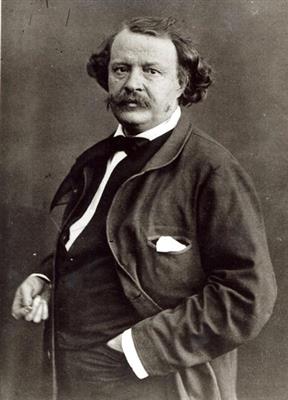
Pioneering French portrait photographer and aeronaut who captured the luminaries of Second Empire Paris and hosted the first Impressionist exhibition.
Museums7
Countries2
Largest reported holdingNational Gallery of Art, Washington D.C. · 5 recorded works
Loading map…
Where to see Felix Nadar
Collection holdings are reported here; current display varies. Check with each museum before visiting.
-
5 recorded works
National Gallery of Art
Washington D.C., United States
-
4 recorded works
Metropolitan Museum of Art
New York City, United States


-
3 recorded works
J. Paul Getty Museum
Los Angeles, United States
-
3 recorded works
Bibliothèque nationale de France
Paris, France
-
1 recorded work
Museum of Modern Art
New York City, United States
-
1 recorded work
Musée d'Orsay
Paris, France
-
1 recorded work
Museum of Fine Arts, Houston
Houston, United States


Frequently Asked Questions
Where can I see Felix Nadar's work?
Nadar's photographs can be viewed in several public collections. Many are held by museums in the United States, such as the Metropolitan Museum of Art (New York), the Museum of Modern Art (New York), the Museum of Photographic Arts (San Diego), and the National Gallery of Art (Washington). Other US institutions holding his work include the Philadelphia Museum of Art, the Seattle Art Museum, and the Toledo Museum of Art (Ohio). In Europe, Nadar's works can be seen at the Musée d'Orsay in Paris, the National Gallery of Canada (Ottawa), and the Maison de Victor Hugo (Paris). Other collections are held by the National Museum of Photography, Film & Television (Bradford, England), the Victoria and Albert Museum (London), and the Rijksmuseum (Amsterdam).What should I know about Felix Nadar's prints?
Nadar, a 19th-century photographer, gained fame for his wet-plate photographic portraits. He also produced the first aerial photographs of Paris in 1858[1] from his balloon Le Géant. When considering Nadar's prints, it is useful to understand photographic print terminology. A "vintage print" is made around the time the negative was taken. A "period print" is one made within roughly 10 to 15 years after. If the printing time is unknown or more than 15 years after the shot, it is termed an "old print". A "modern print" is a recent print from the original negative. An "original print" is made by the artist or under their supervision. The market considers the individual execution of a photographic print to be a sign of originality. A photographer's signature acknowledges the print's conformity with their idea. The number of prints in a run is less important.Why are Felix Nadar's works important today?
Gaspar-Félix Tournachon (1820[1]-1910[1]), known as Nadar, was a French novelist, journalist, caricaturist, and photographer. His photographic portraits are important because they capture the essence of his subjects. Nadar aimed for "that instant of understanding that puts you in touch with the model", producing what he called "an intimate portrait". Nadar's talent attracted important figures in France to his studio, including Delacroix, Daumier, Courbet, and Manet. His portraits flatten the spatial perspective, emphasising the relationships between figures, which intrigued the Impressionists, especially Degas. Nadar achieved fame for his wet-plate photographic portraits. Daumier created a lithograph of Nadar in his balloon, commenting on photography's struggle for recognition as a fine art. This followed an 1862[1] court decision acknowledging photography's artistic status and copyright protection. Nadar's aerial photographs of Paris, taken in 1858 from his balloon Le Géant, also mark him as an innovator. His work represents an early, artistic approach to photography.What techniques or materials did Felix Nadar use?
Gaspar-Félix Tournachon (1820[1]-1910[1]), known as Nadar, was a French photographer, caricaturist, journalist, novelist, and balloonist. Nadar's photographic studies for his caricatures led him to open a portrait studio. Nadar was an early master of an improved calotype photography. He used glass negatives and albumen printing paper (prepared with egg white). This combination could record finer detail and a wider range of light and shadow than Talbot’s calotype process. The wet-plate technology, where the photographic plate was exposed, developed, and fixed while wet, quickly became the universal way of making negatives until 1880[1]. However, wet-plate photography had drawbacks. The plates had to be prepared and processed on the spot. Working outdoors meant taking along a portable darkroom, such as a wagon, tent, or box with light-tight sleeves. The calotype photographic process made possible the range of tones in Nadar’s images.Who did Felix Nadar influence?
Nadar, a French novelist, journalist, balloonist, and caricaturist, opened a portrait studio after using photography for his caricatures. His talent for capturing his subjects' essence attracted important French figures, including Delacroix, Daumier, Courbet, and Manet, who had their portraits taken by him. His photographic portraits gained such recognition that Daumier created a lithograph in response to a court decision in 1862[1] acknowledging photography as an art form. The lithograph depicts Nadar energetically taking pictures from his balloon over Parisian rooftops, a reference to his aerial photographs of Paris taken in 1858 from his balloon Le Géant (The Giant). The flattening of spatial perspective and emphasis on the relationships between figures in Nadar's work intrigued the Impressionists, especially Degas.Who influenced Felix Nadar?
Gaspard Félix Tournachon (1828[1]-1910[1]), known as Nadar, was a French novelist, journalist, caricaturist, and photographer. His photographic portraiture was among the first to use improved calotype technology. Nadar's photographic studies for his caricatures led him to open a portrait studio. He sought to capture the essence of his subjects, aiming for "that instant of understanding that puts you in touch with the model". His talent attracted important figures in France, including Eugène Delacroix, Honoré Daumier, Gustave Courbet, and Édouard Manet, all of whom sat for portraits in his studio. Nadar's portraits flatten spatial perspective and emphasise the relationships of figures; the Impressionists, especially Edgar Degas, found this approach intriguing. Nadar was also an enthusiastic balloonist. During the Franco-German war, he used balloons to deliver mail from besieged Paris. He was the first person to photograph Paris from above, capturing a bird's-eye view from an aerostat. He also photographed the catacombs of Paris. Nadar's studio, located at 35, boulevard des Capucines, was later used by the Impressionists for exhibitions.What is Felix Nadar's most famous work?
Gaspard Felix Tournachon (pen name Nadar) was a noted journalist, writer, and cartoonist. He gained considerable recognition as a photographer, particularly for his portraits of contemporary figures. Nadar's photographic subjects included Alexander Dumas, George Sand, Charles Baudelaire, Eugene Delacroix, Honoré Daumier, Gustave Doré, Giacomo Meyerbeer, Charles Gounod, Richard Wagner, and Sarah Bernhardt, among others. Beyond portraiture, Nadar was an adventurous airman. During the Franco-Prussian War, he flew over German troops to deliver mail from besieged Paris. In 1871[1], he transported Gambetta out of the city via balloon. Nadar pioneered aerial photography, capturing bird's-eye views of Paris from his balloon. He also photographed the Parisian catacombs, which had been discovered in the mid-19th century.What was Felix Nadar known for?
Gaspard Felix Tournachon, known as Nadar, was a prominent figure in 19th-century France. He worked as a journalist, writer, and cartoonist. Nadar gained recognition as a photographer, creating portraits of notable contemporaries. His subjects included Alexander Dumas, Georges Sand, Charles Baudelaire, Eugene Delacroix, Honoré Daumier, Gustave Doré, Giacomo Meyerbeer, Charles Gounod, Richard Wagner, and Sarah Bernhardt. Beyond his artistic pursuits, Nadar was a courageous airman. During the Franco-Prussian War, he flew over German troops to deliver mail from besieged Paris. In 1871[1], he transported Gambetta out of the city via balloon. Nadar pioneered aerial photography, capturing bird's-eye views of Paris from his balloon. He also photographed the Parisian catacombs after their mid-19th century discovery. His work was known in locations such as London, Paris, and Australia.
Sources
Where to See guide aggregates verified holdings of Felix Nadar's works across the following collections.
- [1] wikipedia Wikipedia: Felix Nadar Used for: biography.
- [2] book Ross King, The Judgment of Paris Used for: biography.
Editorial overseen by Solis Prints. Sources verified 2026-09-30. Click a source for details, or hover over [N] in the page above to preview.
Editorial standardsMethodologyCorrectionsAI disclosureAbout the editorial team