

Jenny Saville
- Contemporary
- New Figurative
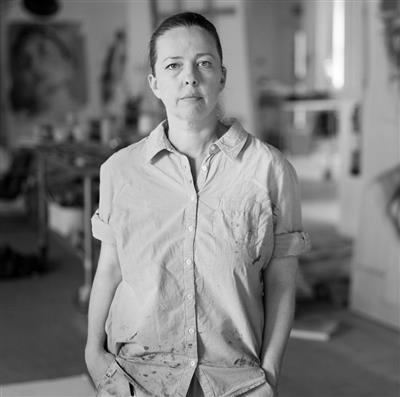
Jenny Saville, a British painter born in 1970, redefined how the female figure is presented in contemporary art. Her large-scale oil paintings challenge conventional beauty standards, depicting bodies with a raw, unflinching honesty. She became known as part of the Young British Artists movement, though her focus on classical painting techniques and the human figure set her apart from many of her contemporaries.
Biography
Her meticulous approach often involves direct observation. For her early works, Saville spent time in plastic surgery clinics in New York, studying the human body under various forms of alteration. This research informed her powerful portrayals of flesh, weight, and volume. She applies paint thickly, building up layers that give her figures a sculptural presence and explore themes of identity and perception.
Saville's career gained significant momentum when Charles Saatchi acquired her graduate show piece, *Propped* (1992). This acquisition, made while she was still a student at the Slade School of Fine Art, quickly brought her work to a wider audience. Since then, her paintings have continued to command attention, establishing her as a leading voice in contemporary figurative art.
Timeline
- 1970Born in Britain.
- 1992Charles Saatchi acquired her graduate show piece, "Propped", while Saville was a student at the Slade School of Fine Art.
- 1992Gained recognition as part of the Young British Artists movement.
- 1992Her work began to reach a wider audience after Saatchi's acquisition.
Notable Works
Tap to view larger.
Next stop
Contemporary →
Explore the artists and ideas of Contemporary.
Related Artists
_%E2%80%93_LOC.jpg)
.jpg)


Frequently Asked Questions
What is Jenny Saville known for?
Jenny Saville is best known for her large-scale paintings of women's bodies. Her early works often featured herself as the main subject, even though she exaggerated her form. As a female painter, she portrayed the subject from a different perspective.What is Jenny Saville's most famous work?
Jenny Saville is best known for large paintings of women's bodies. Saville studied at the Glasgow School of Art, and she also received a scholarship from the University of Cincinnati. Subsequently, Charles Saatchi offered her a contract to paint more. She gained international recognition in the 1990s, after being included in the Young British Artists’ exhibitions. Her 1992 oil on canvas *Propped* is among her most discussed works. It is a self-portrait showing a nude woman in front of a mirror. The painting challenges conventional standards of beauty. Saville has said that she grew up in the 1980s, when body regulation became a cultural obsession. The painting was displayed with a mirror hanging opposite it when first exhibited. The quotation scratched across the canvas is from an essay by Luce Irigaray, which discusses male-female relations. Saatchi purchased every work that Saville would sell to him after seeing *Propped*.What should I know about Jenny Saville's prints?
Jenny Saville is known for her large-scale paintings and drawings. She has also produced prints, often in limited editions. A limited edition is when an artist decides to cap the number of prints produced. This decision is the artist's choice, not a technical requirement. The edition is limited by a written statement, usually in pencil, at the bottom of the print. This statement typically includes the print number and the total edition size (for example, 3/25 indicates the third print in an edition of 25). The title is written in the centre, and the artist's signature is on the right. Prints on paper are susceptible to environmental changes. Japanese paper, for example, should be stored interleaved with acid-free tissue in a drawer or box. Pigments can fade if prints are hung in bright light for extended periods. Some colours fade faster than others, altering the print's appearance. Vermilion can turn black over time. It is best not to hang prints over radiators or other heat sources.What style or movement did Jenny Saville belong to?
Jenny Saville is associated with the Young British Artists (YBAs), a group who became prominent in the late 1980s and 1990s. The YBAs are known for their entrepreneurial attitude, use of shock tactics, and interest in popular culture. Saville's large-scale paintings often depict the female nude, challenging conventional representations of beauty and the body. Her work engages with themes of obesity, disfigurement, and the abject. Saville studied at the Glasgow School of Art from 1988 to 1992, and then at the University of Cincinnati. In Ohio, she was able to observe plastic surgery procedures. This experience had a marked impact on her artistic practice. While Saville shares some characteristics with the YBAs, such as a willingness to confront difficult subjects, her focus on painting and her engagement with art-historical precedents set her apart from some of her peers, who worked in diverse media. Her influences include Lucian Freud and Francis Bacon. Saville's work contributes to contemporary debates about the body, representation, and the gaze.What techniques or materials did Jenny Saville use?
Jenny Saville, born in 1970, is best known for large paintings of women's bodies. She often depicts fleshy figures with exaggerated elements, contrasting with traditional representations. Saville's technique involves thick impasto and fluid paint application. She uses subtle colour changes to create the appearance of mottled flesh. In works such as *Plan*, she painted women with surgical markings, resembling topographical maps. Saville observed a New York plastic surgeon in the operating theatre in the year she began that work. When working with oil paints, the drying times can cause problems. If the paint is over-brushed, the top layer will mix with the wet paint underneath, and this can result in the colour becoming muddy or chalky. One technique to manage this is called ‘tonking’, where the medium from the paint will have been removed. Saville's early success is attributed to Charles Saatchi, who commissioned fifteen of her paintings after spotting her work at the 'Critics' Choice' show in 1993.What was Jenny Saville known for?
Jenny Saville, born in Cambridge in 1970, is best known for her large paintings of women's bodies. She attended the Glasgow School of Art, and a scholarship allowed her to study at the University of Cincinnati. Saville gained international attention in the 1990s as part of the Young British Artists exhibitions. Her works often feature over-life-size self-portraits with exaggerated proportions; she depicts heavy folds of flesh and visible veins, often from sharply foreshortened angles. One of her paintings, *Branded* (1992), features words like "delicate" inscribed on her flesh. Saville's art is often seen as a commentary on contemporary society's obsession with idealised body images. Some critics have described her paintings as embodying a "feminist aesthetics of disgust". Saville has stated that she aims to challenge history, tradition, and cultural conventions in her work. She lives and works in Palermo, Italy.When did Jenny Saville live and work?
Jenny Saville was born in Cambridge, England, in 1970. She is known for her large paintings of women's bodies. Saville studied art at the Glasgow School of Art. During her time there, she received a six-month scholarship from the University of Cincinnati. While still a student in Glasgow, she painted a self-portrait, *Plan*, showing surgical markings on the contours of the body. For this work, she observed a New York plastic surgeon in the operating theatre. *Plan* won the Newbery Medal, the highest award given to a Glasgow student. In the 1990s, Saville gained international recognition after being included in the Young British Artists exhibitions. The businessman and art dealer Charles Saatchi offered her a contract to paint more. Saville's early works often featured herself as the main subject, even when she exaggerated her form. As a female painter, she aimed to present a different perspective in a male-dominated world.Where can I see Jenny Saville's work?
Jenny Saville's paintings and drawings are held in numerous public collections. These include the Metropolitan Museum of Art in New York, the San Francisco Museum of Modern Art, and the Broad Art Foundation in Los Angeles. In Britain, her work can be found at the Scottish National Gallery of Modern Art in Edinburgh and the Tate in London. Saville is represented by Gagosian, a multinational gallery with locations in New York, Los Angeles, London, Paris, Basel, Geneva, and Hong Kong. Her work is often included in their exhibition programmes. Saville's pieces are also frequently sold at auction. Major auction houses such as Sotheby's and Christie's regularly feature her work in their contemporary art sales. These sales take place in cities such as London, New York, and Paris. Checking museum websites, gallery listings, and auction catalogues will provide information on current and upcoming exhibitions or sales that include Saville's art.Where was Jenny Saville from?
Jenny Saville was born in Cambridge, England, in 1970. She is best known for her large-scale paintings of women's bodies. Saville received her art degree from the Glasgow School of Art. While studying in Glasgow, she received a six-month scholarship from the University of Cincinnati. During her time as a student, Saville observed a New York plastic surgeon in the operating theatre. This experience led her to paint women with surgical markings, resembling topographical maps, on their bodies. One such work, titled *Plan*, depicted lines drawn on a woman's body to designate liposuction areas. Saville created this work while still a student at the Glasgow School of Art, and it received the Newbery Medal, the highest award given to a Glasgow student. In the 1990s, Saville gained international recognition as part of the Young British Artists exhibitions. Charles Saatchi, a businessman and art dealer, offered her a contract to paint more after seeing her work.Who did Jenny Saville influence?
Jenny Saville's influence can be seen in the renewed interest in figural art during recent decades. Her paintings offer a commentary on social attitudes and prejudices related to the human body. Saville's work is often compared to that of Lucian Freud and Egon Schiele, though her focus differs. Saville exaggerates the girth of her figures and depicts heavy folds of flesh with visible veins. Her paintings challenge conventional representations of the body found in art and media. She explores themes of identity, social construction, and control over one's body. Some critics have described Saville's paintings as embodying a "feminist aesthetics of disgust". Saville's work has encouraged viewers to consider how external forces shape perceptions of their bodies. Her unflattering self-portraits, sometimes "branded" with words, highlight the difference between the perfect bodies of fashion models and those of most people. She challenges history, tradition, cultural viewpoints, and conventions related to the body.Who influenced Jenny Saville?
Jenny Saville's artistic development occurred within the context of broader movements and figures in art history. Expressionism, with its emphasis on subjective experience, is one such movement. Saville also emerged during a period influenced by feminism and postmodernism, both of which impacted art school curricula and artistic discourse. Saville's education at art school exposed her to various teaching methods, including expressionist and formalist approaches. The curriculum incorporated discussions of artists such as Henri Fantin-Latour. The writings of theorists like Michel Foucault also had an impact on the art world during this time. Saville's work can be situated within a lineage of artists who explored the human form, including Francis Bacon, Paul Cézanne, and Alberto Giacometti. These artists, like Saville, challenged conventional representations of the body.Who was Jenny Saville?
Jenny Saville, born in Cambridge in 1970, is best known for her large-scale paintings of women's bodies. She studied at the Glasgow School of Art, where she won the Newbery Medal and received a scholarship to the University of Cincinnati. In the 1990s, she gained international recognition after being included in the Young British Artists exhibitions. Saville's early works often featured herself as the main subject, even when she exaggerated her form. As a female painter in a male-dominated field, she portrayed the female nude from a different viewpoint. Her work challenges traditional and cultural conventions. Saville aims to confront history and cultural viewpoints. One of her paintings, *Propped*, was displayed with a mirror opposite it. The image initially provoked negative reactions because it did not conform to conventional standards of beauty. Saville's work addresses cultural obsessions with the body. She has stated that she grew up in the 1980s, when body regulation became a widespread phenomenon. In *Hybrid* (1997), Saville presents a modern take on the female nude, contrasting with idealised versions. She confronts viewers with the damaging unnaturalness of striving for perfection.
Sources
Editorial draws on the following primary and tertiary references for Jenny Saville.
- [1] book Susie Hodge, ArtQuake Used for: biography.
- [2] book Susie Hodge, ArtQuake: The Most Disruptive Works in Modern Art Used for: biography.
- [3] book Hodge, Susie, 1960- author, The short story of women artists : a pocket guide to movements, works, breakthroughs, & themes Used for: biography.
Editorial overseen by Solis Prints. Sources verified 2026-10-15. Click a source for details, or hover over [N] in the page above to preview.
Editorial standardsMethodologyCorrectionsAI disclosureAbout the editorial team