



M.C. Escher
- modern art
M.C. Escher was an artist from the Netherlands. He lived from 1898 to 1972.
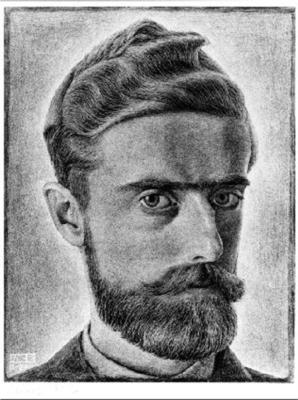
Biography
Solis Prints offers several of his works, including Circle Limit I, Convex and Concave, Depth, Division, and Horseman.
Timeline
- 1898Born in Leeuwarden, Netherlands
- 1919Failed final exams aged 21; teacher De Mesquita persuaded him to switch to printmaking
- 1922First trip to Italy aged 24; Moorish architecture in Spain later inspired tessellations
- 1936Visited Alhambra in Granada aged 38; began systematic tessellation studies
- 1948Drawing Hands aged 50; the impossible constructions period began
- 1953Relativity aged 55; his most reproduced work
- 1972Died in Laren, Netherlands, aged 73
Notable Works
Tap to view larger.
Where to See M.C. Escher
5 museums worldwide.
-
 1330 works
National Gallery of Art
Washington D.C., United States
Mon–Sat 10:00–17:00, Sun 11:00–18:00 · Free
-

-

- 2 works
Art Institute of Chicago
Chicago, United States
Mon 11:00–17:00, Tue closed, Wed 11:00–17:00, Thu 11:00–20:00, Fri–Sun 11:00–17:00 · $32 adults
-
 1 works
Van Abbemuseum
Eindhoven, Netherlands
Tue–Sun 11:00–17:00, closed Mondays · €16 adults
Next stop
Browse the movements →
Every movement in the collection, from the Renaissance to Pop art.
M.C. Escher prints
Hand-finished archival prints from M.C. Escher's body of work.


Related Artists




Take M.C. Escher home.
See all M.C. Escher prints →Frequently Asked Questions
How did mc escher make his art?
M.C. Escher produced 448 lithographs, woodcuts, and wood engravings.What is mc escher best known for?
M.C. Escher is best known for his impossible constructions. Examples of these include Ascending and Descending, Relativity, and Waterfall.What is mc escher famous for?
M.C. Escher is famous for being the most mathematically inventive printmaker of the twentieth century, despite having no mathematical training. He is known for his tessellations, impossible constructions, and explorations of logic.What is M.C. Escher's most famous work?
It is difficult to name a single "most famous" work by M.C. Escher, as his popularity has shifted over time and varies among audiences. However, some of his images are particularly well known. Escher is recognised for his mathematically inspired woodcuts, lithographs and mezzotints. His works often feature impossible constructions, explorations of infinity, repeating patterns (tessellations), and spatial paradoxes. Among his most recognised pieces are *Relativity* (1953), with its impossible staircases, and *Drawing Hands* (1948), which depicts two hands drawing each other. Other popular works include *Metamorphosis III*, *Sky and Water I*, and *Ascending and Descending*. These prints demonstrate Escher's manipulation of perspective and geometry to create visually arresting and intellectually stimulating images. His art continues to appeal to a broad audience, including mathematicians, artists, and the general public, because of its unique blend of technical skill and imaginative vision.What should I know about M.C. Escher's prints?
M.C. Escher was a graphic artist. Printmaking has a long history; the earliest examples on paper are from China, after paper became available in the second century A.D. In Europe, printmaking began to flourish at the end of the fourteenth century. Woodcuts were used for book illustrations, religious icons, souvenirs, and playing cards. Prints assumed greater artistic importance in the later nineteenth century. Artists began to sign their prints, differentiating original graphics from commercial reproductions. A signature testified to authenticity and the artist's approval. Artists also controlled quality by limiting edition sizes and numbering prints. This influenced the price and prevented printing after the plate degraded. Handmade papers further contributed to the aesthetic value. Edition numbers are typically written on the bottom left margin of the print, in pencil, as a fraction. The print number appears above the total edition size. The print's title is in the centre, and the artist's signature is on the right.What style or movement did M.C. Escher belong to?
M.C. Escher's work resists easy categorisation within specific art movements. His mathematically inspired prints have links to various aspects of modern art, but he remained largely independent of any particular school. Some have associated him with Surrealism because of the often dreamlike and impossible nature of his constructions. Others point to a connection with aspects of Op Art, due to his manipulation of perspective and the creation of optical illusions. Still, Escher's meticulous technique and intellectual approach set him apart. His art shares qualities with movements exploring abstraction and non-naturalistic representation; however, his precise and deliberate style distinguishes him from the randomness embraced by some modern artists. Escher created an order from unordered elements, but his work does not quite fit into any established category. His unique vision has gained appreciation across diverse fields, including mathematics and popular culture, further blurring any art-historical classification.What techniques or materials did M.C. Escher use?
Maurits Cornelis Escher, often known as M.C. Escher, is well known for his mathematically inspired art. He worked primarily with woodcuts, lithographs, and mezzotints. Escher's process involved careful planning and execution. He began with mathematical concepts, translating them into visual designs. These designs often featured tessellations, impossible constructions, and explorations of infinity. He would create preliminary sketches, refining the composition before transferring the design to a woodblock or lithographic stone. In woodcuts, Escher used knives and gouges to carve away sections of the woodblock, leaving the raised areas to receive ink. Lithography involved drawing with a grease crayon on a stone surface, which was then treated to accept ink only where the crayon had been applied. Mezzotint, a more laborious process, involved roughening a copper plate with a rocker, then smoothing areas to create lighter tones. Escher printed his own works, allowing him complete control over the final image. His technical skill in these printmaking methods allowed him to achieve precise detail and subtle gradations of tone, essential for conveying his complex visual ideas.What was M.C. Escher known for?
M.C. Escher is known for illusionistic art. Modern artists examine established relationships, separating plastic achievement into antagonistic components. In their abstractions, they carry the world of tangibility to its logical conclusions, making the painting a thing in itself, freed from human associations. In illusory painting, they explore the subconscious, consciously making arrangements to hint at the ultimate unity of these worlds, a unification we are yet to achieve. Through their search, they provide notions of how art functions, offering a language for our re-apprehension of the world of art, commensurate with our present knowledge and understanding. Modern art directly examines the relationships of past centuries, allowing the scaffolding to remain. These artists display the human quality of their world's magic.When did mc escher die?
M.C. Escher died in 1972 at the age of 74.When did mc escher live?
M.C. Escher died in 1972, at the age of seventy-three.When did M.C. Escher live and work?
Maurits Cornelis Escher was born in Leeuwarden, Netherlands, on 17 June 1898. He died on 27 March 1972 in Laren, also in the Netherlands. Escher's early artistic training occurred at the School of Architecture and Decorative Arts in Haarlem, where he studied from 1919 to 1922. He developed his wood engraving skills there. His work is characterised by mathematical concepts, such as tessellations, Möbius strips, and impossible constructions. During his career, Escher lived and worked in several countries. He resided in Italy from 1924 until 1935. He then moved to Switzerland, followed by Belgium in 1937, before returning to the Netherlands in 1941. He continued to produce art until his death, with his work gaining international recognition during the 1950s and 1960s.Where can I see M.C. Escher's work?
M.C. Escher's works appear in numerous public collections around the world. In the United States, you can find his pieces at the Art Institute of Chicago[3]; the Museum of Modern Art, New York; the Metropolitan Museum of Art, New York; the Solomon R. Guggenheim Museum, New York; the Herbert F. Johnson Museum of Art, Ithaca, New York; the Minneapolis Institute of Arts; and the National Gallery of Art[2], Washington DC. In Europe, notable locations include the Staatliche Museen, Kupferstichkabinett, Berlin; the Kunstmuseum, Basel; the Musée d'Art et d'Histoire, Geneva; the Kunstmuseum, Luzern; the Graphische Sammlung Albertina, Vienna; the Nationalmuseum, Stockholm; the Kunstmuseum Bern; and the Museum of Modern Art, Oxford. Other museums that hold his work are located in Denmark, Sweden and Norway.
Sources
Editorial draws on the following primary and tertiary references for M.C. Escher.
- [1] museum Van Abbemuseum Used for: museum holdings.
- [2] museum National Gallery of Art Used for: museum holdings.
- [3] museum Art Institute of Chicago Used for: museum holdings.
- [4] museum Israel Museum Used for: museum holdings.
- [5] museum Escher Museum Used for: museum holdings.
- [6] book Dorling Kindersley, Artists: Inspiring Stories of the World's Most Creative Minds Used for: biography.
- [7] book guggenheim-masterp00solo Used for: biography.
Editorial overseen by Solis Prints. Sources verified 2026-10-14. Click a source for details, or hover over [N] in the page above to preview.
Editorial standardsMethodologyCorrectionsAI disclosureAbout the editorial team