



About M.C. Escher
- modern art
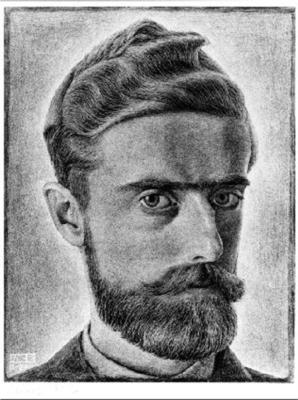
Failed his architecture exams, found Moorish tile patterns at the Alhambra, and became the most mathematically inventive printmaker of the century without any maths training.
Where to see M.C. Escher
Ranked by works you can see in person.
-
872 works
National Gallery of Art
Washington D.C., United States
-
 18 works
Israel Museum
Jerusalem, Israel

-
6 works
Stedelijk Museum voor Actuele Kunst
Ghent, Belgium
-
2 works
Musea Brugge
Bruges, Belgium
-
2 works
Art Institute of Chicago
Chicago, United States
-
 2 works
Escher Museum
The Hague, Netherlands
-
2 works
National Gallery of Canada
Ottawa, Canada
-
 1 works
Van Abbemuseum
Eindhoven, Netherlands
-
1 works
Museum of Fine Arts Boston
Boston, United States


Own a piece of it
M.C. Escher prints
Hand-finished archival prints from M.C. Escher's body of work.
 Smaller and Smaller - M.C. Escher
From £37.00
Smaller and Smaller - M.C. Escher
From £37.00
 White Cat I - M.C. Escher
From £37.00
White Cat I - M.C. Escher
From £37.00
 Circle Limit I - M.C. Escher
From £37.00
Circle Limit I - M.C. Escher
From £37.00
 Stars - M.C. Escher
From £28.00
Stars - M.C. Escher
From £28.00
 Plane Filling Motif with Reptiles - M.C. Escher
From £37.00
Plane Filling Motif with Reptiles - M.C. Escher
From £37.00
 Convex and Concave - M.C. Escher
From £28.00
Convex and Concave - M.C. Escher
From £28.00
 Regular Division of The Plane I - M.C. Escher
From £28.00
Regular Division of The Plane I - M.C. Escher
From £28.00
 Depth - M.C. Escher
From £28.00
Depth - M.C. Escher
From £28.00
Can't travel? Bring M.C. Escher home.
See all M.C. Escher prints →Frequently Asked Questions
Where can I see M.C. Escher's work?
M.C. Escher's works appear in numerous public collections around the world. In the United States, you can find his pieces at the Art Institute of Chicago[3]; the Museum of Modern Art, New York; the Metropolitan Museum of Art, New York; the Solomon R. Guggenheim Museum, New York; the Herbert F. Johnson Museum of Art, Ithaca, New York; the Minneapolis Institute of Arts; and the National Gallery of Art[2], Washington DC. In Europe, notable locations include the Staatliche Museen, Kupferstichkabinett, Berlin; the Kunstmuseum, Basel; the Musée d'Art et d'Histoire, Geneva; the Kunstmuseum, Luzern; the Graphische Sammlung Albertina, Vienna; the Nationalmuseum, Stockholm; the Kunstmuseum Bern; and the Museum of Modern Art, Oxford. Other museums that hold his work are located in Denmark, Sweden and Norway.What should I know about M.C. Escher's prints?
M.C. Escher was a graphic artist. Printmaking has a long history; the earliest examples on paper are from China, after paper became available in the second century A.D. In Europe, printmaking began to flourish at the end of the fourteenth century. Woodcuts were used for book illustrations, religious icons, souvenirs, and playing cards. Prints assumed greater artistic importance in the later nineteenth century. Artists began to sign their prints, differentiating original graphics from commercial reproductions. A signature testified to authenticity and the artist's approval. Artists also controlled quality by limiting edition sizes and numbering prints. This influenced the price and prevented printing after the plate degraded. Handmade papers further contributed to the aesthetic value. Edition numbers are typically written on the bottom left margin of the print, in pencil, as a fraction. The print number appears above the total edition size. The print's title is in the centre, and the artist's signature is on the right.Why are M.C. Escher's works important today?
Maurits Cornelis Escher (1898-1972) is remembered for his mathematically inspired woodcuts, lithographs, and mezzotints. His art often features impossible constructions, explorations of infinity, tessellations, repeating patterns, and metamorphoses. Escher's work gained popularity outside the art world, especially among mathematicians and scientists, due to its clever use of mathematical principles. His images provide visualisations of mathematical concepts like hyperbolic geometry and Möbius strips, making these abstract ideas more accessible. This interdisciplinary appeal contributes to his ongoing relevance. His images continue to be reproduced and reinterpreted in popular culture. Escher's art has influenced various fields, including advertising, architecture, and computer graphics. The artist's exploration of perception and illusion remains engaging. His images prompt viewers to question their assumptions about reality and representation. This encourages a playful, thoughtful interaction with art.When did mc escher live?
M.C. Escher died in 1972, at the age of seventy-three.How did mc escher make his art?
M.C. Escher produced 448 lithographs, woodcuts, and wood engravings.Who was mc escher inspired by?
In 1922 and again in 1936, M.C. Escher visited the Alhambra in Granada; the Moorish tessellation patterns inspired him. These patterns showed him that surfaces could be filled with repeating forms that fitted together like a puzzle.How did mc escher create his tessellations?
M.C. Escher began developing his own tessellations using recognisable figures: birds, fish, lizards, and horsemen. Each shape interlocked with its neighbour.When did mc escher start making art?
His graphic arts teacher, Samuel Jessurun de Mesquita, persuaded M.C. Escher to switch from architecture to printmaking.
Sources
Where to See guide aggregates verified holdings of M.C. Escher's works across the following collections.
- [1] museum Van Abbemuseum Used for: museum holdings.
- [2] museum National Gallery of Art Used for: museum holdings.
- [3] museum Art Institute of Chicago Used for: museum holdings.
- [4] museum Israel Museum Used for: museum holdings.
- [5] museum Escher Museum Used for: museum holdings.
- [6] book Dorling Kindersley, Artists: Inspiring Stories of the World's Most Creative Minds Used for: biography.
- [7] book guggenheim-masterp00solo Used for: biography.
Editorial overseen by Solis Prints. Sources verified 2026-08-29. Click a source for details, or hover over [N] in the page above to preview.
Editorial standardsMethodologyCorrectionsAI disclosureAbout the editorial team