

Martin Creed
- Contemporary
- Conceptual
Martin Creed became widely known after winning the Turner Prize in 2001 for 'Work No. 227: The lights going on and off'. This piece involved an empty room where the lights switched on and off every five seconds. The decision sparked much debate in the art world, drawing attention to Creed's minimalist and conceptual approach. Born in 1968, Creed's art often questions what constitutes an artwork.
Biography
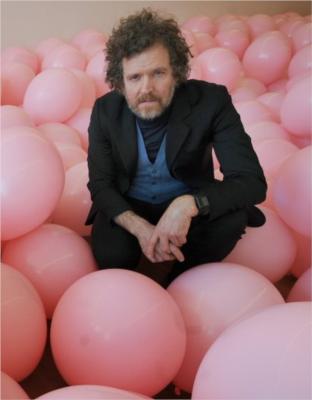
His practice frequently involves simple, everyday actions and objects. He assigns a numerical title to each work, regardless of medium, from paintings and sculptures to performances and musical compositions. For instance, 'Work No. 200: Half the air in a given space' (1998) filled a gallery room with balloons, occupying half its volume. Another example is 'Work No. 88: A sheet of A4 paper crumpled into a ball' (1995), which is exactly as described.
Creed extends his work beyond traditional gallery settings. 'Work No. 1197' (2012), a large revolving neon sign spelling 'MOTHERS', was installed outside Tate Modern in London. His public commissions also include 'Work No. 1059' (2011), where runners sprinted through Tate Britain every 30 seconds. These projects bring his characteristic directness to public spaces.
Beyond visual art, Creed is also a musician. He writes and performs songs, often featuring repetitive structures and direct lyrics, mirroring the simplicity found in his visual output. His music further illustrates his consistent artistic philosophy, where the idea and its execution are paramount.
Timeline
- 1968Born in 1968.
- 1995'Work No. 88: A sheet of A4 paper crumpled into a ball' created.
- 1998'Work No. 200: Half the air in a given space' created.
- 2001Won the Turner Prize for 'Work No. 227'.
- 2011'Work No. 1059' runners sprinted through Tate Britain.
- 2012'Work No. 1197' neon sign installed outside Tate Modern.
Notable Works
Tap to view larger.
Next stop
Contemporary →
Explore the artists and ideas of Contemporary.
Related Artists

.jpg)



_%E2%80%93_LOC.jpg)
Frequently Asked Questions
What is Martin Creed known for?
Martin Creed is widely known for winning the Turner Prize in 2001 for 'Work No. 227: The lights going on and off'. The piece featured an empty room where the lights switched on and off every five seconds.What is Martin Creed's most famous work?
Martin Creed is a Turner Prize-winning British artist known for conceptual and minimalist works. While he has produced a diverse range of art, including installations, sculptures, paintings, and performances, he is perhaps best known for 'Work No. 227: The lights going on and off'. This artwork, which won the Turner Prize in 2001, consists simply of an empty room where the lights turn on and off at five-second intervals. The work generated considerable debate, with some critics praising its simplicity and others dismissing it as trivial. Despite the controversy, 'Work No. 227' remains one of Creed's most recognisable and discussed pieces, and it has come to represent his interest in everyday experiences and challenging traditional notions of art.What should I know about Martin Creed's prints?
Martin Creed is a British artist known for conceptual works that often explore minimalism and the everyday. Born in 1968, he won the Turner Prize in 2001. His art frequently incorporates simple materials and actions, inviting viewers to consider the essence of art itself. Creed's prints share these characteristics. They often feature simple geometric shapes, lines, or texts. The prints are characterised by their directness and lack of ornamentation. Work No. 88, for example, consists of a single crumpled A4 sheet. Many of Creed's prints are screen prints, a process that suits his preference for bold, flat colour and precise lines. He often uses seriality and repetition, creating series of prints that explore variations on a single theme. This approach reflects his interest in systems and the subtle differences that emerge within them. His prints are often produced in limited editions, adding to their collectability. They offer an accessible entry point into his wider body of work, encapsulating his conceptual approach in a tangible form.What style or movement did Martin Creed belong to?
Martin Creed's art resists easy categorisation. Born in 1968, he emerged during a period of diverse artistic practices, making it difficult to assign him neatly to a single movement. While some critics associate him with Minimalism, due to his use of simple forms and everyday materials, others see Conceptual art influences in his emphasis on ideas over traditional aesthetics. His Turner Prize win in 2001 for *Work No. 227: The lights going on and off* (a room where the lights simply blinked) cemented his position as a significant, if controversial, figure in contemporary art. Creed's work often incorporates elements of performance and installation, further blurring stylistic boundaries. His practice includes actions, sculptures, paintings, and musical compositions. This multidisciplinary approach aligns him with Postmodernism's rejection of fixed categories and embrace of pluralism. Ultimately, Creed's individualistic vision transcends any specific art movement, although it engages with several.Where can I see Martin Creed's work?
Martin Creed's art has been exhibited in many locations internationally. Major museums often hold examples of his output. In Britain, his work can be seen in public collections such as the Tate; they hold examples like *Work No. 88, A sheet of A4 paper crumpled into a ball* (1995) and *Work No. 79, Some Blu-Tack kneaded, rolled into a ball, and placed on a Blue Tack-covered wall* (1994). The Government Art Collection also includes Creed's *Work No. 370: An escalator going nowhere* (2004). Internationally, Creed has had solo shows at the Museum of Contemporary Art, Chicago; the Hiroshima City Museum of Contemporary Art; and the Ikon Gallery, Birmingham. His art was included in the 2008 Biennale of Sydney. In 2009, he had a solo exhibition at the Scottish National Gallery of Modern Art. In 2012, *Work No. 1020: Ballet Shoes* was displayed at the Hauser & Wirth gallery in London. Public art commissions, such as *Work No. 2630, UNDERSTANDING*, installed in Brooklyn Bridge Park in 2019, offer further opportunities to view his output. Check museum websites for current exhibitions.Where was Martin Creed from?
Martin Creed was born in Wakefield, Yorkshire, in 1968. When he was three years old, his family relocated to Glasgow, where he was raised. His father was a physics lecturer at the University of Glasgow. Creed studied at the Slade School of Fine Art, University College London, from 1988 to 1992. He lives and works in London. Creed is known for his conceptual and minimalist works, often using simple materials and ideas to explore complex themes. His work spans various media, including sculpture, installation, painting, drawing, music, and performance. He won the Turner Prize in 2001 for his work *Work No. 227: The Lights Going On and Off* (2000), an empty room where the lights go on and off at five-second intervals.Who did Martin Creed influence?
It is difficult to identify specific artists influenced by Martin Creed. The concept of 'influence' is itself a contested idea in art history. Some critics suggest that tracing influence is a way to declare who was first, and therefore greatest. Art dealers may promote artists as influencers to increase sales. Others believe influence is overstated, and many artists arrive at similar ideas independently. Marcel Duchamp is often cited as a major influence on Conceptual art. After Duchamp's death in 1968, his ideas became widespread through art education. By the 1970s, many college-educated artists were familiar with Conceptual art, often justified by Duchamp's work. Some were told that painting was dead, and idea-art was the only option. While few artists are strictly Duchampian, his ideas continue to permeate art education. The 'anti-art' orientation of Dada also had an impact on later generations.Who influenced Martin Creed?
It is difficult to identify specific influences on Martin Creed from the material provided. However, we can discuss some artists with whom he shares certain affinities. Roberto Clemente, an Italian artist, developed a close relationship with Alighiero Boetti in 1972. Boetti, a member of the Arte Povera movement, explored the relationship between art and life through sculpture and installations using humble materials. Clemente saw Boetti's ideas as exceeding the boundaries of Arte Povera. Boetti collaborated with artisans in Afghanistan, incorporating chance and unpredictability into his art by removing the artist's direct control. Creed's conceptual art shares some ground with Marcel Duchamp, Vito Acconci, Joseph Kosuth, and Robert Barry. These artists challenge traditional notions of art through their work.Who was Martin Creed?
Martin Creed is a British conceptual artist, born in 1968. He is known for works that are simple, direct, and often playful, inviting viewers to question the definition and boundaries of art. Creed's art often incorporates everyday materials and actions. His work spans various media, including installations, sculptures, paintings, and performance. He won the Turner Prize in 2001 for *Work No. 227: The Lights Going On and Off*, an empty room where the lights blinked on and off. Other notable pieces include *Work No. 79: Some Blu-tack kneaded, rolled into a ball, and attached to a wall* (1993) and *Work No. 88: A sheet of A4 paper crumpled into a ball* (1995). Creed has exhibited extensively internationally.Why are Martin Creed's works important today?
Martin Creed's art is relevant because it questions fundamental assumptions about what art can be. His Turner Prize-winning work, *Work No. 227: The Lights Going On and Off* (2001), consisted simply of an empty room where the lights flickered. This piece challenges viewers to consider the line between art and non-art. Creed's work often involves simple actions or interventions. These can include stacking things, using Blu-Tack on walls, or employing runners sprinting through galleries. The simplicity of these actions forces a re-evaluation of artistic skill and intention. His practice aligns with a broader trend in contemporary art toward multimedia installations and a relaxation of traditional boundaries between artistic media. Like Marcel Duchamp's readymades, Creed's work reduces art to a matter of nomination, prompting reflection on the role of the artist's signature and the very definition of art itself. His art invites ongoing interpretation and re-evaluation, ensuring its continued significance.What was Martin Creed's art style?
Martin Creed's art style is minimalist and conceptual. His practice frequently involves simple, everyday actions and objects, assigning a numerical title to each work, regardless of medium.When was Martin Creed born?
Martin Creed was born in 1968 in British.
Sources
Editorial draws on the following primary and tertiary references for Martin Creed.
- [1] book Dorling Kindersley, Artists: Inspiring Stories of the World's Most Creative Minds Used for: biography.
- [2] book Artmarketissue66january2022 Used for: biography.
Editorial overseen by Solis Prints. Sources verified 2026-10-15. Click a source for details, or hover over [N] in the page above to preview.
Editorial standardsMethodologyCorrectionsAI disclosureAbout the editorial team