



About Alfred Dehodencq
French · 1822–1882
- Orientalism
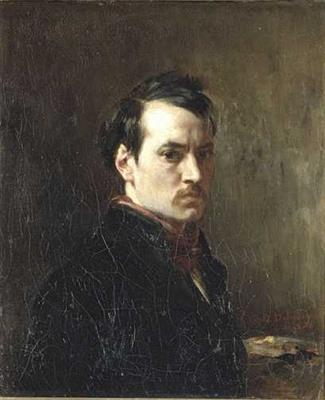
French[1] Orientalist painter who lived in Morocco for a decade, known for his unflinching paintings of Moroccan Jewish life.
Museums10
Countries3
Most worksMusée d'Orsay, Paris · 8 works
Loading map…
Where to see Alfred Dehodencq
Ranked by works you can see in person.
-
8 works
Musée d'Orsay
Paris, France
-
2 works
Royal Collection
London, United Kingdom


-
2 works
Musée Carnavalet
Paris, France
-
1 works
Goya Museum
Castres, France
-
1 works
Baltimore Museum of Art
Baltimore, United States
-
1 works
Museum of Fine Arts of Reims
Reims, France
-
1 works
Palais des Beaux-Arts de Lille
Lille, France
-
1 works
Musée des Beaux-Arts de la ville de Paris
Paris, France
-
1 works
Musée d'Art et d'Histoire du Judaïsme
Paris, France
Also here (3)
-
0 works
National Gallery of Art
Washington D.C., United States


Frequently Asked Questions
Where can I see Alfred Dehodencq's work?
Alfred Dehodencq's works can be viewed in several museums across Europe and North America. In France, notable locations include the Musée des Arts Décoratifs in Paris, as well as the Musée des Beaux-Arts in Nancy. Spain also holds collections of his art; visit the Museo Art Nouveau y Art Déco in Salamanca, and the Museu d’Art Modern (MNAC) in Barcelona. Other European museums with collections include the Brangwyn Museum in Bruges, Belgium, and the Museu Calouste Gulbenkian in Lisbon, Portugal. In the United Kingdom, you might find his pieces at the Brighton Museum & Art Gallery, the Manchester Art Gallery, the National Museums of Scotland (Royal Museum) in Edinburgh, or the Victoria & Albert Museum in London. For those in North America, consider visiting the Metropolitan Museum of Art in New York, the Los Angeles County Museum of Art (LACMA), the Minneapolis Institute of Arts, or the Royal Ontario Museum in Toronto.What should I know about Alfred Dehodencq's prints?
Alfred Dehodencq was a French[1] Orientalist painter who lived from 1822[1] to 1882[1]. When considering his prints, it is helpful to understand print terminology. A 'vintage print' is a photograph printed around the time the negative was taken. A 'period print' is one made within roughly 10 to 15 years after the image was shot. An 'old print' refers to photographs printed more than 15 years after the shot, while a 'modern print' is a recent print from the original negative. An 'original print' is one made by the artist or under their supervision. Finally, a 'facsimile' is a print made by re-photographing a print or using the original negative, with print base and processing as close as possible to the reference print, generally a vintage print. These terms can help to evaluate and describe prints of Dehodencq's work.Why are Alfred Dehodencq's works important today?
Alfred Dehodencq (1822[1]-1882[1]) was a French[1] Orientalist painter known for his depictions of scenes from North Africa and Spain. His importance today lies in his contribution to the Orientalist movement, which offered European audiences a glimpse into the cultures and daily life of the Middle East and North Africa during the 19th century. Dehodencq's paintings are valued for their ethnographic detail and dramatic compositions. He moved away from earlier, more idealised depictions of the Orient, and instead presented scenes with greater realism. His work provides insight into the social dynamics, religious practices, and cultural traditions of the regions he portrayed. Although Orientalism[1] has been critiqued for its potential to exoticise or misrepresent non-Western cultures, Dehodencq's art remains significant as a visual record of a specific historical period and a reflection of European perceptions of the 'Orient'.What techniques or materials did Alfred Dehodencq use?
Information regarding Alfred Dehodencq's specific techniques is scarce. However, we can discuss the general practices of nineteenth-century French[1] painters. Painters in France typically followed a sequence. First, they made drawings. Then, they outlined the composition on prepared canvas. Modelling was indicated, often with a reddish-brown "sauce". Local colour, light, and shade were applied. This initial sketch was then elaborated upon, using a full range of tones. The final painting stage refined this process further. Some artists sought to recapture the techniques of earlier masters like Titian, Rubens, and Rembrandt. This involved investigating ancient tempera techniques and the oil techniques used by Jan van Eyck. The choice of materials determined the nature of the work. Some painters even incorporated plaster or granular raw material into their paint mixtures to achieve desired effects.Who did Alfred Dehodencq influence?
It is difficult to identify specific artists who were directly influenced by Alfred Dehodencq. However, during the summer of 1905, the painter Alfred Maurer, along with sculptor Mahonri Young, played a role in introducing some Americans to new artistic ideas. While Leo and Gertrude Stein were in Florence, Maurer and Young took visitors to see artwork. Maurer reported that they "shocked some Americans the other day with them." By the early 20th century, artists such as Signac and Henri de Toulouse-Lautrec had been encouraged by the work of Henri Rousseau. Later, around 1908, Picasso bought Rousseau's *Portrait of Yadwigha*, and held a banquet in his studio to honour the painter. By 1909, both Léger and Delaunay were friends with Rousseau, and frequented his musical evenings. The critic Vauxcelles reviewed Rousseau's work favourably around this time, marking a shift in how his art was received.Who influenced Alfred Dehodencq?
Alfred Dehodencq belonged to a generation that admired Eugène Delacroix and Théodore Chassériau. Gustave Moreau, who taught most of the Fauves, also had an impact on various aspects of Post-Impressionism. Joris-Karl Huysmans, a novelist and art critic, is largely known for two works published in the 1890s, A Rebours and La-bas. These became important to the younger generation of writers and painters, especially the Symbolists. Puvis de Chavannes, who studied under Delacroix and Couture, dedicated himself to mural and decorative painting. He favored placid mythological and symbolic subjects, and was admired by younger artists. These figures, each with their unique approach to art and literature, influenced the artistic climate in which Dehodencq worked.What style or movement did Alfred Dehodencq belong to?
Alfred Dehodencq is associated with the Orientalist movement, which gained momentum in the 19th century. This interest in the East was spurred by events such as the Greek struggle for independence and, earlier, Napoleon's Egyptian campaign. These events captured the imagination of French[1] artists and the public. Orientalism[1], in painting, provided an escape from the industrialising Northern European world. It offered scenes of exoticism, combining savagery and sensuality that proved attractive to the 19th-century art world. Many artists made the trip to places such as Algeria, resulting in Salon exhibitions being filled with art inspired by these voyages. The opening of the Suez Canal in 1869[1] made travel to the East more accessible. This led to later Orientalist pictures becoming less anecdotal, as the public grew more accustomed to these once-mysterious lands. In 1893, the Société des Peintres Orientalistes was formed, with Jean-Léon Gérôme as honorary president.What was Alfred Dehodencq known for?
Alfred Dehodencq was a French[1] artist known for his Orientalist paintings. The Orientalist movement became popular in France following the Greek struggle for independence. Interest in scenes with Algerian backgrounds grew after the French campaign in Algeria from 1830[1]. Many artists visited Algeria, and the Salons were filled with art from these voyages. Orientalism[1] in the nineteenth century was geographically limited. China was mostly closed to European travellers. Japan opened to Western traders in 1856, which led to japonisme in European painting, a separate movement from academic Orientalism. For artists exhibiting at the Salon, the East began in Spain, recalling its Moorish past, and in Greece, with its Turkish remains after independence in 1824. Some artists who never visited the East created their own visions of these lands to meet the demand for the style.
Sources
Where to See guide aggregates verified holdings of Alfred Dehodencq's works across the following collections.
- [1] wikipedia Wikipedia: Alfred Dehodencq Used for: biography.
- [2] book Harding, James, Artistes pompiers : French academic art in the 19th century Used for: biography.
- [3] book Neoclassicism and romanticism : architecture, sculpture, painting, drawings, 1750-1848 Used for: biography.
Editorial overseen by Solis Prints. Sources verified 2026-08-29. Click a source for details, or hover over [N] in the page above to preview.
Editorial standardsMethodologyCorrectionsAI disclosureAbout the editorial team