



About Antoniazzo Romano
- portrait
Rome's leading 15th-century painter, Vatican collaborator across five papacies, and co-founder of the Accademia di San Luca, known for his luminous devotional Madonnas.
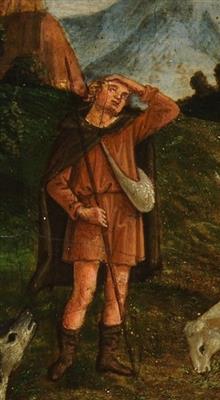
Where to see Antoniazzo Romano
Ranked by works you can see in person.
-
3 works
Courtauld Gallery
London, United Kingdom
-
3 works
Gemäldegalerie Berlin
Berlin, Germany


-
3 works
Detroit Institute of Arts
Detroit, United States
-
3 works
Metropolitan Museum of Art
New York City, United States
-
2 works
Louvre
Paris, France
-
2 works
Galleria Nazionale d'Arte Antica
Rome, Italy
-
2 works
Museo del Prado
Madrid, Spain
-
1 works
Städel Museum
Frankfurt, Germany
-
1 works
Museo Poldi Pezzoli
Milan, Italy
-
1 works
Palais des Beaux-Arts de Lille
Lille, France


View all 13 museums
-
1 works
Musée du Petit Palais
Avignon, France
-
1 works
National Gallery of Ireland
Dublin, Ireland
Also here (6)
-
1 works
Museum of Fine Arts, Houston
Houston, United States


Frequently Asked Questions
Where can I see Antoniazzo Romano's work?
Antoniazzo Romano, born Antonio di Benedetto Aquilio (c. 1430[1]-1512), was a painter active in Rome and the surrounding cities of Latium. He led a large workshop and frequently accepted commissions from the Vatican between 1464 and 1492. He also restored and copied revered Roman icons. In 1478, Antoniazzo helped draft statutes for the incorporation of painters in Rome, which led to the founding of the Pontifical Academy of Saint Luke. His paintings show the influence of Benozzo Gozzoli and Fra Angelico. Later, his work reflected the styles of Melozzo da Forli, Domenico Ghirlandaio, and Perugino. A *Madonna and Child* panel by Antoniazzo Romano is held in the collection of the Museum of Fine Arts, Houston. A free copy of Giotto’s *Navicella* by Antoniazzo is in Lyons. An altarpiece signed and dated 1464 can be seen in the museum at Rieti.What should I know about Antoniazzo Romano's prints?
Antoniazzo Romano was active in Rome during the second half of the fifteenth century. He is known for his paintings, and the available texts do not offer specific information about his prints. However, the context of printmaking in Italy at the time provides some information. The rise of interest in Roman antiquities created a demand for reproductions of sculptures and other ancient objects. These reproductions came in the form of casts, statuettes, and bronze plaquettes. Printmaking also played a role, with artists like Marcantonio Raimondi producing prints of Roman statues as well as the works of artists such as Raphael and Michelangelo. These prints allowed a wider audience to view and appreciate both ancient works and the works of contemporary artists. Print culture also prompted questions about how people view art, and the relationship between objects, viewers, and images.Why are Antoniazzo Romano's works important today?
Antoniazzo Romano, or Antonio di Benedetto Aquilio, was a painter active in Rome and Latium from the mid-15th to early 16th century. He was a significant figure in the refurbishment of Roman churches, receiving commissions from important families such as the Colonnas and Orsinis, as well as Vatican officials. Romano's importance stems from his role as a leading local artist in Rome during a period when other masters were often brought in from elsewhere. He maintained a large workshop and collaborated with artists such as Domenico Ghirlandaio, Melozzo da Forlì, and Perugino. He was involved in the foundation of the Pontifical Academy of Saint Luke. Although much of his documented work is lost, Antoniazzo's surviving paintings and frescoes offer insight into the artistic tastes of his time. He restored and copied revered Roman icons, and his style reflects an assimilation of influences, including Benozzo Gozzoli and possibly Fra Angelico. Some scholars argue for an independent development based on Piero della Francesca. His devotional panels often feature archaising elements, which may reflect the conservative tastes of his clientele.What techniques or materials did Antoniazzo Romano use?
Antoniazzo Romano's practice involved both fresco and tempera techniques. Fresco entails painting with pigments mixed only with water, applied to fresh plaster. As the plaster dries, the paint and plaster become integrated. This 'true' fresco method was common from the late thirteenth to the mid-sixteenth centuries. The artist would apply a preliminary rough plaster layer (arriccio), then a final smooth layer (intonaco). The amount of intonaco applied corresponded to what could be painted in a single day (giornata). Artists sometimes painted on dry plaster (a secco) to add details or use pigments unsuitable for fresco. In this method, colours are mixed with an adhesive. Tempera, where pigments are bound using egg yolk, was often used to finish fresco paintings. Because the pigment and dry wall surface do not fully unite, a secco murals tend to deteriorate faster. Before painting, artists often made preparatory drawings (sinopia) on the arriccio, usually in red ochre.Who did Antoniazzo Romano influence?
Titian dominated Venetian painting in the 16th century. His work became a high standard for his contemporaries. Some talented artists were indebted to Titian; they created works of considerable innovation and influence. Titian's paintings sparked a chain reaction that shaped much of Western painting. Many artists absorbed Titian’s style during the 18th century, either through direct contact with his canvases or secondhand through other painters' works. Antoine Watteau (1684-1721[1]), arguably the greatest artist of 18th-century France, encountered Titian’s art through the latter. Rubens copied all the paintings by Titian in the royal collection. This is surprising because Rubens was already fifty-one and a mature, successful painter and diplomat. Rubens’ copying was both an exercise in learning and a late homage to an artist whom he had admired from his youth. Anthony Van Dyck (1599-1641) also carried on the Venetian tradition through northern Europe and into England. He spent two years in Rubens’ workshop. He spent the years 1621-1627 working for aristocratic patrons in Italy. He became an assiduous student of Venetian art and Titian.Who influenced Antoniazzo Romano?
Antoniazzo Romano, active primarily in Rome during the second half of the 15th century, absorbed a variety of artistic influences. His early style shows the impact of Fra Angelico. This is evident in Antoniazzo's delicate figures and use of gold leaf, seen, for example, in works such as the altarpiece for the church of Sant'Anna dei Funari. Later in his career, Antoniazzo adapted aspects of the Florentine Renaissance style. He studied the work of artists such as Masaccio and Filippo Lippi. These painters had moved away from the Gothic style toward greater naturalism and more convincing spatial depth. The influence of these Florentine masters can be seen in Antoniazzo's increased attention to anatomy and perspective. In addition, the work of contemporary artists working in Rome affected Antoniazzo's artistic development. These included painters such as Melozzo da Forlì and Piero della Francesca. These influences helped Antoniazzo to create a distinctive style that blended elements of both the Florentine and Umbrian traditions.What is Antoniazzo Romano's most famous work?
Antoniazzo Romano's career spanned much of the second half of the fifteenth century. He is known for his paintings of the Virgin and Child, and for his collaborations with other artists on large-scale decorative projects in Rome and the surrounding area. It is difficult to name a single "most famous" work. He did not produce singular, iconic pieces. Instead, his notability rests on his overall artistic output and his role in the Roman art scene. He is well known for his contributions to the Vatican Library frescoes (1470s), where he worked alongside artists such as Domenico Ghirlandaio and Melozzo da Forlì. These frescoes represent an important example of early Renaissance decoration in Rome. He also painted several altarpieces for Roman churches, including Santa Maria sopra Minerva and Santa Maria in Aracoeli. These paintings often feature the Virgin and Child surrounded by saints. His style blends elements of the Roman tradition with influences from Florentine artists.What style or movement did Antoniazzo Romano belong to?
Antoniazzo Romano, or Antonio di Benedetto Aquilio, was active in Rome and Latium from the mid-15th to the early 16th century. He is considered the leading local painter in Rome during the later 15th century, a period when the city was drawing in influences from diverse regions. His early works show familiarity with Benozzo Gozzoli and Fra Angelico. Later, critics focussed on the impact of Melozzo da Forli and painters from Umbria and Florence, who were brought to Rome to decorate the Sistine Chapel in the early 1480s. However, one view suggests an independent development, with direct knowledge of Piero della Francesca, tempered by contact with Melozzo and Ghirlandaio before the arrival of Perugino and Pinturricchio. Antoniazzo's style is viewed in relation to his assimilation of outside influences, but his work also displays archaising elements, perhaps reflecting the taste of his clientele and a reverence for holy icons venerated in Rome.
Sources
Where to See guide aggregates verified holdings of Antoniazzo Romano's works across the following collections.
- [1] wikipedia Wikipedia: Antoniazzo Romano Used for: biography.
- [2] book Museum of Fine Arts, Houston, Italian paintings XIV-XVI centuries in the Museum of Fine Arts, Houston Used for: biography.
- [3] book Masterpieces of western art : a history of art in 900 individual studies from the Gothic to the present day Used for: biography.
- [4] book Gombrich, E. H. (Ernst Hans), 1909-2001, New light on old masters Used for: biography.
- [5] book Nagel, Alexander, The controversy of Renaissance art Used for: stylistic analysis.
- [6] book Cole, Bruce, Titian and Venetian painting _ 1450-1590 Used for: stylistic analysis.
- [7] book Cole, Bruce, Titian and Venetian painting _ 1450-1590 Used for: stylistic analysis.
Editorial overseen by Solis Prints. Sources verified 2026-08-29. Click a source for details, or hover over [N] in the page above to preview.
Editorial standardsMethodologyCorrectionsAI disclosureAbout the editorial team