



About Benito Quinquela Martin
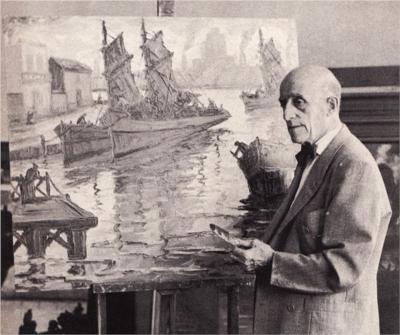
Argentine[2] painter who grew up in La Boca's coal yards and made the Buenos Aires docklands his life's subject, with work in the Metropolitan Museum.
Where to see Benito Quinquela Martin
Collection holdings are reported here; current display varies. Check with each museum before visiting.
-
 8 recorded works
Art Institute of Chicago
Chicago, United States
-
4 recorded works
National Museum of Fine Arts, Argentina
Buenos Aires, Argentina
Also here (6)

-
1 recorded work
National Football Museum
Manchester, United Kingdom
-
1 recorded work
Manchester Art Gallery
Manchester, United Kingdom
-
1 recorded work
National Museum Cardiff
Cardiff, United Kingdom
-
1 recorded work
Birmingham Museums Trust
Birmingham, United Kingdom
-
1 recorded work
Museum of Fine Arts, Houston
Houston, United States


Frequently Asked Questions
Where can I see Benito Quinquela Martin's work?
Benito Quinquela Martin (1890[2]-1977[2]) was an Argentinian painter known for his depictions of the port district of La Boca in Buenos Aires. To see his work, a good place to start is the Museo Quinquela Martin in La Boca; it houses a significant collection of his paintings and also displays works by other Argentinian artists. His art has also been included in major museum exhibitions. For example, his paintings have been part of the Latin American Collection at The Solomon R. Guggenheim Museum, New York. Works by Quinquela Martin may also appear in exhibitions of Argentinian art or Latin American art held in museums around the world. Check museum websites and exhibition catalogues for current and past shows featuring his work.What should I know about Benito Quinquela Martin's prints?
When considering Benito Quinquela Martin's prints, it is useful to understand some basic print terminology. Print editions are often categorised as 'artist's proofs', 'lettered proofs', or 'presentation proofs'. An artist's proof might include the Association stamp on the lower left margin, with the publication line minutely written above or below the work. It is sometimes signed in pencil by the artist and engraver. A lettered proof has the title of the work lightly engraved, in a manner that allows for erasure. Presentation proofs are artist's proofs, but are specifically printed for presentation to the painter and engraver. Proofs before letters lack an engraved title, but include the artist’s and engraver’s names printed near the bottom. These often have an Association stamp on the lower right margin. Some artist's proofs have a device in the margin. When buying art prints, it is helpful to research the market, and to check a company's website or catalogue. When creating a limited edition, all prints should be numbered; for example, 35/100, where 100 is the total number of prints, and 35 is the sequential number of that particular print.What techniques or materials did Benito Quinquela Martin use?
Benito Quinquela Martin is known for his paintings of the port district of La Boca in Buenos Aires, Argentina. His works often depict dockworkers and the activities of the port. While specific details about his precise methods are scarce, it is known that he used house paint on unconventional surfaces. He employed a palette knife, applying thick layers of paint to create texture and a sense of dynamism. His bold use of colour captured the energy of the industrial environment. His approach was largely self-taught. Rather than academic techniques, he favoured direct application and expressive handling of materials. This gave his work a raw, immediate quality. His focus was on conveying the atmosphere of La Boca, rather than precise representation.Who did Benito Quinquela Martin influence?
Benito Quinquela Martin's influence is complex, and not always direct. Armando Morales, a Nicaraguan painter, may have been indirectly affected by Martin via Abstract Expressionism. Morales won the Ernst Wolf Prize as Best Latin American Artist at the V Sao Paulo Bienal in Brazil, 1959[2]. His visual language showed a debt to Robert Motherwell, Antoni Tapies, and Serge Poliakoff. His 1958 abstract painting *Guerrillo muerto I* (Dead Guerrilla I) led to a series related to revolutionary martyrdom. This painting was indebted to Motherwell’s “Spanish Elegy” series begun in 1948; Motherwell's series may have synthesised influences from European and Latin American artists. Similarly, the Cuban modernist group Los Once, which arose in 1953, aimed to make Cuban art more internationalist. Paintings by members such as Ratil Martinez alluded to U.S. Abstract Expressionism. Martinez's paintings integrated international artistic language with local political resistance. Martinez later switched from Abstract Expressionism to Pop Art, becoming influential in Cuba and Latin America.Who influenced Benito Quinquela Martin?
Benito Quinquela Martin was exposed to art history up to Impressionism. He saw reproductions of Jean-François Millet's *Angelus* and chromolithographs of Bartolomé Esteban Murillo's Madonnas, but these did not appeal to him. Martin stated that he was most struck by a Cubist still life by Georges Braque. He sought insight into the work from artists and advanced students. They told him Cubism was difficult and required serious study. Martin investigated Cubism and the latest work of Pablo Picasso. He then explored Paul Cézanne and Vincent van Gogh. He was somewhat drawn to Paul Gauguin, liking his colour but less convinced by his forms and symbolic vision. Martin saw paintings by real painters for the first time during his last year of study, in a private collection that included Alfred Sisley and André Dunoyer de Segonzac. He stated that he did not really understand Impressionism in Venezuela, because Impressionist light did not correspond to the strong, bright tropical light.What style or movement did Benito Quinquela Martin belong to?
Benito Quinquela Martin is difficult to categorise neatly. Some classify him as an Expressionist, because of his subjective and emotional depictions of labour in the port of La Boca, Buenos Aires. Others associate him with social realism, because of his focus on working-class subjects and industrial scenes. However, neither label fully captures the character of his output. Quinquela Martin's style was highly personal, marked by bold colours and dynamic compositions. His paintings often present a romanticised view of port life, rather than a strictly objective representation. In 1946[2], Quinquela Martin associated himself with a group of Argentinian artists who signed a manifesto promoting an "art based on the unity of time and space" and "the unity of psycho-physical elements". This suggests an openness to modern art movements, but does not clarify a single style. Ultimately, Quinquela Martin's art resists easy classification, occupying a space between Expressionism, social realism, and modernism.What is Benito Quinquela Martin known for?
Benito Quinquela Martín is known for his paintings of the working port of La Boca, with its furnaces, cranes, freighters, and dock workers.
Sources
Where to See guide aggregates verified holdings of Benito Quinquela Martin's works across the following collections.
- [1] museum Art Institute of Chicago Used for: museum holdings.
- [2] wikipedia Wikipedia: Benito Quinquela Martin Used for: biography.
- [3] book Claire Bishop, Artificial Hells Used for: stylistic analysis.
- [4] book guggenheim-luciofo00solo Used for: biography.
- [5] book guggenheim-omaggio00font Used for: biography.
- [6] book guggenheim-peggygu00alle Used for: stylistic analysis.
- [7] book Braun, Emily, 1957-; Asor Rosa, Alberto; Royal Academy of Arts (Great Britain), Italian art in the 20th century : painting and sculpture, 1900-1988 Used for: biography, stylistic analysis.
Editorial overseen by Solis Prints. Sources verified 2026-09-30. Click a source for details, or hover over [N] in the page above to preview.
Editorial standardsMethodologyCorrectionsAI disclosureAbout the editorial team