



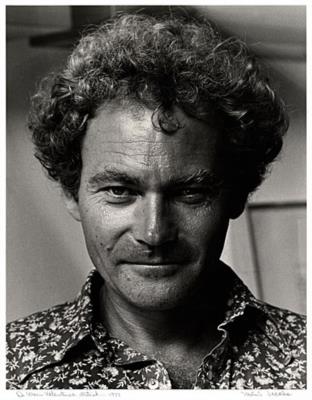
About De Wain Valentine
American · 1936–2022
California sculptor whose monumental resin discs and columns, developed from a proprietary casting formula, made him a key figure in the Light and Space movement.
Museums2
Countries1
Most worksArt Institute of Chicago, Chicago · 1 works
Loading map…
Where to see De Wain Valentine
Ranked by works you can see in person.
-
1 works
Art Institute of Chicago
Chicago, United States
-
1 works
National Gallery of Art
Washington D.C., United States


Frequently Asked Questions
Where can I see De Wain Valentine's work?
De Wain Valentine's work can be viewed in several museums in the United States and Canada. These include the Los Angeles County Museum of Art (LACMA), at 5905 Wilshire Boulevard, Los Angeles; the Metropolitan Museum of Art, on Fifth Avenue in New York; and the Museum of Modern Art, also in New York, at 11 West 53rd Street. Valentine's art is also held at the Minneapolis Institute of Arts, located at 2400 Third Avenue South, Minneapolis. Another location is the Charles Hosmer Morse Museum of American[2] Art, at 445 North Park Avenue, Winter Park, Florida. You can also find his pieces at the Virginia Museum of Fine Arts, 200 N. Boulevard, Richmond. Finally, his work is available at the Royal Ontario Museum, 100 Queens Park, Toronto.What should I know about De Wain Valentine's prints?
De Wain Valentine worked at printmaking studios such as Universal Limited Art Editions, Inc. (ULAE), Graphicstudio/University of South Florida, Gemini GEL, and Tyler Graphics Ltd. These workshops are filled with equipment for different processes: woodblocks for relief printing; metal plates for etching; limestone or metal plates for lithography; and screens of synthetic fibres for screenprints. There are drawing supplies; liquids and crayons; masking materials; delineative tools; greases, gums, and waxes; acid resists; and acids for etching. Also, there are inks, driers, and additives to alter the ink consistency. Printmaking workshops have individual characters, but also myriad elements in common. Gemini GEL, which was founded in Los Angeles in 1966[2], became known for its technological ability, its use of materials and processes, its reach for the largest size printed image possible, and its tendency to do series of works rather than single editions. Tyler Graphics Ltd deepened its interest in making paper by hand, becoming a cornerstone of his new enterprise.Why are De Wain Valentine's works important today?
De Wain Valentine (born 1936[2]) is associated with the Light and Space movement that emerged in Southern California during the 1960s. This group of artists experimented with industrial materials like resin and fibreglass to explore perception and the effects of light. Valentine's large-scale, translucent sculptures exemplify this interest. His best-known works are smooth, colourful resin cylinders and discs. These pieces appear deceptively simple, but their creation involved complex technical processes. Valentine developed his own methods for casting resin in order to achieve the flawless surfaces and subtle gradations of colour that characterise his art. His sculptures invite viewers to contemplate the interplay of light, colour, and form, offering a contemplative visual experience. Valentine's innovations with materials make him a significant figure in post-war American[2] sculpture.What techniques or materials did De Wain Valentine use?
De Wain Valentine is associated with the use of particular materials, especially cast polyester resin. He developed techniques for creating large-scale, translucent sculptures using this material. In the 1960s, Valentine experimented with polyester resin, which allowed him to create smooth, clear, and often colourful forms. His work involved a complex process of layering resin, sometimes with added pigments, into moulds. This resulted in objects that appear to glow from within. Valentine's practice also included the use of fibreglass, which provided structural support for his larger resin pieces. The combination of these materials allowed him to achieve a distinctive aesthetic, characterised by clean lines and luminous surfaces. His innovative approach to materials contributed to the development of the California Light and Space movement.Who did De Wain Valentine influence?
It is difficult to identify specific artists directly influenced by De Wain Valentine. However, his work is associated with the Light and Space movement, a school of art that emerged in Southern California in the 1960s. This movement included artists such as Larry Bell, Robert Irwin, and James Turrell. These artists shared an interest in exploring perception, light, volume, and scale. They often used industrial materials like resin and fibreglass to create minimalist sculptures and installations. Their work aimed to alter the viewer's sensory experience and create an awareness of the surrounding space. While it is hard to name artists who directly emulated Valentine's style, his contributions to the Light and Space movement helped to shape a particular sensibility within the broader art world. This sensibility valued perceptual experience and the use of new materials.What is De Wain Valentine's most famous work?
It is difficult to name one single "most famous work" by De Wain Valentine. He is best known as a West Coast artist working with cast polyester resin, creating large-scale translucent sculptures. Valentine began experimenting with plastics in the 1960s. He developed techniques for casting large, flawless blocks of resin, often in subtle colours. These sculptures explore light, colour, and perception. While no single piece eclipses his overall body of work, his series of large discs and columns are particularly well known. These works often have evocative titles, such as *Gray Column* or *Double Red-Yellow*. They are included in major museum collections. His work is associated with the Light and Space movement, a group of California artists who explored perceptual phenomena through minimalist forms and industrial materials.What style or movement did De Wain Valentine belong to?
De Wain Valentine is associated with the Light and Space movement, a development related to Minimalism and Op Art. This artistic tendency emerged in Southern California during the 1960s. Valentine, along with artists like Larry Bell, Robert Irwin, and Craig Kauffman, explored perception, light, volume, and scale in their work. They often used industrial materials such as resin, fibreglass, and cast acrylic to create objects that appear to dematerialise in ambient light. Valentine is best known for his large-scale, translucent sculptures. These works frequently take the form of disks, columns, and other geometric shapes. These sculptures are intended to interact with light and space, altering the viewer's perception of the surrounding environment. The smooth, polished surfaces and subtle gradations of colour contribute to the ethereal quality of his pieces.What was De Wain Valentine known for?
De Wain Valentine is known for his contributions to the Light and Space movement, particularly his large-scale resin sculptures. These works often took the form of transparent discs, columns, and other geometric shapes. Valentine's interest in light and surface is evident in his pieces, which manipulate light in a way that alters the viewer's perception of space. His process involved developing new techniques for working with industrial materials, such as polyester resin. This enabled him to create flawless, translucent objects that appear to dematerialise in the light. Valentine’s work is included in the collections of the Los Angeles County Museum of Art, the Whitney Museum of American[2] Art in New York, and the Solomon R. Guggenheim Museum, also in New York.
Sources
Where to See guide aggregates verified holdings of De Wain Valentine's works across the following collections.
- [1] museum Art Institute of Chicago Used for: museum holdings.
- [2] wikipedia Wikipedia: De Wain Valentine Used for: biography.
- [3] book Beard, Lee, 1973- author, Butler, Adam, author; Van Cleave, Claire, author; Fortenberry, Diane, author; Stirling, Susan, author, Beard, Lee, 1973- author, Butler, Adam, author; Van Cleave, Claire, author; Fortenberry, Diane, author; Stirling, Susan, author - The Art Book_ New Edition, Mini Format Used for: biography.
- [4] book Landauer, Susan, The not-so-still life : a century of California painting and sculpture Used for: biography.
Editorial overseen by Solis Prints. Sources verified 2026-08-03. Click a source for details, or hover over [N] in the page above to preview.
Editorial standardsMethodologyCorrectionsAI disclosureAbout the editorial team