



About Edward Moran
- marine art
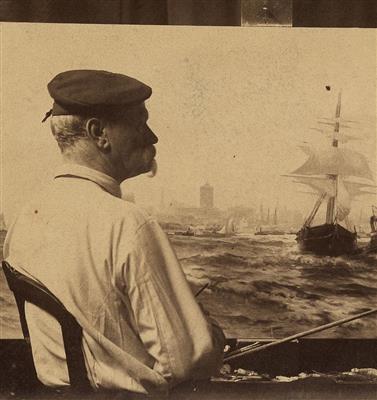
Lancashire-born marine painter who settled in America and created a 13-canvas cycle of US maritime history, from Columbus to the Statue of Liberty.
Where to see Edward Moran
Collection holdings are reported here; current display varies. Check with each museum before visiting.
-
5 recorded works
Smithsonian American Art Museum
Washington D.C., United States
-
2 recorded works
New Britain Museum of American Art
New Britain, United States


-
1 recorded work
New York Historical
New York City, United States
-
1 recorded work
Worcester Art Museum
Worcester, United States
-
1 recorded work
Indianapolis Museum of Art
Indianapolis, United States
-
1 recorded work
Cincinnati Art Museum
Cincinnati, United States
-
1 recorded work
Metropolitan Museum of Art
New York City, United States
-
1 recorded work
Vanderbilt Museum of Art
Nashville, United States
-
1 recorded work
National Gallery of Ireland
Dublin, Ireland
Also here (6)


Frequently Asked Questions
Where can I see Edward Moran's work?
To view Edward Moran's paintings, visit several museums in the United States. The Metropolitan Museum of Art in New York City holds examples of his work, as does the Los Angeles County Museum of Art (LACMA) in Los Angeles. Other US museums with works by Moran include the Minneapolis Institute of Arts in Minneapolis, the Virginia Museum of Fine Arts in Richmond, and the Charles Hosmer Morse Museum of American[1] Art in Winter Park, Florida. You can also find his paintings at the Yale University Art Gallery in New Haven, Connecticut; the Philadelphia Museum of Art in Philadelphia; the National Gallery of Art in Washington, DC; the National Museum of American Art, also in Washington; the Saint Louis Art Museum in St. Louis, Missouri; the Seattle Art Museum in Seattle, Washington; and the Toledo Museum of Art in Toledo, Ohio.What should I know about Edward Moran's prints?
Edward Moran (1829[1]-1901[1]) was an American[1] artist known for his marine paintings. While he is not directly associated with the Pre-Raphaelite Brotherhood, prints were made after paintings by artists in that circle, and these prints were sold in large numbers. Prints related to Pre-Raphaelite artists were often reproductive, meaning they were created after an existing painting. These reproductions used various techniques, including mixed method, stipple, etching, mezzotint, and photogravure. The Printsellers’ Association catalogues (1847[1]-1911[1]) and publications such as *The Year’s Art* catalogue these prints. Some examples of prints from the Pre-Raphaelite circle include *The Huguenot*, reproduced using mixed method and stipple and etching; *An Idyll of 1745*, an etching; *A Jersey Lily*, reproduced using mixed method; *The Knight Errant*, a photogravure; *Over the Hills & Far Away!*, an etching; and *The Order of Release 1745*, a mezzotint. These prints were produced by various engravers and publishers, including R. B. Parkes, G. Zobel, W. Hole, T. O. Barlow, F. Hanfstaengl, A. Brunet Debaines, S. Cousins, H. Graves, B. Brooks & Sons, J. S. Virtue & Goupil & Co, Ansdell, T. Agnew & T. McLean, and Frost & Reed.Why are Edward Moran's works important today?
Edward Moran (1829[1]-1901[1]) was an Anglo-American[1] artist known for his marine paintings. Born in Lancashire, England, he emigrated to the United States as a child. He is significant for his detailed depictions of maritime history and naval scenes. Moran's series of chromolithographs, published by Prang and Company, helped popularise nautical subjects. These prints made maritime art accessible to a wider audience. His large-scale paintings, such as "The First Ship Arriving in New York" (1892[1]), offered romanticised visions of American history. His work provides insights into 19th-century American attitudes toward maritime power and exploration. Moran's paintings document specific ships, naval battles, and harbour activity. They also reflect a broader cultural interest in the sea. His images contributed to the visual culture of maritime history. They remain valuable for understanding how the past was perceived and presented. Although Moran was one of several artists working in this genre, his prolific output and popular prints secured his place in American art history.Who did Edward Moran influence?
Edward Moran (1829[1]-1901[1]) was an American[1] artist known for his marine paintings. While it is difficult to pinpoint direct pupils, we can consider his influence through the lens of his artistic style and subject matter. Moran's detailed depictions of historical naval scenes and maritime life had an impact on later artists who pursued similar themes. His large-scale historical paintings, such as "The Undocking of the Ocean Telegraph Cable, 1858[1]" (c. 1865) and "The Statue of Liberty Enlightening the World" (1886), set a precedent for dramatic, patriotic maritime art. Some artists working in late 19th- and early 20th-century America adopted aspects of Moran's style, particularly his attention to detail in shipbuilding and wave action. Though not a formal school, a shared interest in maritime subjects created connections among artists. Further research into exhibition records and artist biographies could reveal more specific connections and influences.Who influenced Edward Moran?
Edward Moran, born in Lancashire, England, in 1829[1], emigrated to America with his family in 1844[1]. Early influences included the marine painter James Hamilton, under whom Moran studied in Philadelphia. Hamilton's dramatic seascapes certainly affected Moran's artistic development. Moran also studied with Paul Weber, a German-born artist who had settled in Philadelphia and specialised in romantic scenery. Weber's instruction provided Moran with a foundation in drawing and painting techniques. Later in his career, while living in New York, Moran encountered the work of J.M.W. Turner. Turner's atmospheric seascapes and use of light had a considerable effect on Moran's style, leading him to adopt a more dramatic and expressive approach to marine painting. He is known for a series of historical paintings of the US Navy.What is Edward Moran's most famous work?
Edward Moran is best known for his historical and maritime paintings. Born in Lancashire, England, in 1829[1], Moran emigrated to the United States in 1844[1]. He is particularly celebrated for his series of paintings depicting the maritime history of the United States. One of his most recognised works is *The Statue of Liberty Enlightening the World* (circa 1886), showing New York Harbour with various vessels. Moran created multiple versions of this subject; one is held by the National Museum of American[1] Art. Moran's detailed and dramatic depictions of naval scenes earned him acclaim during his lifetime. He died in 1901[1]. His paintings continue to be admired for their historical value and artistic skill.What style or movement did Edward Moran belong to?
Edward Moran (1829[1]-1901[1]) is associated with the Hudson River School, an American[1] art movement from the mid-19th century. This group of artists created works concerned with themes of discovery, exploration, and appreciation of the American wilderness. Moran, in particular, became known for his marine paintings. The Hudson River School artists shared an approach to subject, style, and artistic values. They commonly depicted the natural scenery around the Hudson River Valley (in New York state) and surrounding areas. Their aesthetic was influenced by European Romanticism, which stressed emotion, drama, and awe in response to nature. Moran's work fits within this style, as he captured maritime settings with a romanticised, dramatic sensibility.What was Edward Moran known for?
Edward Moran (1829[1]-1901[1]) was an American[1] artist known for maritime paintings. He is particularly noted for historical depictions of naval events. Born in Lancashire, England, Moran emigrated to America with his family in 1844[1]. He trained with James Hamilton and Paul Weber in Philadelphia. By the 1870s, Moran had studios in both Philadelphia and New York City. Moran produced a series of paintings representing the maritime history of the United States. These paintings aimed to illustrate important moments in the nation's past. One of the best-known works from this series is "The Statue of Liberty Enlightening the World" (1886), showing New York Harbour with the newly erected Statue of Liberty. Other paintings in the series include "The Constitution and the Guerriere" (1896) and "The Burning of the Frigate Philadelphia in the Harbor of Tripoli" (1897). These paintings are characterised by their attention to detail in the ships and sea. Moran's work contributed to a sense of national identity through its visual representation of American maritime achievements.
Sources
Where to See guide aggregates verified holdings of Edward Moran's works across the following collections.
- [1] wikipedia Wikipedia: Edward Moran Used for: biography.
- [2] book Bénédicte Savoy, Charlotte Guichard, Christine Howald, Acquiring Cultures Used for: biography, stylistic analysis.
- [3] book Rococo : art and design in Hogarth's England Used for: biography, stylistic analysis.
- [4] book Carol Strickland and John Boswell, The Annotated Mona Lisa Used for: biography.
- [5] book Carol Strickland and John Boswell, The Annotated Mona Lisa Used for: biography.
- [6] book Carol Strickland and John Boswell, The Annotated Mona Lisa Used for: biography.
- [7] book Laura Cumming, The Vanishing Velázquez Used for: biography, stylistic analysis.
Editorial overseen by Solis Prints. Sources verified 2026-10-06. Click a source for details, or hover over [N] in the page above to preview.
Editorial standardsMethodologyCorrectionsAI disclosureAbout the editorial team