



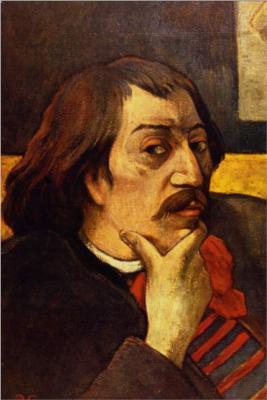
About Paul Gauguin
a Parisian stockbroker who abandoned his family to paint in Tahiti, survived a suicide attempt, and died in the Marquesas at fifty-four
Where to see Paul Gauguin
Collection holdings are reported here; current display varies. Check with each museum before visiting.
-
26 recorded works
Musée d'Orsay
Paris, France
-
 23 recorded works
Ny Carlsberg Glyptotek
Copenhagen, Denmark

-
13 recorded works
National Gallery of Art
Washington D.C., United States
-
19 recorded works
Hermitage Museum
Saint Petersburg, Russia
-
15 recorded works
Pushkin Museum of Fine Arts
Moscow, Russia
-
 3 recorded works
Cleveland Museum of Art
Cleveland, United States
-
 10 recorded works
Kunsthaus Zürich
Zurich, Switzerland
-
 10 recorded works
Art Institute of Chicago
Chicago, United States
-
 9 recorded works
Metropolitan Museum of Art
New York City, United States
-
 9 recorded works
Thyssen-Bornemisza Museum
Madrid, Spain


Own a piece of it
Paul Gauguin prints
Hand-finished archival prints from Paul Gauguin's body of work.
 Blue Barge - Paul Gauguin
From £28.00
Blue Barge - Paul Gauguin
From £28.00
 Still Life with Lemon and Glass - Paul Gauguin
From £37.00
Still Life with Lemon and Glass - Paul Gauguin
From £37.00
 Young Breton Woman - Paul Gauguin
From £28.00
Young Breton Woman - Paul Gauguin
From £28.00
 At the Pond - Paul Gauguin
From £28.00
At the Pond - Paul Gauguin
From £28.00
 Orchard under the Church of Bihorel (Children in the Pasture) - Paul Gauguin
From £28.00
Orchard under the Church of Bihorel (Children in the Pasture) - Paul Gauguin
From £28.00
 Calvaire breton - Paul Gauguin
From £28.00
Calvaire breton - Paul Gauguin
From £28.00
 Portrait of William Molard - Paul Gauguin
From £28.00
Portrait of William Molard - Paul Gauguin
From £28.00
 Portrait of Achille Granchi-Taylor - Paul Gauguin
From £28.00
Portrait of Achille Granchi-Taylor - Paul Gauguin
From £28.00
View all 67 museums
-
8 recorded works
Van Gogh Museum
Amsterdam, Netherlands
-
8 recorded works
Ordrupgaard
Charlottenlund, Denmark
Also here (3)
-
6 recorded works
Museum of Fine Arts Boston
Boston, United States
-
 7 recorded works
Statens Museum for Kunst
Copenhagen, Denmark
-
6 recorded works
Wallraf–Richartz Museum
Cologne, Germany
-
6 recorded works
Foundation E.G. Bührle Collection
Zurich, Switzerland
-
 6 recorded works
Museum of Modern Art
New York City, United States
-
6 recorded works
National Museum of Art, Architecture and Design
Oslo, Norway
-
5 recorded works
Israel Museum
Jerusalem, Israel
-
5 recorded works
Indianapolis Museum of Art
Indianapolis, United States
-
 5 recorded works
Fogg Museum
Cambridge, United States
-
4 recorded works
Artizon Museum
Tokyo, Japan
-
4 recorded works
National Gallery
London, United Kingdom
-
4 recorded works
Matsukata Collection
Tokyo, Japan
-
4 recorded works
National Museum of Western Art
Tokyo, Japan
-
4 recorded works
Pola Museum of Art
Hakone, Japan
-
4 recorded works
Los Angeles County Museum of Art
Los Angeles, United States
-
 4 recorded works
Museum Folkwang
Essen, Germany
-
 3 recorded works
Kunstmuseum Basel
Basel, Switzerland
-
 3 recorded works
The Nelson-Atkins Museum of Art
Kansas City, United States
-
3 recorded works
Nationalmuseum
Stockholm, Sweden
-
3 recorded works
Harvard Art Museums
Cambridge, United States
-
 3 recorded works
Kröller-Müller Museum
Otterlo, Netherlands
-
 2 recorded works
Brooklyn Museum
New York City, United States
-
2 recorded works
Buffalo AKG Art Museum
Buffalo, United States
-
 2 recorded works
Musée des Beaux-Arts de Quimper
Quimper, France
-
2 recorded works
Museum Boijmans Van Beuningen
Rotterdam, Netherlands
-
2 recorded works
Dallas Museum of Art
Dallas, United States
-
 2 recorded works
Worcester Art Museum
Worcester, United States
-
2 recorded works
Virginia Museum of Fine Arts
Richmond, United States
-
 2 recorded works
Fitzwilliam Museum
Cambridge, United Kingdom
-
 2 recorded works
Saint Louis Art Museum
St. Louis, United States
-
2 recorded works
Museum of Fine Arts, Houston
Houston, United States
-
2 recorded works
Philadelphia Museum of Art
Philadelphia, United States
-
2 recorded works
Yale University Art Gallery
New Haven, United States
-
 1 recorded work
Toledo Museum of Art
Toledo, United States
-
 1 recorded work
Hungarian National Gallery
Budapest, Hungary
Also here (6)
Bertalan SzekelyVilmos Aba-NovakEndre BalintAladar Korosfoi-KrieschEgry JózsefAugust von Pettenkofen -
1 recorded work
Musée des Beaux-Arts d'Orléans
Orléans, France
-
 1 recorded work
Galleria d'arte moderna di Milano
Milan, Italy
-
 1 recorded work
National Gallery Prague
Prague, Czech Republic


17 more museums hold works by Paul Gauguin with smaller collections, not listed here.
Can't travel? Bring Paul Gauguin home.
See all Paul Gauguin prints →Frequently Asked Questions
Where can I see Paul Gauguin's work?
Paul Gauguin's paintings and prints are held in museum collections around the world. The Musée d’Orsay in Paris has a substantial collection of his paintings, including works from his time in Brittany and Tahiti. The Art Institute of Chicago also holds a number of important paintings, such as "Why Are You Angry?" (1896[7]). Other significant collections are at the National Gallery of Art in Washington, D.C., the Courtauld Gallery in London, and the Ny Carlsberg Glyptotek in Copenhagen. These museums offer a range of Gauguin's output, from early Impressionist-influenced works to his later Synthetist style. Prints and drawings by Gauguin are less frequently on display than his paintings, due to their sensitivity to light. However, major print rooms such as the British Museum and the Bibliothèque Nationale de France hold significant collections. These can often be viewed by appointment, or during special exhibitions. Catalogues raisonnés are available; these document the locations of known works.Where did Paul Gauguin live?
Paul Gauguin lived in Lima, Peru as a baby, before returning to Paris when he was seven years old. Later in life, he lived in Copenhagen, Brittany, and Tahiti, among other places.What should I know about Paul Gauguin's prints?
Paul Gauguin produced prints throughout his career, although they are fewer in number than his paintings or sculptures. His printmaking experiments include woodcuts, lithographs, and monotypes. These graphic works often echo themes and imagery found in his paintings, such as Tahitian figures and Pacific island settings. Gauguin's prints are characterised by bold lines and simplified forms. He often employed a technique of leaving areas of the paper untouched, creating a stark contrast between light and dark. This is particularly evident in his woodcuts, where the grain of the wood itself becomes an important element of the composition. One notable set of prints is the Noa Noa series (circa 1893[7]-94). These works were created to accompany his book of the same name, a semi-fictional account of his time in Tahiti. The Noa Noa prints combine woodcut and monotype techniques, resulting in unique impressions with varied colour and texture. These prints helped to disseminate Gauguin's vision of Polynesia to a wider audience. Other important prints include his Bretonneries series, depicting scenes from Brittany.Why are Paul Gauguin's works important today?
Paul Gauguin's art is important for several reasons. He experimented with colour and form, moving away from representational accuracy. His interest in non-Western cultures introduced new subjects and styles to European art. Gauguin (1848[7]-1903[7]) rejected Impressionism's focus on optical realism. He sought to express inner emotions and spiritual ideas through simplified shapes and symbolic colours. This approach influenced the development of Symbolism[7] and Expressionism. Artists such as Henri Matisse and Pablo Picasso were inspired by Gauguin's bold use of colour and his flattening of perspective. His time in French[7] Polynesia, particularly Tahiti, produced some of his most well-known paintings. These works depict Tahitian people and culture, although with a Western gaze that has become a subject of debate. Gauguin's representation of indigenous people has been criticised for idealising and exoticising them. This raises important questions about cultural appropriation and the artist's role in representing other cultures. His art continues to be studied for its aesthetic innovations and the complex issues it raises about colonialism and representation.Why did Paul Gauguin move to tahiti?
Paul Gauguin moved to Tahiti expecting an untouched paradise, but instead found a French[7] colonial territory.Paul Gauguin most famous?
Paul Gauguin died in poverty in the Marquesas in 1903[7]. Three years later, a large retrospective exhibition of 227 of his paintings and engravings was held in Paris.Why did Paul Gauguin and van gogh fight?
Paul Gauguin and Vincent van Gogh argued constantly about art during their sixty-three days of cohabitation in Arles. Van Gogh was exhausted and overstrained, which made him no match for Gauguin, who had strong nerves and a cool manner of arguing.What techniques or materials did Paul Gauguin use?
Paul Gauguin's techniques and materials evolved throughout his career. Initially, he used minimally hand-ground colours, which gave a granular texture, unlike the smooth, machine-made pigments available at the time. His palette included cadmium and chrome yellows, yellow ochre, viridian and emerald greens, ultramarine and cobalt blues, cobalt violet, red lakes, vermilion, and white. Gauguin often employed unprimed, coarse fabrics like sackcloth, exploiting their texture to create matt surfaces. He applied thin, opaque paint layers, allowing the fabric to show through. When using primed canvas, he preferred thin, pale layers. He believed absorbent grounds were important, as they gave a sunken appearance to the paint, similar to unprimed cloth. He sometimes added wax to his paint to stiffen it and create a matt finish, a common practice at the time to stabilise the paint and reduce the pigment needed. In warmer climates like Tahiti, wax-filled colours remained malleable. Gauguin applied paint with brushes, sometimes stiff, and occasionally used a palette knife. He outlined contours directly onto the canvas in vermilion and dark ultramarine or Prussian blue paint, building up modelling in flat areas of colour.
Sources
Where to See guide aggregates verified holdings of Paul Gauguin's works across the following collections.
- [1] museum Brooklyn Museum Used for: museum holdings.
- [2] museum Toledo Museum of Art Used for: museum holdings.
- [3] museum Buffalo AKG Art Museum Used for: museum holdings.
- [4] museum Hungarian National Gallery Used for: museum holdings.
- [5] museum Musée des Beaux-Arts d'Orléans Used for: museum holdings.
- [6] museum Galleria d'arte moderna di Milano Used for: museum holdings.
- [7] wikipedia Wikipedia: Paul Gauguin Used for: biography.
- [8] book Susie Hodge, Art Used for: biography.
- [9] book Susie Hodge, Art: Everything You Need to Know About the Greatest Artists and Their Work Used for: biography.
- [10] book Susie Hodge, Artistic Circles Used for: biography.
- [11] book Vincent van Gogh, Delphi Complete Works of Vincent Van Gogh (Illustrated) Used for: biography.
- [12] book Susie Hodge, I Know an Artist Used for: biography, museum holdings.
- [13] book Susie Hodge, I Know an Artist: The Inspiring Connections Between the World's Greatest Artists Used for: biography, museum holdings.
- [14] book Masterpieces of western art : a history of art in 900 individual studies from the Gothic to the present day Used for: biography.
- [15] book Vincent van Gogh, Masters of Art - Vincent van Gogh Used for: biography.
- [16] book Nathalia Brodskaya, Post-Impressionism Used for: biography.
- [17] book Post-impressionism : cross-currents in European painting Used for: biography.
- [18] book Post-impressionism : cross-currents in European painting Used for: biography.
- [19] book Perry, Gill, Frascina, Francis, Harrison, Dr. Charles, Primitivism, Cubism, Abstraction_ The Early Twentieth Century_ Book 2 (Open University_ Modern Art - Practices & Debates) Used for: biography.
- [20] book VINCENT VAN GOGH, Works of Vincent van Gogh (Masters of Art) Used for: biography.
Editorial overseen by Solis Prints. Sources verified 2026-10-06. Click a source for details, or hover over [N] in the page above to preview.
Editorial standardsMethodologyCorrectionsAI disclosureAbout the editorial team