



About Emma Amos
American · 1937–2020
- Feminist Art
- Postmodernism
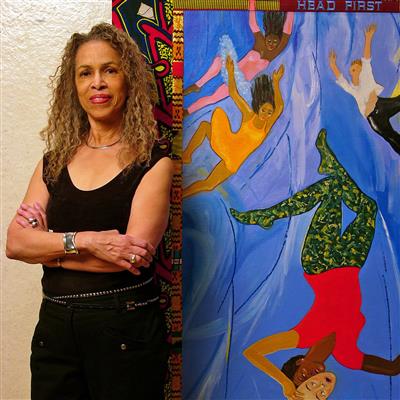
Atlanta-born painter and the sole woman in Spiral, whose linen canvases bordered with African textiles confronted the race and gender politics of American[1] art.
Museums7
Countries2
Most worksCleveland Museum of Art, Cleveland · 50 works
Loading map…
Where to see Emma Amos
Ranked by works you can see in person.
-
50 works
Cleveland Museum of Art
Cleveland, United States
-
3 works
Minneapolis Institute of Art
Minneapolis, United States


-
1 works
Whitney Museum of American Art
New York City, United States
-
1 works
Smithsonian American Art Museum
Washington D.C., United States
-
1 works
Crystal Bridges Museum of American Art
Bentonville, United States
-
0 works
British Museum
London, United Kingdom
-
0 works
Metropolitan Museum of Art
New York City, United States


Frequently Asked Questions
Where can I see Emma Amos's work?
Museums regularly adjust their schedules and COVID-19 rules. Some museums are temporarily closed, while others are open but require timed-entry tickets to limit visitor numbers. Almost all require face coverings. Many have also increased their online presence through social media or virtual exhibitions. It is best to check museum websites for the latest information. As of 2021, several museums were planning solo exhibitions of women artists. The Baltimore Museum of Art planned to exhibit Joan Mitchell's work from March 21 through July 18, in an exhibition co-organised with the San Francisco Museum of Modern Art. The Westmoreland Museum of American[1] Art in Greensburg, Pennsylvania, planned to present Simple Pleasures: The Art of Doris Lee from September 26 through January 9, 2022.What should I know about Emma Amos's prints?
Emma Amos created original prints, often sold in limited editions. These are distinct from reproductions because the artist creates the artwork directly on a plate, woodblock, stone, or screen. Original prints can be woodcuts, engravings, linocuts, mezzotints, etchings, lithographs or serigraphs. Each print in a limited edition is considered an original because the artist produces it by hand. The number of prints is limited either by the medium or by the artist's decision. Printmakers mark up each print with the edition number, the print's title, and their signature, usually in pencil on the bottom margin. The edition is written as a pair of numbers; for example, 35/100, where 100 is the total number of prints, and 35 is the sequential number of that particular print. Some artists also create artist's proofs, marked AP. Prices for prints depend on the quantity available, the artist’s reputation, the image's popularity, and the quality of materials.Why are Emma Amos's works important today?
Emma Amos (1937[1]-2020[1]) was a painter, printmaker, and weaver who explored themes of race, gender, and identity in her art. Amos was associated with the Spiral Group, a collective of Black artists formed in 1963[1] to discuss the role of Black artists in the Civil Rights movement. She was also a member of the Heresies Collective, a feminist art collective founded in 1976. Amos's work often incorporates images of herself and her family, as well as references to popular culture and art history. She challenged conventional representations of Black women in art, presenting them as complex, multifaceted individuals. Her Afrofemcentrist perspective gave primacy to Black-female consciousness. Amos's innovative approach to figuration and her willingness to address difficult social issues make her work relevant today.What techniques or materials did Emma Amos use?
Emma Amos employed varied materials and methods in her artistic practice. Historically, painters have used media such as fresco, egg tempera, and watercolour, progressing to oil paint. Contemporary materials include acrylics, household emulsions, and mixed media, which combines different materials in a single work. Knowledge of how materials such as oil paint can be applied thickly (impasto) or thinly (glazes) informs understanding of the artwork. Brushwork varies from fine and disguised to thickly applied with a palette knife, or stencilled. Technique is more than a method; it is how manual and mechanical operations act upon raw material to shape it according to artistic intentions. Some artists begin with craft, then move to ideas; others start with ideas and then address the practicalities of craft to express them. Artists are not always confined by their chosen medium. Choices exist outside the constraints of materials and techniques.Who did Emma Amos influence?
Emma Amos's direct artistic influence is difficult to measure, but some general trends can be identified. Elizabeth Catlett, for example, acted as a role model for younger African-American[1] women artists. Catlett championed modern art, black aesthetic traditions, and black liberation ideology. Younger artists had opportunities to meet her through the National Conference of Artists, an organisation of professional black artists, critics, and art historians founded in 1959[1]. Faith Ringgold co-founded a black women’s art group in 1971 with Dinga McCannon and Kay Brown, called Where We At: Black Women Artists. Ringgold focused more on her black female sensibility, leaving avenues open for networking with other artists and groups. Within two years, she had ‘begun to speak almost exclusively for women, Black women,’ who in turn began to speak to the world through her art.What is Emma Amos's most famous work?
It is difficult to name one single work as Emma Amos's most famous. Her body of work engages with themes of race, gender, and class, often incorporating personal narratives and challenging conventional artistic boundaries. Amos was associated with the Spiral Group in the 1960s, a collective of Black artists who discussed the role of Black artists in the Civil Rights movement. Later, she became a member of the feminist collective Heresies. Her art often combines painting, printmaking, and textiles, creating layered and textured surfaces. While no single piece may eclipse her other works, recurring motifs and themes appear throughout her career. These include explorations of the female body, representations of African textiles, and a critical examination of Western art history. Her distinctive approach and engagement with social issues have secured her a place in contemporary art discourse.What style or movement did Emma Amos belong to?
Emma Amos's career coincided with the rise of both feminist art and postmodernism. These movements, emerging in the late 1960s, questioned traditional artistic norms and power structures. Feminist art specifically addresses inequalities faced by women, aiming to instigate change. It lacks a singular style, encompassing various media and approaches. Some scholars link feminist art with conceptual art, where the idea behind a work takes precedence over its physical form. Conceptual art can manifest as performance, happenings, or even written statements. Postmodernism[1], gaining traction in the 1970s, views contemporary society as fragmented, lacking a central, coherent structure. Postmodern artists often borrow from the past, blending styles to mirror this fragmented reality. The relationship between feminism and postmodernism is complex; some feminist scholars have critiqued postmodern theories for potentially hindering political action and marginalising certain voices. Despite these criticisms, feminist art history has also adopted postmodern tools of analysis.What was Emma Amos known for?
Emma Amos (born 1937[1]; died 2020[1]) was an American[1] artist known for work that engaged with feminist and postmodernist ideas. Her career developed during a period when feminist art historians analysed how culture and visual representation maintained the secondary status of women. Amos's work can be situated within a broader art world that, from the late 1960s, saw artists explore conceptual and performance art. Feminist art, linked with conceptual art, focused on inequalities faced by women and aimed to provoke change. This movement had no set style; it could include painting or performance. Postmodernism[1], dating from 1970[1] onwards, viewed society as fragmented, lacking a coherent centre. Artists sometimes borrowed from the past, mixing old styles to reflect contemporary society. Some feminist artists explored how women were presented in the media.
Sources
Where to See guide aggregates verified holdings of Emma Amos's works across the following collections.
- [1] wikipedia Wikipedia: Emma Amos Used for: biography.
- [2] book guggenheim-museum00solo Used for: biography.
- [3] book Shirley Samuels;, Race and Vision in the Nineteenth-Century United States Used for: stylistic analysis.
- [4] book Norma Broude, The Expanding Discourse Used for: biography, stylistic analysis.
- [5] book Hodge, Susie, 1960- author, The short story of women artists : a pocket guide to movements, works, breakthroughs, & themes Used for: biography.
- [6] book Charlene Spretnak (auth.), The Spiritual Dynamic in Modern Art _ Art History Reconsidered, 1800 to the Present Used for: stylistic analysis.
Editorial overseen by Solis Prints. Sources verified 2026-08-29. Click a source for details, or hover over [N] in the page above to preview.
Editorial standardsMethodologyCorrectionsAI disclosureAbout the editorial team