

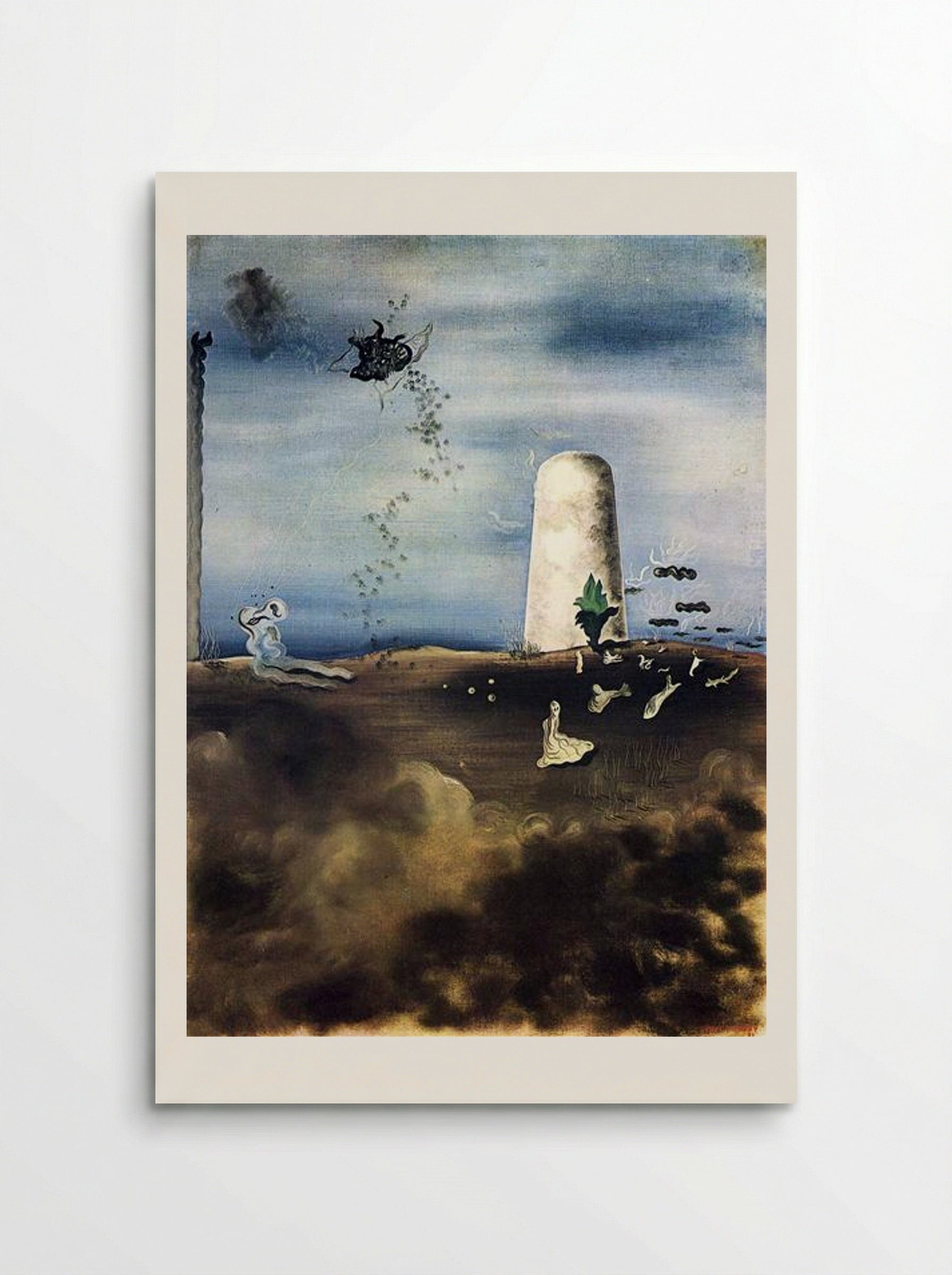
Death Awaiting his Family - Yves Tanguy
Archival giclée
Frames arrive ready to hang
Secure checkout
Made to order
Description
A classic Surrealist composition by Yves Tanguy, featuring biomorphic forms in a vast, desolate dreamscape.
Yves Tanguy, a self-taught painter who joined the Surrealist group in 1925, produced this work during a period of rapid stylistic development. The composition presents a characteristic dreamscape, a hallmark of his output throughout the late 1920s. Tanguy constructs an expansive, barren plain that stretches toward a distant, hazy horizon, creating a sense of infinite space. Within this desolate environment, the artist places various biomorphic forms. These objects appear to exist in a state of suspension, neither fully solid nor entirely gaseous. A large, monolithic structure stands in the middle ground, providing a stark contrast to the smaller, fluid shapes that populate the foreground. The painting employs a precise, smooth application of paint, which allows the strange, organic entities to appear as if they possess a tangible, physical reality despite their impossible geometry. The colour palette is dominated by muted blues, browns, and ochres, which contribute to the overall atmosphere of isolation and quietude. Tanguy avoids traditional perspective, opting instead for a flattened, expansive view that draws the viewer into a psychological space rather than a physical one. The objects seem to interact with one another through subtle, unseen forces, suggesting a narrative that remains elusive and open to individual interpretation. This work reflects the Surrealist interest in the unconscious mind and the creation of imagery that defies rational explanation. By removing these forms from any recognisable context, Tanguy forces the viewer to engage with the painting on a purely intuitive level. The lack of clear light sources or shadows further enhances the otherworldly quality of the scene, ensuring that the focus remains on the strange, rhythmic arrangement of the forms themselves. It is a clear example of the artist's ability to render the impossible with a high degree of technical control.
You might also like
Return policy
Because every print is made to order, we don't offer change-of-mind returns, refunds or exchanges. If your order arrives faulty, damaged or incorrect, we'll replace it free of charge — just contact us within 48 hours of delivery. See our refunds page for full details.
Shipping
We ship worldwide, printing at the production hub nearest to your delivery address. Delivery times and costs vary by destination — you'll see the options available to you at checkout.
Manufacturing
Each print is produced to order using 12-colour giclée printing on FSC-certified archival paper. Designed in Britain and printed at your nearest production hub to reduce waste and speed up delivery.
Care and materials
Specific Features
Every Solis piece is made to order with archival, gallery-quality materials built to last.
- Museum-grade giclée printing for rich, fade-resistant colour
- Archival matte fine-art paper, FSC-certified
- Multiple sizes and framing options available
- Frames in black, natural wood, dark wood or white
- Framed prints arrive ready to hang
Care & Cleaning
To keep your artwork looking its best:
- Dust gently with a soft, dry cloth
- Avoid prolonged direct sunlight
- Never use liquid cleaners on the print or canvas surface
- Keep in a dry, room-temperature space
- Handle prints with clean, dry hands
Materials & Sizing
Museum-grade giclée on FSC-certified archival matte paper, with framed and canvas options.
- Paper sizes: A4, A3, A2, A1, A0 and B2 (50×70 cm)
- Canvas: XS (20×30 cm) to Large (60×90 cm)
- Frames: black, natural wood, dark wood or white
Death Awaiting his Family - Yves Tanguy

Artist Biography
Yves Tanguy
He was born in Paris in 1900. He briefly joined the merchant navy in 1918 before being drafted into the army, where he met the poet Jacques Prevert, who later introduced him to Andre Breton's Surrealist circle. He joined the Surrealists in 1925 and had his first solo show just two years later, having taught himself everything.
His paintings consistently depict flat, featureless landscapes resembling sea floors or alien terrain, populated by biomorphic forms that look like melted rocks or bones. He never explained them. The palette is muted, the horizons infinite, the atmosphere airless. The same vocabulary of forms appears across decades of work with only gradual variation.
He married the American Surrealist painter Kay Sage in Reno, Nevada, in 1940. They settled in Woodbury, Connecticut, converting an old farmhouse into a studio. He died there in 1955, aged fifty-five.
Why Choose Us ?
Damage-free delivery guarantee
Fast Shipping
Museum-Quality Materials
You May Also Like