

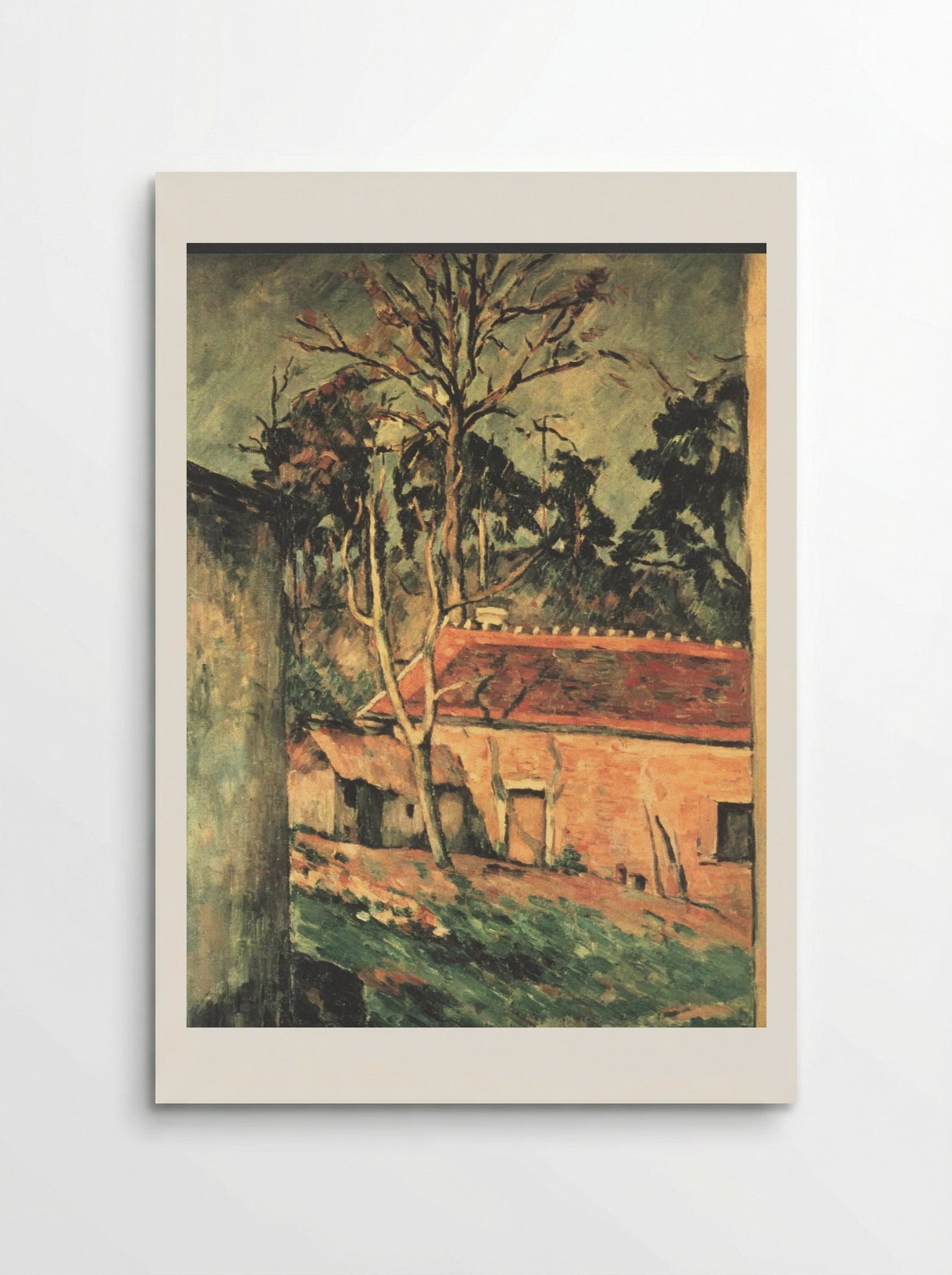
Farmyard at Auvers - Paul Cézanne
Archival giclée
Frames arrive ready to hang
Secure checkout
Made to order
Description
Farmyard at Auvers by Paul Cézanne captures a rural French scene with simplified shapes and geometric forms, showcasing the artist's Post-Impressionist style and emphasis on structure.
Paul Cézanne's painting, Farmyard at Auvers, presents a view of rural France through the artist's distinctive lens. Cézanne, a Post-Impressionist painter, moved away from the fleeting impressions of the Impressionists, instead seeking to capture the underlying structure and form of his subjects. This work exemplifies his approach, with its simplified shapes and emphasis on geometric forms. The painting depicts a farmyard scene, likely in the village of Auvers-sur-Oise, where Cézanne spent time. A cluster of buildings with red-tiled roofs dominates the centre, framed by a bare tree and surrounding greenery. The composition is structured around a series of planes, creating a sense of depth and solidity. Cézanne's brushwork is visible throughout, with individual strokes of colour building up the forms. The palette is muted, with earthy tones of green, brown, and ochre predominating. The overall effect is one of quiet contemplation, inviting the viewer to consider the enduring qualities of the natural world.
Return policy
Because every print is made to order, we don't offer change-of-mind returns, refunds or exchanges. If your order arrives faulty, damaged or incorrect, we'll replace it free of charge — just contact us within 48 hours of delivery. See our refunds page for full details.
Shipping
We ship worldwide, printing at the production hub nearest to your delivery address. Delivery times and costs vary by destination — you'll see the options available to you at checkout.
Manufacturing
Each print is produced to order using 12-colour giclée printing on FSC-certified archival paper. Designed in Britain and printed at your nearest production hub to reduce waste and speed up delivery.
Farmyard at Auvers - Paul Cézanne

Artist Biography
Paul Cézanne
While often associated with the Impressionists, Cézanne diverged from their fleeting, optical approach. He sought to capture the underlying structure and solidity of objects, famously stating his desire to "make of Impressionism something solid and durable, like the art in the museums." This pursuit led him to develop his signature style, characterised by fragmented brushstrokes, subtle colour modulations, and a flattening of perspective. His landscapes, still lifes, and portraits, such as "The Basket of Apples" and "Mont Sainte-Victoire," reveal a profound engagement with form and perception.
Though initially met with ridicule and rejection by the Salon, Cézanne's relentless experimentation paved the way for modern art movements like Cubism and Fauvism. Artists like Picasso and Matisse revered him as a forefather, recognising his revolutionary approach to depicting the world. Today, Paul Cézanne's art hangs in the world's finest museums, a testament to his enduring influence and the power of artistic vision.
Our Features
Designed for Lasting Impact
Specific Features
Every Solis piece is made to order with archival, gallery-quality materials built to last.
- Museum-grade giclée printing for rich, fade-resistant colour
- Archival matte fine-art paper, FSC-certified
- Multiple sizes and framing options available
- Frames in black, natural wood, dark wood or white
- Framed prints arrive ready to hang
Care & Cleaning
To keep your artwork looking its best:
- Dust gently with a soft, dry cloth
- Avoid prolonged direct sunlight
- Never use liquid cleaners on the print or canvas surface
- Keep in a dry, room-temperature space
- Handle prints with clean, dry hands
Materials & Sizing
Museum-grade giclée on FSC-certified archival matte paper, with framed and canvas options.
- Paper sizes: A4, A3, A2, A1, A0 and B2 (50×70 cm)
- Canvas: XS (20×30 cm) to Large (60×90 cm)
- Frames: black, natural wood, dark wood or white
Why Choose Us ?
Damage-free delivery guarantee
Fast Shipping
Museum-Quality Materials
Artist Biography
Paul Cézanne
While often associated with the Impressionists, Cézanne diverged from their fleeting, optical approach. He sought to capture the underlying structure and solidity of objects, famously stating his desire to "make of Impressionism something solid and durable, like the art in the museums." This pursuit led him to develop his signature style, characterised by fragmented brushstrokes, subtle colour modulations, and a flattening of perspective. His landscapes, still lifes, and portraits, such as "The Basket of Apples" and "Mont Sainte-Victoire," reveal a profound engagement with form and perception.
Though initially met with ridicule and rejection by the Salon, Cézanne's relentless experimentation paved the way for modern art movements like Cubism and Fauvism. Artists like Picasso and Matisse revered him as a forefather, recognising his revolutionary approach to depicting the world. Today, Paul Cézanne's art hangs in the world's finest museums, a testament to his enduring influence and the power of artistic vision.
You May Also Like