

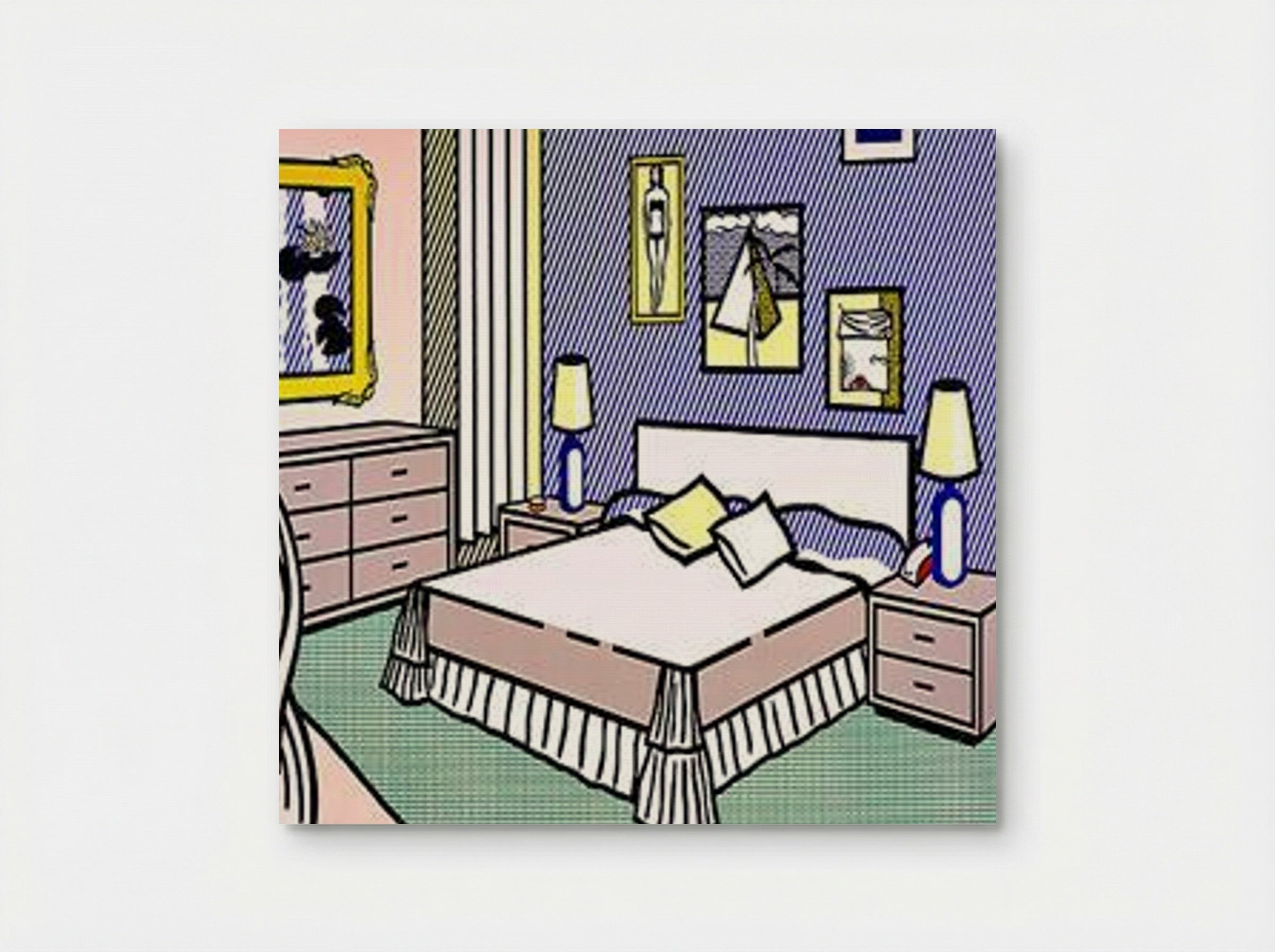
Interior with Water Lilies - Roy Lichtenstein
Archival giclée
Frames arrive ready to hang
Secure checkout
Made to order
Description
A 1991 Pop Art interior scene by Roy Lichtenstein, featuring his iconic Ben-Day dot technique and bold graphic lines.
Roy Lichtenstein produced Interior with Water Lilies in 1991, a period during which he revisited the domestic spaces that occupied his earlier work. This piece employs his signature Ben-Day dot technique, a method derived from commercial printing processes. The composition presents a bedroom scene, flattened into a graphic arrangement of bold outlines and primary colours. Lichtenstein uses these mechanical aesthetic choices to distance the viewer from the subject, turning a private space into a series of signs and symbols. The work references Claude Monet’s famous water lily series, yet it strips away the atmospheric quality of Impressionism. Instead, the image relies on sharp contrasts and rigid geometry. The walls are covered in a diagonal hatching pattern, while the floor features a dense grid of dots. These textures create a sense of artificiality. The furniture, including the bed and bedside tables, is rendered with minimal detail, functioning as icons of domesticity rather than realistic objects. Lichtenstein’s approach here is analytical. He examines how images are constructed and consumed in mass media. By placing a framed artwork within the painting, he creates a meta-commentary on the nature of art itself. The inclusion of the water lily motif serves as a direct nod to art history, recontextualised through the lens of mid-century graphic design. The result is a clean, precise image that prioritises clarity over emotional depth. It remains a clear example of his late-career focus on the interplay between high art and popular culture, maintaining the detached, cool observation that defined his practice for decades.
Return policy
Because every print is made to order, we don't offer change-of-mind returns, refunds or exchanges. If your order arrives faulty, damaged or incorrect, we'll replace it free of charge — just contact us within 48 hours of delivery. See our refunds page for full details.
Shipping
We ship worldwide, printing at the production hub nearest to your delivery address. Delivery times and costs vary by destination — you'll see the options available to you at checkout.
Manufacturing
Each print is produced to order using 12-colour giclée printing on FSC-certified archival paper. Designed in Britain and printed at your nearest production hub to reduce waste and speed up delivery.
Care and materials
Specific Features
Every Solis piece is made to order with archival, gallery-quality materials built to last.
- Museum-grade giclée printing for rich, fade-resistant colour
- Archival matte fine-art paper, FSC-certified
- Multiple sizes and framing options available
- Frames in black, natural wood, dark wood or white
- Framed prints arrive ready to hang
Care & Cleaning
To keep your artwork looking its best:
- Dust gently with a soft, dry cloth
- Avoid prolonged direct sunlight
- Never use liquid cleaners on the print or canvas surface
- Keep in a dry, room-temperature space
- Handle prints with clean, dry hands
Materials & Sizing
Museum-grade giclée on FSC-certified archival matte paper, with framed and canvas options.
- Paper sizes: A4, A3, A2, A1, A0 and B2 (50×70 cm)
- Canvas: XS (20×30 cm) to Large (60×90 cm)
- Frames: black, natural wood, dark wood or white
Interior with Water Lilies - Roy Lichtenstein

Artist Biography
Roy Lichtenstein
He was not young when this happened. He was thirty-eight, teaching art at Rutgers University, and had spent the previous decade painting Abstract Expressionist canvases that looked like everyone else's. The comic paintings were a deliberate rejection of the idea that art had to show the artist's inner emotional state. They showed Donald Duck instead.
Leo Castelli gave him his first show in 1962. Every painting sold before the exhibition opened. The speed was unusual. Warhol was doing similar things with soup cans and Coca-Cola bottles, but Lichtenstein's method was different: he hand-painted everything to look mechanically reproduced. The Ben-Day dots were applied through a stencil. The lines were drawn with a projector and then painted by hand. The process was laborious and precise, which was the joke: meticulous craftsmanship in the service of something that was supposed to look cheap.
He moved beyond comics into landscapes, brushstrokes (paintings of brushstrokes), Chinese landscapes, interiors, and nudes, all in the same flat, graphic style. The Brushstroke series, where he painted enormous images of painterly brushstrokes in the same deadpan comic-book technique, annoyed Abstract Expressionists specifically and delighted everyone else.
Why Choose Us ?
Damage-free delivery guarantee
Fast Shipping
Museum-Quality Materials
You May Also Like