

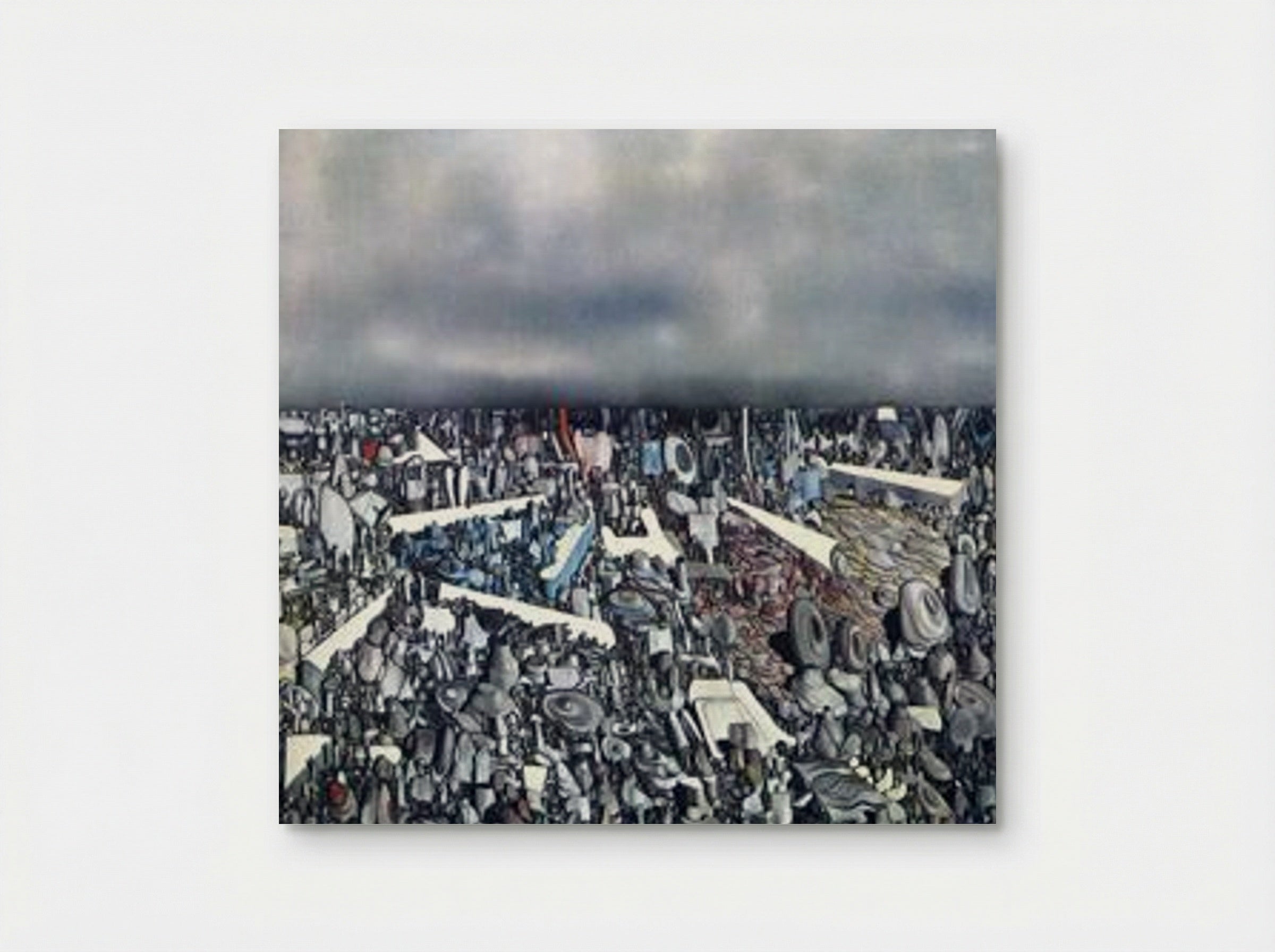
Multiplication of the Arcs - Yves Tanguy
Archival giclée
Frames arrive ready to hang
Secure checkout
Made to order
Description
A late Surrealist work by Yves Tanguy, featuring a dense, claustrophobic arrangement of biomorphic forms beneath a heavy, overcast sky.
Multiplication of the Arcs, painted in 1954, represents the final phase of Yves Tanguy's career. The composition features a dense, crowded field of ambiguous, biomorphic forms that occupy the lower two-thirds of the canvas. These shapes, which defy easy categorisation, appear to be constructed from rigid, geometric planes and soft, organic curves. They are arranged in a manner that suggests a vast, alien architecture or a collection of geological specimens scattered across a barren plain. The upper portion of the painting is dominated by a heavy, oppressive sky. This expanse of grey, atmospheric clouds creates a stark contrast with the detailed, cluttered surface below. Tanguy employs a precise, almost clinical technique to render these objects, which contributes to the uncanny quality of the scene. The light source is difficult to determine, as the shadows cast by the various forms do not align with a single point of illumination. This lack of consistent perspective enhances the dreamlike, irrational nature of the work. Unlike his earlier paintings, which often placed a few isolated objects in an expansive, empty void, this work is characterised by an overwhelming sense of accumulation. The forms seem to multiply and crowd one another, creating a claustrophobic effect. The palette is restricted to cool tones, including slate greys, muted blues, and off-whites, which reinforces the desolate, otherworldly atmosphere. Tanguy's work from this period reflects his interest in the subconscious and the creation of internal, psychological spaces. By presenting these unidentifiable objects with such clarity, he invites the viewer to project their own interpretations onto the scene, while simultaneously denying any singular, rational explanation for the arrangement.
Return policy
Because every print is made to order, we don't offer change-of-mind returns, refunds or exchanges. If your order arrives faulty, damaged or incorrect, we'll replace it free of charge — just contact us within 48 hours of delivery. See our refunds page for full details.
Shipping
We ship worldwide, printing at the production hub nearest to your delivery address. Delivery times and costs vary by destination — you'll see the options available to you at checkout.
Manufacturing
Each print is produced to order using 12-colour giclée printing on FSC-certified archival paper. Designed in Britain and printed at your nearest production hub to reduce waste and speed up delivery.
Care and materials
Specific Features
Every Solis piece is made to order with archival, gallery-quality materials built to last.
- Museum-grade giclée printing for rich, fade-resistant colour
- Archival matte fine-art paper, FSC-certified
- Multiple sizes and framing options available
- Frames in black, natural wood, dark wood or white
- Framed prints arrive ready to hang
Care & Cleaning
To keep your artwork looking its best:
- Dust gently with a soft, dry cloth
- Avoid prolonged direct sunlight
- Never use liquid cleaners on the print or canvas surface
- Keep in a dry, room-temperature space
- Handle prints with clean, dry hands
Materials & Sizing
Museum-grade giclée on FSC-certified archival matte paper, with framed and canvas options.
- Paper sizes: A4, A3, A2, A1, A0 and B2 (50×70 cm)
- Canvas: XS (20×30 cm) to Large (60×90 cm)
- Frames: black, natural wood, dark wood or white
Multiplication of the Arcs - Yves Tanguy

Artist Biography
Yves Tanguy
He was born in Paris in 1900. He briefly joined the merchant navy in 1918 before being drafted into the army, where he met the poet Jacques Prevert, who later introduced him to Andre Breton's Surrealist circle. He joined the Surrealists in 1925 and had his first solo show just two years later, having taught himself everything.
His paintings consistently depict flat, featureless landscapes resembling sea floors or alien terrain, populated by biomorphic forms that look like melted rocks or bones. He never explained them. The palette is muted, the horizons infinite, the atmosphere airless. The same vocabulary of forms appears across decades of work with only gradual variation.
He married the American Surrealist painter Kay Sage in Reno, Nevada, in 1940. They settled in Woodbury, Connecticut, converting an old farmhouse into a studio. He died there in 1955, aged fifty-five.
Why Choose Us ?
Damage-free delivery guarantee
Fast Shipping
Museum-Quality Materials
You May Also Like