

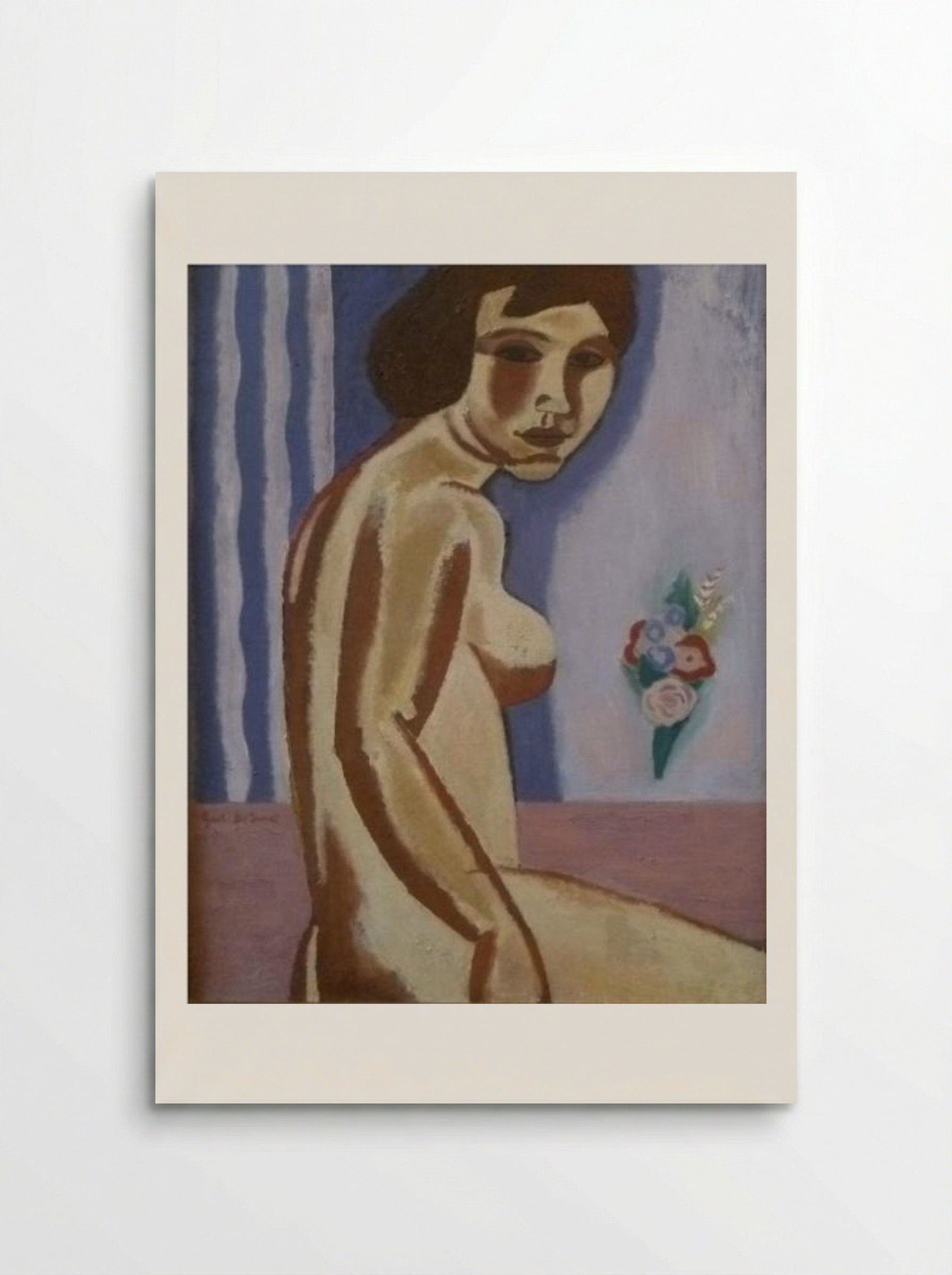
Naked Woman with Flower Bouquet - Gustave de Smet
Archival giclée
Frames arrive ready to hang
Secure checkout
Made to order
Description
A nude woman is depicted with a bouquet of flowers in this oil painting by Belgian artist Gustave de Smet. The work is characterised by its simplified forms and muted colours.
Gustave de Smet (1877-1943) was a Belgian painter associated with Flemish Expressionism. He is known for his simplified, geometric style and his use of colour to convey emotion. De Smet's work often depicts scenes from everyday life, as well as portraits and nudes. His style evolved over time, moving from early influences of Impressionism and Luminism toward a more personal, expressive form of modernism. He spent time in the Netherlands during the First World War, where he was influenced by Dutch modernism. After the war, he returned to Belgium and continued to develop his distinctive style. This painting features a nude woman seated with her back to the viewer, glancing over her shoulder. A bouquet of flowers sits to her right, and a striped curtain hangs in the background. The artist uses simplified forms and a muted palette to create a sense of intimacy and contemplation. The composition is carefully balanced, with the figure's curves contrasting against the straight lines of the curtain.
Return policy
Because every print is made to order, we don't offer change-of-mind returns, refunds or exchanges. If your order arrives faulty, damaged or incorrect, we'll replace it free of charge — just contact us within 48 hours of delivery. See our refunds page for full details.
Shipping
We ship worldwide, printing at the production hub nearest to your delivery address. Delivery times and costs vary by destination — you'll see the options available to you at checkout.
Manufacturing
Each print is produced to order using 12-colour giclée printing on FSC-certified archival paper. Designed in Britain and printed at your nearest production hub to reduce waste and speed up delivery.
Care and materials
Specific Features
Every Solis piece is made to order with archival, gallery-quality materials built to last.
- Museum-grade giclée printing for rich, fade-resistant colour
- Archival matte fine-art paper, FSC-certified
- Multiple sizes and framing options available
- Frames in black, natural wood, dark wood or white
- Framed prints arrive ready to hang
Care & Cleaning
To keep your artwork looking its best:
- Dust gently with a soft, dry cloth
- Avoid prolonged direct sunlight
- Never use liquid cleaners on the print or canvas surface
- Keep in a dry, room-temperature space
- Handle prints with clean, dry hands
Materials & Sizing
Museum-grade giclée on FSC-certified archival matte paper, with framed and canvas options.
- Paper sizes: A4, A3, A2, A1, A0 and B2 (50×70 cm)
- Canvas: XS (20×30 cm) to Large (60×90 cm)
- Frames: black, natural wood, dark wood or white
Naked Woman with Flower Bouquet - Gustave de Smet
Why Choose Us ?
Damage-free delivery guarantee
Fast Shipping
Museum-Quality Materials
You May Also Like